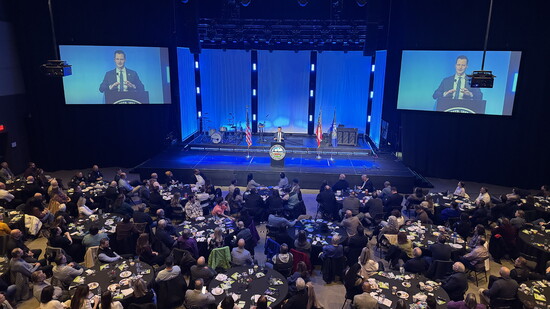
Woodstock has never been shy about ambition, but Mayor Michael Caldwell framed it with something quieter: home. In his fifth State of the City address, he credited neighbors, entrepreneurs, and first responders for shaping a downtown that feels lived-in rather than staged and a civic culture built on familiarity, trust, and pride.
The past year offered clear evidence. The police department reached full staffing for the first time in more than a decade, alongside its most significant pay increase and an expanded downtown presence. Crime remains among the lowest in Georgia. Financially, the city’s credit rating climbed again; the tax rate is now 15 percent lower than in 2022, and the rainy-day fund has doubled. Even a headline infrastructure win arrived with a distinctly local touch: Cherokee County’s most enormous parking deck opened in the heart of downtown and remains free.
From there, Caldwell looked ahead. Woodstock is currently experiencing the highest level of active capital investment in its 129-year history. More than $50 million in public transportation and infrastructure projects are underway, joined by hundreds of millions in private development. Orange cones, he noted, are simply the visible markers of long-range planning. While other cities defer repairs, Woodstock is choosing to build now, with durability in mind.
Mobility sits at the center of that strategy. The long-planned transformation of the Interstate 575 and Ridgewalk Parkway interchange into a diverging diamond has entered state oversight, with the Georgia Department of Transportation carrying it through design toward bidding next year. Closer to home, the reconstruction of Neese Road is nearing completion on its southern segment, while the northern portion and a new roundabout at Washington continue moving toward Arnold Mill.
Voters have also expanded the scope. A countywide transportation sales tax approved in November is expected to deliver roughly $65 million in dedicated funding for Woodstock projects, including widening Main Street, extending critical street connections, and improving several high-conflict intersections. Regional coordination has helped move projects from planning to pavement, including federal appropriations supported by Barry Loudermilk and planning leadership from the Atlanta Regional Commission.
Downtown itself continues to evolve with restraint. The Woodstock Mill District will address a bottleneck on Town Lake Parkway by extending Lindy Lane and introducing a long-requested addition: Publix, designed as a walkable extension of downtown with integrated trails, public art, and more than 180 new trees. Nearby, the City Center development is advancing with a six-story, 130-room hotel planned to include restaurants, a spa, street-front retail, and conference space, all designed to reflect the scale and character of downtown Woodstock.
While construction defines the skyline, Caldwell returned to the fundamentals of security and stewardship. Woodstock’s public safety investments emphasize consistency: a fully staffed police department, visible downtown patrols, and a leadership transition welcoming Chief Roland Castro. Fire services are expanding as well, with two new stations under construction, additional firefighters in training, and response times continuing to improve.
Financially, the city remains measured. Woodstock’s tax rate is at its lowest level in more than three decades, reserves now approach half of the general operating budget, and the city holds an AA-plus credit rating, signaling stability alongside growth.
Caldwell also highlighted attainable homeownership as a long-term priority. A planned downtown apartment project has shifted to owner-occupied condominiums, keeping wealth-building local. Woodstock now ranks among Georgia’s more affordable places to buy a home while remaining one of its most competitive markets.
And because home should include joy, the city’s cultural life continues to thrive. The Woodstock Summer Concert Series returns with artists including Carly Pearce, Midnight Star, and Black Jacket Symphony, underscoring a city committed not only to growth but also to gathering.
Home isn’t just a feeling. It’s a place we build with strong foundations, safe streets, connected trails, and room to play. The orange cones are a promise to our children for generations after them, too.