Like a genie-granted wish, the turkey emerges from the oven in a puff of steam. The family gathers. Platters and tureens waltz to the tune of “Please pass the ___.” Stories swirl. Jokes crackle. Family lore unspools.
“It’s funny,” remarks Todd Wilkens, “People sit at a table, but they don’t really think about the table. Where it came from, who made it, how much work went into it.”
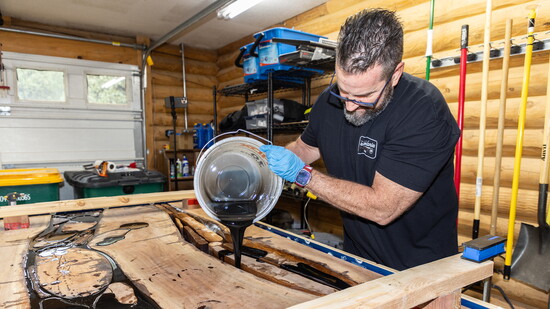
As the owner and founder of Gecko Woodworx, custom woodturning for hollow form vessels and handcrafted wood and resin tables, Wilkens spends his days thinking of little else.
For instance, he sources his teardrop vessels from 200-year-old craggy olive branches, trunks, and burls rescued from West Texas, where they would have been burned. His tables are slabs of magnolia, hickory, or walnut sourced from northeastern Colorado, New Mexico, and Oklahoma, which Wilkens notes is smack in the middle of hardwood country.
Even harder than sourcing materials is creating something new and unique. “Typically, engineers aren’t artistically creative,” the retired electrical engineer chuckles.
And yet, Wilkens’ creations are arresting. Reminiscent of ancient Egyptian canopic jars, the vessels combine wood and gem-colored resin in fanciful swirls—each one gleaming like a sentient potion. The tables unite slabs and other irregular wood cuts with sinews of resin blacker than squid ink. Lumber masquerades as rare minerals, wild rivers, and perhaps even lean cuts from the cosmic meat of the universe itself.
Wilkens sort of stumbled upon his passion for woodturning. He explains, “My father always tried to get me into woodworking. He got into it twenty years ago when he retired [also from electrical engineering]. But I was always working. I was busy. Finally, he got me started, and I was like: Man…I really like this.”
What will this piece become? The question nags Wilkens each time he confronts a thick slab of lumber or a snarling hunk of wood encased in a resin cylinder. He has no clue, no plan, no schematic to follow. It almost makes him giddy as a skydiver when a chisel or sawblade creeps in to kiss the wood.
Over the years, Wilkens has learned that creativity is exploration and experimentation. It’s trial and error. The real fun lies in exposing what was hidden inside the wood all along. Through this process, he also uncovered a hidden talent in himself.
“It's like I've discovered a whole new side of myself that I didn't really know existed. I didn't think I had a creative bone in my body. It's really changed me,” he confides.
Wilkens has always been cognizant of the inherent legacy imbued in every table and vessel. He notes, “A table is going to be in someone’s home for 30 or 50 years. That’s probably gonna be in somebody's will one day.”
And over those many years, that table joins the family for every meal, every big discussion and decision, every homework session. It’s how a piece of handcrafted furniture evolves into a member of the family and, thus, an heirloom—a tool, item, or implement that weaves through a family, generation after generation.
Of course, Wilkens is the first to admit that furniture need not be handcrafted to be cherished. He points to two simple, factory-pressed stools in his kitchen, their gloss and varnish worn from heavy use.
He explains, “That's where I taught all four of my kids math on those stools in my house in Texas.”
However, handcrafted heirlooms are different than mementos. Like a family, they were shaped by loving intentions. Like a family, no two are alike. Like a family, a handcrafted item, such as a table, endures.