When Xin Zhang Zeck’s 12-year-old son Gavin asked her for a credit card, she was stunned.
“He wasn’t asking how to make money,” she recalls. “He wasn’t asking for a debit card. He wanted a credit card! And he had no idea how to make money in the first place.”
Xin, an acupuncturist, and her husband, attorney Mark Zeck, are both small business owners who share office space on Grove Street. Building a business from the ground up is second nature to them—and Xin realized her son needed some of that firsthand experience. So instead of getting him a credit card, she gave him a challenge: before spending money, he needed to learn how to make it.
Xin began researching ways to teach Gavin and daughter Brianna financial literacy. She spoke with local banks and crowdsourced ideas from other parents.
“No one I spoke to was proactively teaching their kids about business,” she says. “But everyone wanted to know what I was doing.”
That gap became the catalyst. Xin went home and told her husband she wanted to build something—not just for their kids, but for other kids, too.
“It’s about time,” Mark told her. “You can do it!”
The idea grew into the Ridgefield Children’s Business Fair: an opportunity for kids to build a small business from scratch—market it, sell their products, and experience both the rewards and realities of entrepreneurship. Think lemonade stand, then add mentorship, business fundamentals, and dozens of young entrepreneurs sharing a communal marketplace.
Participants met three months ahead of the fair for a kickoff meeting at the Zecks’ office on Grove Street. This was followed by Zoom check-ins and an active Telegram group chat.
Xin guided the kids—and their parents—through the essentials: turning an idea into a business, sourcing materials, pricing, budgeting, and marketing.
“Everything has to come from an initial idea,” Xin explains. “Once the kids had their idea, we talked about how they’d actually put it into action. Would they make something or collect it? How would they price it? What was their budget?”
The kids also learned the difference between revenue and profit so they would understand that the money they earned still had to account for the cost of materials.
Many participants teamed up with siblings, neighbors, or friends, fostering another valuable lesson along the way.
“In addition to everything else, they’re also learning what teamwork is all about,” Xin says.
Parents were given a job description too—and it was a simple one.
“Your job is not to do everything for them!” Xin told them. “Your job is to let them learn.”
Jenny Hlavac, whose fifth-grade daughter Hannah, of Hannah’s Custom Creations, sold customized Ridgefield merchandise, says that philosophy has been one of the program’s greatest strengths.
“I think it’s a lesson for parents to take a step back and let their kids take the lead,” she says. “To ask questions and allow them the space to figure things out and problem-solve on their own.”
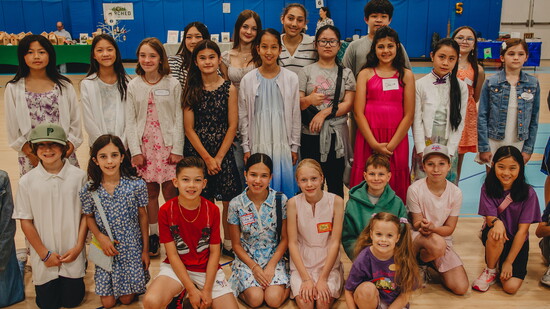
In just one year, the Children’s Business Fair doubled in size. Last year, nine booths filled half the gym at the Boys & Girls Club. This year, the entire gymnasium buzzed with activity as 19 young vendors, ranging in age from 6 to 14, showcased jewelry, 3D-printed creations, customized clothing, birdhouses, paintings, and more.
Before the doors opened to the public, Xin led the group of entrepreneurs from booth to booth, interviewing and encouraging the kids, and giving everyone a chance to learn from one another.
“I told them, even if you only have one customer today, it’s going to be exactly the same as if you had one hundred customers,” she says. “You’re going to show the best of yourself. You’re going to share your story—where you’re coming from and why you made what you’re selling. You’re going to ask questions that help you improve and be brave enough to take risks, because some people may ask tricky questions. You’re going to learn from each other. You’re going to have fun. But most important of all—you’re going to be proud of yourself and have faith in yourself.”
Steve Ippolito, whose daughter Katelyn was participating in the event, volunteered to take photos of the fair. Spencer Arrindell, who graduated from Scotts Ridge Middle School in June, filmed throughout the event. Two secret judges circulated, evaluating booths on categories including presentation, creativity, and entrepreneurship. Customers stopped in to browse, and young vendors practiced their sales pitches—halting and uncertain at first, but growing more confident as the morning went on.
For many of the young entrepreneurs, the hardest part wasn’t coming up with an idea or building a product. It was putting themselves out there.
Rong Huang shared a story about watching his daughters hang flyers around town to promote the fair. At the start, they were reluctant to approach people.
“I could see the transformation,” he says. “From the earliest strangers they talked to, to the last—they probably spoke with at least 50 people that day. The growth in their confidence was incredible.”
That flyer led to one of Xin’s favorite stories from the fair. A local resident saw the girls promoting the event and reached out the next day. She had slate sitting unused in her basement and offered it to any vendor who could use it. Another young entrepreneur ended up incorporating the donated materials into her booth.
“I told the kids the little things you’re doing today may seem like they’re only helping your booth,” Xin says. “But you’re impacting other people, too.”
Moments like that were everywhere at the Children’s Business Fair. Volunteers—friends, neighbors, and adults whose children weren’t even participating—pitched in to help make the event a success. Local businesses contributed as well. 850 offered a steep discount on pizza after Xin allowed the owner’s son, Landon of LRB Layercraft 3D Printing, late entry to the fair.
As the morning wound down, Xin handed out certificates and announced awards in the same categories the secret judges had been quietly scoring all morning.
Then came the closing ceremony, where participants had the option to donate a portion of their earnings to local nonprofits: the Boys & Girls Club, Meals on Wheels, and Rides for Ridgefield.
“It’s a way to teach kids that money can be spent, saved, invested—or donated,” Xin says.
The young entrepreneurs left the fair carrying more than the day’s earnings. They left with confidence.
“Xin organized such a wonderful fair,” one parent told us. “It was truly beautiful to see so many young entrepreneurs showcasing their creativity, hard work, and dedication through their creations. It was inspiring to watch them step outside their comfort zones, interact with customers, and learn such valuable life lessons. We so appreciate Xin and all of the time, effort, and care she put into making this event possible for the children.”
What started as a mother’s response to a simple question about a credit card has become something much larger: a place where children learn not only how to make money, but how to take risks, solve problems, support one another, and discover what they’re capable of achieving.
Weeks after the event, Xin says she is still hearing from people interested in products they discovered while visiting the young entrepreneurs’ booths.
“I want them to feel special,” she says. “I want them to be proud of themselves. You have to put yourself out there and let the whole world know what you’re doing. At the Children’s Business Fair, they’re the superstars.”