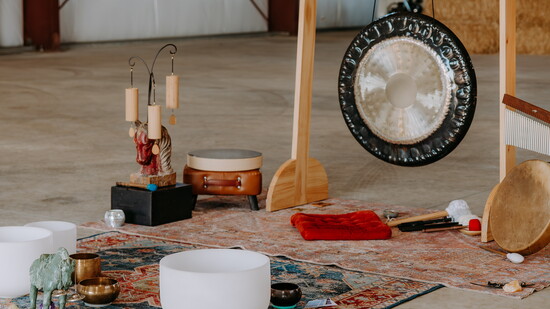
A gong rises and splinters into space as the room around you slowly disappears. A chime retrieves a long-lost memory and, with it, a sudden rush of joy. Sounds appear, transform and fade before you have time to hold onto them.
And then there is the silence in between.
Imagine an uninterrupted hour. No one needs you. There is nowhere else you need to be.
Get comfortable. You won't know what is coming next, and you won't need to.
Just listen and notice.
That may sound remarkably simple. These days, it isn't.
We spend much of our lives learning not to listen. We tune out the hum of the highway, the spin of the dryer and the plane overhead. We also tend to tune out the birdsong, the trees in the wind and other sounds that were once at the forefront of human experience.
Sound meditation reverses that relationship. Instead of filtering out another thing competing for our attention, it gives us a landscape of sound to discover and fully explore. It isn't an escape, but a tether to the present moment.
And if you've never experienced one, I think you should.
You don't have to know how to meditate
I had studied Buddhism for years, but traditional meditation remained difficult for me. Sitting still and focusing on my breath left me frustrated, physically uncomfortable and painfully aware of my circular, overanalytic mind.
Sound changed that. It gave my attention somewhere to go- an anchor and a guide- without demanding that my mind become something it wasn't.
You don't need experience, flexibility, physical fitness, previous knowledge or a belief system.
You listen. Your mind wanders. You notice it. You reward yourself for noticing. And you listen again.
Voilà.
We hear far more than we intentionally listen to
Our attentional environment has changed enormously. The same human instincts that once helped us notice something new, seek connection or respond to uncertainty now operate in a world specifically designed to keep calling our attention back.
Sound meditation offers a way to reclaim our attention by deliberately choosing exactly where it goes.
Sound isn't only something you hear
This is difficult to explain until you've felt it.
A large gong can produce tones your body seems to register before your ears do. Think of a rumble of thunder so low it's felt before it's heard.
The resonance of a mustang drum can be enveloping and grounding, a rhythm that might just come from inside you. Chimes seem to caress the air around you, but their sound arrives from somewhere you can't quite place. Bowls produce layers of tone that meet, separate, settle and disappear.
I'm listening alongside everyone else, making choices within the structure of the meditation- when to build, when to soften and when the most interesting thing I can offer is silence.
Goosebumps aren't unusual. Sometimes there are tears. A sound can produce an unexpected emotion, image or memory entirely your own. Sometimes it just feels extraordinarily good.
After listening that intently, even silence feels different.
There is something powerful about being present together
Research is beginning to support something meditation traditions have understood for a long time: practicing together can strengthen our sense of connection.
We don't have to know one another, think alike or have much of anything in common for that to happen.
For a short time, a room full of people collectively agrees to do something increasingly unusual: simply be present together. Nobody needs to introduce themselves, explain themselves or find common ground.
We can be complete strangers- even polar opposites- and still positively contribute to one another's experience.
There is something reassuringly human about that.
For me, that's where some of the magic of group meditation lives.
Meaningful doesn't have to mean solemn
There can be joy in meditation. There can be curiosity, surprise and whimsy.
You might become completely absorbed in the resonance of a gong and, minutes later, hear an unfamiliar instrument that makes you smile. Your mind may wander. You might feel peaceful, restless, emotional, curious, amused or deeply relaxed. You might fall asleep.
None of it means you did it wrong.
There is no prize for meditating correctly. Curiosity can bring us into the present just as effectively as concentration can. Sometimes delight gets us there even faster.
I don't call myself a sound healer, although I believe sound can have a profound effect on us. What I know from my own practice is much simpler: there is value in giving ourselves time to pay attention—to sound, to the silences between, and to the people around us.
There is something that feels naturally good about finding your way back to a more present version of yourself.
Just go to a sound bath.
Seriously.
"You can't have this practice without it being focused on gratitude."
"I can't think of many places where people can be complete strangers to each other and have this shared experienced and shared connection."