Add it up sometime. Not the big loan you think about every month, but all of it. The notes left over from buying out a competitor. The equipment financing. And the quiet pile of business credit cards, one opened for fuel, one for a tool supplier, one a manager uses for parts runs. A metal fabrication shop in North Texas did exactly that last month and found roughly 160,000 dollars scattered across about 17 cards, on top of its term loans. The owner had no idea it had grown that large, because he had never seen it in one place.
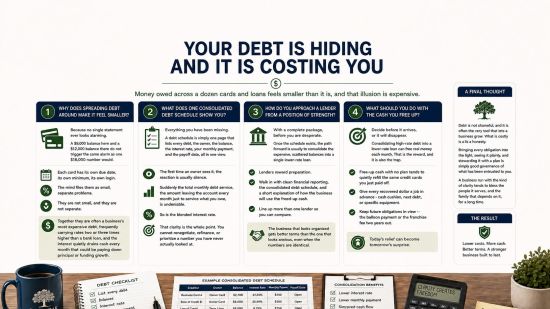
Why does spreading debt around make it feel smaller?
Because no single statement ever looks alarming. A 9,000 dollar balance here and a 12,000 dollar balance there do not trigger the same alarm as one 160,000 dollar number would. Each card has its own due date, its own minimum, its own login. The mind files them as small, separate problems. They are not small, and they are not separate. Together they are often a business's most expensive debt, frequently carrying rates two or three times higher than a bank loan, and the interest quietly drains cash every month that could be paying down principal or funding growth.
What does one consolidated debt schedule show you?
Everything you have been missing. A debt schedule is simply one page that lists every debt you owe, the balance, the interest rate, the monthly payment, and the payoff date, all in one view. The first time an owner sees it, the reaction is usually silence. Suddenly the total monthly debt service, the amount leaving the account every month just to service what you owe, is undeniable. So is the blended interest rate. That clarity is the whole point. You cannot renegotiate, refinance, or prioritize a number you have never actually looked at.
How do you approach a lender from a position of strength?
With a complete package, before you are desperate. Once the schedule exists, the path forward is usually to consolidate the expensive, scattered balances into a single lower-rate loan. Lenders reward preparation. Walk in with clean financial reporting, the consolidated debt schedule, and a short explanation of how the business will use the freed-up cash, and you are negotiating as a serious operator, not a borrower in trouble. Line up more than one lender so you can compare. The business that looks organized gets better terms than the one that looks anxious, even when the numbers are identical.
What should you do with the cash you free up?
Decide before it arrives, or it will disappear. Consolidating high-rate debt into a lower-rate loan can free real money each month. That is the reward, and it is also the trap. Freed-up cash with no plan tends to quietly refill the same credit cards you just paid off. Give every recovered dollar a job in advance, whether that is building a cash cushion, retiring the next debt, or funding a specific piece of equipment. And keep future obligations in view, the balloon payment or the franchise fee two years out, so today's relief does not become tomorrow's surprise.
A Final Thought
Debt is not shameful, and it is often the very tool that lets a business grow. What it asks of us is honesty. Bringing every obligation into the light, seeing it plainly, and stewarding it with a plan is simply good governance of what has been entrusted to you. A business run with that kind of clarity tends to bless the people it serves, and the family that depends on it, for a long time.
Chris Thomas is the founder of Blue Oak Consulting, a fractional CFO firm serving small businesses across North Texas. Visit http://www.blueoakconsulting.net to learn more.
Article by Chris Thomas
Photography by AI Generated