Mike Blocher can tell you the exact birthday of Table X’s sourdough starter: November 17, 2014.
Created shortly after Blocher arrived in Utah, the starter began with golden beets from the former Sugar House farmers market. Blocher juiced them to cultivate local, naturally occurring yeast, then gave the resulting culture a playful name: Levain Benz, a nod to both the French word for sourdough starter and a Seinfeld character.
“At the time, it was just, ‘Hey, let’s see if we can start some wild yeast in our backyard,’” Blocher says. “Here we are with a bakery, a restaurant, 28 employees and a whole bunch of other things.”
More than a decade later, descendants of that starter still produce the bread served at Table X. It is both an ingredient and a living record of how far the business has come.
Every guest at Table X receives its sourdough bread and house-made butter—the one element shared by those who first visited in 2016 and those arriving today.
“It’s the one thing people can expect,” Blocher says. “It has also bridged the restaurant and bakery together over the years with our story.”
That story began on the East Coast, where Blocher met Nick Tramp and David Barboza as culinary students in New York. After going their separate ways, they reconnected several years later, and Tramp’s Utah roots helped draw them west.
They found jobs and began hosting private dinners under the name Table X. After two years, those dinners led them to a neglected Millcreek warehouse, built in 1929 as an egg storage and sorting facility called Mountain Olympus Eggs.
The building had broken windows, no power or water and no separation between its two levels. What it did have was possibility.
The founders restored the building while preserving its original brick exterior, floors and barrel-vaulted ceiling. Local artists and craftspeople created the tables, staircase and geometric murals, while reclaimed wood became art and raised garden beds.
“This space was really just a dirt hole with some old, dead trees and a telephone pole,” Blocher says. “What we saw was the promise of being able to grow food here.”
The garden became central to Table X’s identity. A full-time gardener—now approaching a decade with the restaurant—raises herbs, edible flowers, root vegetables, rhubarb and fruit. The garden supplements relationships with area growers while keeping the restaurant physically connected to the ingredients appearing on its plates.
The property also offered something a downtown restaurant could not: the opportunity to become part of a neighborhood.
“We spent a little time in this neighborhood, and it was pretty much a no-brainer,” Blocher says. “This was where we wanted to be. It was where we belonged.”
Table X opened approximately one month before Millcreek officially became a city. Since then, Blocher has watched City Hall rise nearby and new residents arrive, while longtime neighbors have made the restaurant part of their own lives.
“One of the coolest things about our patrons, especially in Millcreek, is the mix you get,” Blocher says. “We’ve watched people go from coming in every other weekend to having two or three kids and making it a special occasion once a year.”
From its beginning, Table X offered something unfamiliar to many local diners. Its only format is a tasting menu, available in five- or seven-course vegetarian and non-vegetarian versions. Guests may add wine or house-made, seasonal nonalcoholic pairings.
Although called a seven-course menu, the experience may encompass nine or 10 individual preparations, progressing from light bites through increasingly intense flavors before easing into the final courses.
In that sense, dining at Table X unfolds much like a story: an introduction, rising action, climax and resolution.
“The format allows us to present a lot of different things to somebody through the course of their dinner,” Blocher says. “You’re going to have things that are really light, then things that are really fatty, and then it’s going to lighten up again. There’s a progression.”
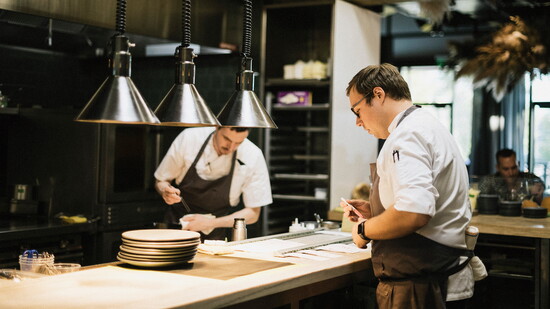
The food is presented with the precision of modern fine dining, but the space was designed to feel relaxed. There are no white tablecloths or rows of waiting glassware and silverware; utensils arrive as needed. The exposed kitchen, brightened by a skylight, places cooks in full view of diners at the chef’s counter.
“We knew the food was going to be a little different from what people were expecting,” Blocher says. “Especially with a tasting menu, where you aren’t choosing what you’re having, we wanted people to feel really comfortable in the setting.”
That did not mean compromising the concept. In the early years, some guests entered, discovered the restaurant served only a tasting menu and turned around. Blocher and his partners resisted adding familiar dishes simply to appeal to everyone.
“Our whole thing from the get-go was to cook food that we were proud of cooking,” he says. “We were going to stick to our guns about what we wanted to do.”
Remaining faithful to the food, however, did not mean remaining unchanged as leaders.
During Table X’s early years, its founders did nearly everything. They cooked, served guests, washed dishes and touched almost every plate that left the kitchen. Blocher believed he would always recognize every person entering the dining room and remain behind the line each night.
“The me who opened this restaurant a decade ago might have scoffed at my schedule now and said, ‘Oh, he’s not even in the kitchen every night,’” he says. “But to grow and keep this place going, we had to make changes.”
The first significant shift came with Table X Bread. Increasing demand for the restaurant’s sourdough made a bakery a natural extension. The downstairs had intentionally been left unfinished, allowing the partners to establish one business before undertaking another.
The bakery launched in early 2020, with its retail café following in 2021. Today, it offers several sourdough breads, laminated pastries, sandwiches, toast, salads and coffee in a setting far more casual than the dining room upstairs.
Opening the bakery prompted Blocher and Tramp to reconsider their roles. Later, marriage and fatherhood shifted Blocher’s understanding of success again. He still plans menus, leads pre-service meetings, handles reservations and hiring and regularly steps into the kitchen. But he no longer needs to do everything himself.
“I gave my job away in small parts,” Blocher says, “but I’ve been able to retain the parts that I really love.”
Former line cooks have risen to become chef de cuisine and sous chef. A cook who helped open the bakery during the pandemic became its head baker. Longtime guests continue to receive personal notes and recognition from staff members, even when Blocher does not know they are dining that evening.
For Blocher, that continuity is evidence that Table X is no longer sustained only by its founders. It is carried by the culture and people they have developed.
“It’s really nice not to have to do everything and to see the team crushing it,” he says. “That’s something I’m proud of.”
“I’m really grateful that people took a chance on us. We’ve done a great job, too, and given people a reason to come back.”