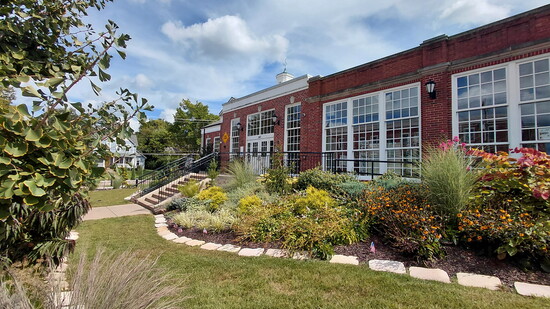
For 100 years, the Kirkwood Public Library has been a constant presence in the community—and so much more than a place to borrow books. It's where children discover favorite stories, entrepreneurs develop new ideas, neighbors connect, and generations of families return again and again.
The story begins in 1922, when the League of Women Voters explored opening a library in Kirkwood. By 1924, the Kirkwood Library Committee was established, and on December 10, 1926, the library became the first tax-supported library in St. Louis County. Over a century later, we still offer the popular voter guides the League produces for each election.
The first library sat on the top floor of City Hall, led by head librarian Mrs. Eugenia Becker. Since then, the library has called three homes: City Hall, a temporary spot at Station Plaza during a 2009 renovation, and our current building at 140 E Jefferson Avenue, dedicated in 1940. We've had seven directors, including our current director, Christa Van Herreweghe, who started in 2020.
The building itself has evolved right along with the community. A 1954 bond doubled our space, relocated the entrance, and removed a fireplace. In 1957 we installed air conditioning, instantly becoming the coolest place to be during Kirkwood summers. An elevator arrived in 1994, and in 2019 our cupola was restored and a time capsule installed for future generations.
Newer updates reflect how community needs have changed. Teens have their own lower-level room with a gaming system and a Library of Things collection that includes a microscope, calligraphy set, and stop-motion animation kit. The New Books Room holds new releases, hot reads, technology, puzzles, and board games. Our train-themed children's room, fully renovated in 2017, welcomes young readers to play, learn, and explore. Books & Beyond, our gift and book shop, was established in 1996 by the Friends of the Kirkwood Public Library. In 2025, we opened a renovated garden with outdoor programming space, native plants, solar-powered benches, and a bike repair station for cyclists passing through.
History lives in the building, too. A mural at the entrance depicts scenes from 1915 to 1984, and near the elevators stands "Kirkwood Roots," a sculpture by Thomas Sleet mapping the eleven early African American settlements in Kirkwood—originally displayed at the Missouri History Museum before being gifted to us. Even our first phone number, "Kirk 1212," has a place in local memory; the reference desk has fielded everything from "Is a virus alive or dead?" to horoscope questions, and today we also make passport appointments.
Our services now reach well beyond our walls. Home Borrowing serves those who can't visit in person, and the Book Caboose brings stories to the community center in winter and the pool in summer. Two storywalks—at Walker Lake and the Kirkwood YMCA—let families enjoy books outdoors. We celebrate with community events like Hot Dog Dayz, with Kirkwood Police and Parks & Recreation, and Read Attack, where staff and local celebrities read to fourth graders.
Our collection has grown from 2,000 books to more than 113,000 items, with 15,000 more added each year. What you can check out has changed dramatically, too. In 1965, you could borrow artwork to hang in your home; films arrived on 8mm in 1966, followed by VHS, then DVDs and Blu-rays (we even had a DVD dispenser for a while). Today you can check out a sewing machine, cake pans, VR headsets, book club kits, reminisce kits, or a bread maker. Digital offerings include streaming and eMedia through Hoopla, Kanopy, and Libby, plus research tools like Ancestry for heritage research, Candid for nonprofit grants, LearningExpress Library for resumes and job skills, and access to more than 3,700 newspapers through Newsbank.
Policies have loosened over time, too. We no longer charge late fines—a shift from 1965, when police went door to door retrieving overdue books. (A 1976 city ordinance making it a misdemeanor to withhold library books remains on the books today.) Sunday hours arrived in 1996, and programming now runs seven days a week: book clubs, storytimes, author fairs, memory cafes, and even a region-wide spelling bee. Since 2012, One Author, One Kirkwood has highlighted a community read, and Summer Reading remains a beloved tradition, complete with Wacky Wednesday performers and cross-age Reading Buddies. Younger patrons can join 1,000 Books Before Kindergarten and read to CHAMP Assistance Dogs.
We also help preserve personal history: a disc duplication machine copies family DVDs, a shot box photographs heirlooms, and a slide scanner digitizes old film. We support the Missouri Bicentennial Project and our own Oral History Project, continuing a tradition that began with our first copy machine in 1964.
Some favorites endure through the years—Winnie the Pooh, published in 1926, remains beloved, while The Women topped our 2025 checkout list. Through two consortia, our reach now extends to more than 5 million items, supported by personalized reader's advisory, an author podcast, eBooks, eAudiobooks, and pandemic-era innovations like curbside service and Dial-A-Story.
More than 12,000 people actively hold library cards, and annual program attendance tops 31,400. Kirkwood voters have supported us through six bond issues or tax increases, and reciprocal agreements let neighbors nearby use our services too. In 2007, we were named Missouri Library of the Year by the Missouri Library Association.
Our growth continues through grants and community generosity—leadership courses, WiFi hotspots, Chromebooks, a partnership with PCs for People for electronics recycling, and Food for Fines, which delivers roughly 150 items a year to Kirk Care.
The Kirkwood Public Library's story isn't only a record of the past 100 years—it's a promise for the next 100. As our community changes, we'll keep adapting, inspiring, and bringing people together as a welcoming place where everyone can learn, connect, and belong.
"Across three homes and a century of change, the library has evolved right along with the community it serves."
"It's where children discover favorite stories, entrepreneurs develop new ideas, neighbors connect, and generations of families return again and again."