This month marks 250 years since the signing of the Declaration of Independence. This is a hugely important moment in American history and can rightfully be called the country’s birthday. As a local historian, it can be difficult at first to connect this historic occasion to our local area. In 1776, the area that is now Cobb County was home to Native American tribes. It was only after the Trail of Tears, decades later in the 1830s, that white settlers began arriving in this area and formed what we now know as Kennesaw and Acworth. By that time, the events of 1776 were just a distant memory.
The defining moment in American history for our area is not the events of 1776 but of 1864. The Civil War’s Atlanta Campaign permanently changed Georgia, and its reverberations can still be felt today. Historians have increasingly begun to reevaluate the Civil War and the resulting Reconstruction as a “second founding” for America. The historian Eric Foner, in particular, has written on this topic. During and after the Civil War, the meaning of freedom and citizenship evolved as African Americans gained their freedom and voting rights. The 13th, 14th, and 15th Amendments are just as important as the Bill of Rights, and their legacy and meaning remain debated political topics today. What cannot be denied is that they fundamentally altered what it means to be an American and laid the groundwork for our modern understanding of the federal government and Constitution. That process was a long and slow one, directly tied to the bloodshed of the Civil War. It is here that we return to local history: without the events of the Atlanta Campaign, this process might not have been possible.
In May 1864, the Union army under William Techumsah Sherman began moving South through Georgia, following the Western & Atlantic Railroad. For the next several months, Sherman would clash with the Confederate army under generals Joseph E. Johnston and John Bell Hood. Sherman’s ultimate objective was Atlanta, a key transportation hub.
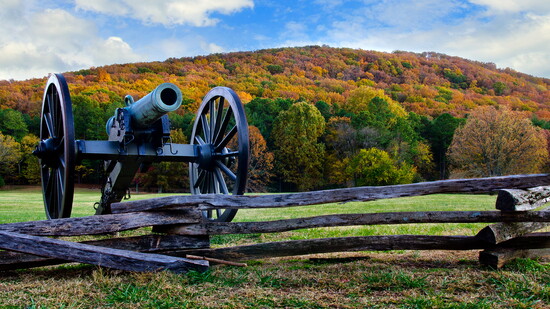
The war arrived in Cobb County in June, with the Battle of Kennesaw Mountain. That clash was one of the worst of the
campaign. The Battle of Kennesaw Mountain was largely fought at an area now called Cheatham Hill, where Union soldiers tried unsuccessfully to overrun the Confederate earthworks. At the end of the battle, the Union had lost, but their opponents remained nervous. General Johnston decided to retreat from the battlefield he had won. After a long siege, Atlanta was captured by Sherman on September 2, 1864. In November, Big Shanty (modern Kennesaw) and Marietta were burned.
The description above highlights the military aspect of the battle, but the social and political context is what ties these troop movements to the broader themes of American liberty. As Sherman marched through Georgia, countless formerly enslaved men and women were freed. Almost 4,000 individuals had been enslaved in Cobb County alone. Once freed, they would help the Union army, serving as nurses and stretcher bearers. To them, the Atlanta Campaign was not the movement of troops across North Georgia, but a moment marking the end of enslavement and the start of a new era in their lives.
At the same time, the Atlanta Campaign was significant from a political standpoint. It had been over three years since the first shots of the war were fired at Fort Sumter, and the war that was supposed to have ended in days had dragged on and caused untold devastation. The campaign coincided with an election year, where Abraham Lincoln ran against former Union general George B. McClellan. McClellan’s party platform promised to end the war by negotiating with the Confederacy, which likely would have meant the continuation of slavery. Lincoln needed a major victory to show voters the Union war effort was successful and that the end of the war was soon at hand. The fall of Atlanta proved to be that moment. Partly because of this success, Lincoln was reelected. Without that moment, it is hard to imagine “America’s second founding” being possible.
The era of Reconstruction that followed may be seen as a period of unfulfilled promises, but it helped lay the groundwork for the important social transformations of the Civil Rights era. Without the Atlanta Campaign – and the events that occurred in our backyard – this key moment of the American story would not have been possible.
For more exploration of this theme, I highly recommend the film at Kennesaw Mountain National Battlefield Park.
*sidebar*
Cobb Celebrates 250
Ragtime Band Concert, Marietta Square
July 1, 12 p.m. to 1 p.m.
Independence Eve, Marietta Square
July 1, 7 p.m.
Kennesaw Salute to America, Downtown Kennesaw Depot,
July 3, 6 p.m. to 10 p.m.
Marietta Fourth in the Park, Marietta Square
July 4, 10 a.m. to 10 p.m.
Independence Day Celebration, Thurman Springs Park
July 4 & 7, 9:30 p.m.