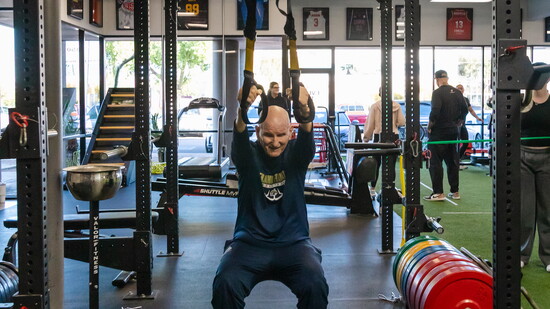
He’s 79 and still lifting weights.
That is not the whole story, but it is the right place to begin.
We caught up with Art Dye during one of his regular workouts at the Valley’s Move Human Performance Center & Physical Therapy, where he still trains with the same discipline that has defined his life in basketball for more than half a century. Just as impressive as the fact that he is still lifting is how clearly he remembers it all.
“I trained Mike Bibby as a little boy. I remember him this big,” he says, dropping his hand low.
In this story, we are paying homage to a 50 year career that helped shape Arizona basketball from the ground up.
Long before the modern club machine, long before the transfer portal and NIL changed the culture of the game, Art was building players here. Through the Arizona Stars, he became one of the most influential figures in the state’s basketball pipeline, helping develop generations of athletes and coaching names that would go on to become part of the sport’s bigger story. Mike Bibby, Richard Jefferson, Channing Frye, Jerryd Bayless. The list is deep, but what matters more is the consistency. Art was there early, before the headlines, before the arenas, before everyone else caught up.
“Mike had 14 years. Richard Jefferson 14 years and a big championship. Channing Frye, same thing. They had longevity,” he says. “That’s the thing. If you can have longevity like they do, amazing.”
That is how he measures success. Not flash and not hype. Who lasts.
Art never built his reputation by being loud for the sake of being loud. He is honest about the fact that he could get on players when he needed to, but there was a line he never crossed.
“I could get loud at times, but never cursed or did anything like that. I never embarrassed a player."
That part of his philosophy says a lot about why so many players stayed connected to him. He coached hard, but he coached with respect. He taught the shot, the footwork, the repetition, but he also taught presence.
For those who have been alongside him for decades, that impact runs even deeper.
“For over 30 years, I’ve had the privilege of standing alongside my dear friend Art Dye, one of the true pillars of Arizona basketball,” says Chad Dunn, owner of Move. “Together, we’ve helped shape some of the state’s top players, but more importantly, we’ve built something far deeper than the game itself.”
When he talks about Bibby now, he is not just talking about the player. He remembers the kid who was shy, the young athlete still growing into himself, the version before the world knew him.
And Art remembers all of it because he lived all of it.
He talks about one story from his years as a shooting coach, when a connection through a friend put him in the orbit of Suns executives and eventually opened the door to a possible opportunity to work with Shaq. The deal was moving, then Phil Jackson took over, and the whole thing disappeared. Art laughs telling it now. He has the kind of career where even the “almost” stories are memorable.
There are plenty of those.
He coached Danny Ainge’s kids. Rex Chapman’s kids. Paul Westphal’s kids. Jimmy Fox’s boys. He learned from legendary figures like Bobby Knight and George Raveling. He coached at every level, from the pro game down to elementary schoolers. Even now, he is still doing shooting camps for kids eighth grade and under.
“I’ve watched him go free throw for free throw with NBA star Richard Jefferson, seen the battles and growth at the Wrigley Mansion during our Rehab Plus days, and been part of a journey that has produced seven McDonald’s All Americans... both boys and girls,” Chad says. “Those moments aren’t just memories, they’re legacy.”
That, too, says something.
Art is not someone who talks about the game as if his best years are behind him. He is still in it.
Taking Art to the McDonald’s All-American Game this year in Phoenix at Desert Diamond Arena was, as Chad describes it, a full-circle moment. The game may have changed, but his passion has not. His love for the kids, for teaching, and for the grind is still unmatched.
At the same time, Art is clear-eyed about how much has changed.
“It’s just so confusing with the portals and all this stuff that these kids go in,” Art says. “It’s like a free for all. In those days, you worked up the ranks the right way. Now it’s crazy.”
He is not bitter. But he is old school in the truest sense. He comes from an era when players were fighting for scholarships, when development took time, and when listening to your coaches was not considered optional. He thinks today’s athletes are often better physically, but not always tougher mentally.
“They’re probably better athletes, but mentally not so good,” he says.
So what does he still tell young players now?
“Number one, you have to put in the work, and if you don’t, then somebody’s going to pass you.”
From a National Championship with the Scottsdale Boys & Girls Club to producing winners on the NIKE Peach Jam stage, Art has always been about one thing. Impact.
He still loves watching the game, too. He mentions Devin Booker with admiration.
“He comes up and never too high, never too low,” Art says. “That’s what I like about him.”
At 79, with neuropathy in his feet and every reason in the world to slow down, he still walks into Move and gets to work.
“The ball will keep bouncing for the ‘Godfather’ of Arizona AAU basketball,” Chad says. “And I’ll make sure he stays on the move. Because with him, it’s always been simple… ball is life.”
In a sports culture obsessed with what is next, there is something grounding about someone who has spent 50 years proving what endures.
Art Dye is part of the living history of Arizona basketball. Not just because of the names he helped shape, but because of the standard he never let go of.
moveperformance.com
“If you don’t put in the work, somebody’s going to pass you. That’s how I measure it. Not who gets there first, who lasts.”