On a quiet stretch of Glenview Road, the fireplace glows where rows of pews once faced forward in unison. Leather chairs and a curved sectional gather close to the stone surround, softening the scale of a room originally designed for congregation rather than conversation. For Pam and Matt MacPherson, this intimate seating area is the heart of a home that still carries the bones, and the memory, of its former life as a Christian Science church.
The MacPhersons purchased the former First Church of Christ, Scientist at 1333 Glenview Road in 2022, transforming the midcentury building into an 8,500-square-foot residence in just over five months. What they chose not to change, however, is what gives the home its distinctive character.
"We really tried to keep little pieces of the church," Pam MacPherson said. "The structure is the exact same."
Pam, president of the MacPherson Group at @properties Christie’s International Real Estate, grew up in the Village of Golf and attended Glenbrook South High School before becoming a scholarship athlete at Duke University. After marrying Matt, the couple moved four times in their first five years together. The experience of researching communities and homes across different states sparked Pam's long-standing interest in real estate. Before settling in Glenview, the family lived in Evanston for 10 years.
Matt, who grew up in Dayton, Ohio, spent years as associate head coach and defensive backs coach for Northwestern University. He now works alongside Pam, helping manage the properties they own.
Ironically, the Glenview church entered their lives at a moment when they were planning to downsize.
They were already under contract on their house and preparing to move into a townhouse they own nearby when Pam received a call from the church’s listing agent, who was also a parishioner. The assumption was that a builder would purchase the property and tear it down.
"She asked if I had any builders that would be interested in dividing it up," Pam said. "I was horrified. I said, why would anyone tear this down? Live in it."
The idea sounded unconventional, even to the seller. But the congregation was relieved to learn the building would be preserved rather than erased.
According to the Glenview History Center, the First Church of Christ, Scientist was designed in a contemporary midcentury style using natural materials, including weathered-edge Lannon stone, redwood and Tennessee sandstone. Construction was completed in 1953, and the congregation held its first service in the new building in April 1954.
That architectural clarity was part of what drew the MacPhersons in. They had recently finished building a barn-style home in Knoxville, defined by expansive, open gathering spaces rather than formal rooms. The church offered something similar: two large volumes filled with light and height, balanced by smaller, more private areas.
The finished home includes four bedrooms, three full bathrooms and two half baths. Pam and Matt live there with their three children, Drew, Tommy and Emily, and their dog, Beaux.
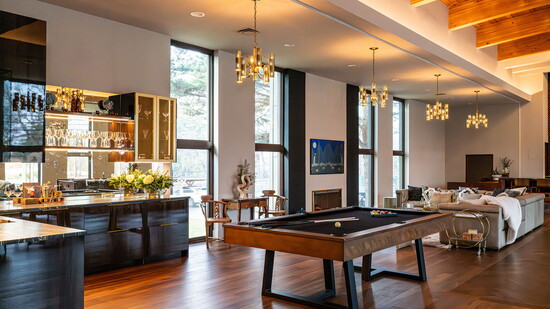
Inside the main living space, the original organ and its vertical pipes remain fully functional, now rising behind a custom bar. Wood ceilings and exposed beams stretch overhead, while new lighting and furnishings warm the room without overwhelming it.
"The organ and the beams are the most impressive," Pam said. "And the fact that the church people were so kind to leave it for us, and that it still works."
Architect Mike Aiello of Glenview-based Aiello Architecture played a key role in making the scale livable. His suggestion to add a fireplace helped anchor a more intimate seating area within the larger volume.
“We sort of sectioned it off and it’s my favorite place to sit,” Pam said. "When you create cozy spaces like that, it works.”
That philosophy continues in the former Sunday school wing, now a recreation room filled with a pool table, foosball, arcade games and a long communal table. Above the television, original lettering still reads, "God is Love," preserved as a focal point and a quiet reminder of the building’s past.
"It is part of the character," Pam said.
Elsewhere, details were saved with intention and personality. Church pews have been repurposed for dining. A vintage water fountain was relocated to a hallway. Even a restroom fixture made the transition; the original boys urinal now sits in the primary bathroom, a detail that often surprises guests.
Structurally, very little was altered. Only one small wall was removed. The renovation focused primarily on updating systems and adapting the layout for daily family life, while respecting the building’s original design.
From the street, the property still reads unmistakably as a church, complete with a tower that remains unused. Pam imagines a future owner might one day add a stairway and rooftop deck, but for now it stands as a reminder that the home is still evolving.
For the MacPhersons, that sense of possibility is part of the appeal.
"We are really enjoying it right now," Pam said. "We’ll see how it goes."
What remains clear is that the home does not attempt to erase its past. Instead, it allows history and daily life to coexist, creating a space that feels both grounded and personal. In a village where teardown-and-rebuild projects are common, the MacPhersons chose a different path. One defined by preservation, restraint and a willingness to imagine something new inside something old.
"We really tried to keep little pieces of the church," Pam MacPherson said. "The structure is the exact same."
"God is Love," preserved as a focal point and a quiet reminder of the building’s past.