Charlotte is changing fast, with more than 150 people moving here daily, high-rises stacking up, condos swallowing every gap and traffic thickening. But one thing has stayed deliciously the same: the Yiasou Greek festival.
Holy Trinity Greek Orthodox Cathedral hosted its 48th annual festival in Dilworth in September, bringing one of the largest Greek festivals in the U.S. back to East Boulevard.
“Charlotte has come to kind of demand our festival,” says John Mahairas, co-chair of this year’s Greek festival committee, who has served in a similar capacity for 35 years. “It's part of the Charlotte community. It's one of those things that come fall, people are expecting it, and we are more than happy to put it on.”
The celebration of Greek food, family and culture dates back to 1978. Before that, Holy Trinity hosted a Greek night to raise money and share their culture and faith with nearby residents. This year, more than 40,000 patrons enjoyed three full days of traditional folk music, dancing, fellowship and of course, Greek food.
“We have a lot of people who've been coming here for 45 years plus,” Mahairas says. “I see it all the time because they come up to me and say, ‘I'm back this year!’ But the other thing that happened—Charlotte has just grown so much, we constantly have new people coming every year.”
Father Jonathan Resmini is in his seventh year as dean of Holy Trinity. Part of that role means that during the festival he gives tours of the cathedral, showing off its architecture and artwork and sharing traditions of the Greek faith. When he’s not giving tours, he’ll don an apron, serve souvlaki and even dance with the senior high school students in the last performance Saturday night.
“They're a lot more polished than I am, but I at least like going up and dancing,” Resmini says. “I've been here long enough now where I've seen these kids grow up.”
THE MACHINE
The second weekend in September is one time of year when the clergy and parishioners all do the same job: serve. The entire “machine,” as Mahairas calls it when putting on a festival, is volunteer-only and includes parishioners from Holy Trinity, as well as St. Nektarios in Matthews and St. Luke in Mooresville.
Planning begins with committee meetings in January, when equipment rentals are secured. By May, teams are ordering ingredients for the baked goods. In June, more than 350 children begin rehearsing for the traditional Hellenic dance performances that go on throughout the three-day festival.
By August, “things are buzzing around the church,” says Dino Pappas, parish council president, whose first memories of the festival date back to being a kid on donkey rides. The festival now has electronic rides for kids, but everything else requires about the same level of maintenance.
Volunteers arrive daily, he says, sometimes as many as 100. People are hand-making pastries, unpacking wine and oils ordered from Greece, setting up tables, tents and cooking equipment, whether it’s one of the three big convection ovens or a 36-inch flat grill, or the dozen or so fryers, coolers and more.
MADE FROM SCRATCH
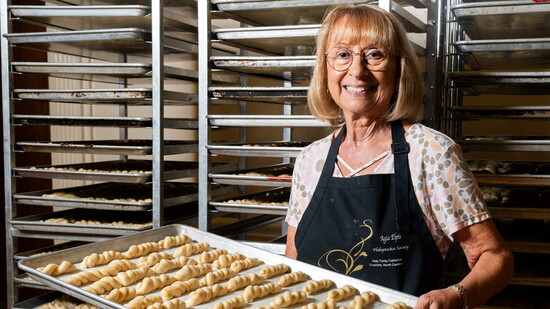
None of the cooking is outsourced to restaurants or even home kitchens. The 13 different pastries and sweet braided bread they offer are all prepared on-site in fellowship, some by women who’ve been doing it since 1978.
Georgia Andrews, whose surname was shortened by her father-in-law from Andreanopoulos when he emigrated to the U.S., has been helping make pastries from the beginning. For the past 20 years, she’s been chair of the pastries.
“I’m willing to turn it over to somebody, but I haven’t found anyone to train yet,” she jokes.
During the three days of the festival, she’s busy behind the scenes, putting together orders and boxing up baked goods. But it’s the backroom bonds that have come to mean the most.
“I love the social aspect,” says Andrews. “Getting here, seeing the ladies, meeting new people. When I came here 50 years ago, I only knew a handful of people, so I started getting involved.”
PASSED DOWN
Irene Politis, who is in charge of the food line, has been at Holy Trinity for 48 years. She took over overseeing food distribution from the woman who did it from the beginning. Now Politis volunteers with her daughter.
“We’re so close-knit,” she says.“I have two grandsons. They’re dancing this year. The children learn all the traditions by participating and helping.”
When the festival first started, Pappas says, one family was in charge of a booth for the gyros, another family for the dolmades and one for the pastries.
“The funny thing is the families that ran them then still actually run them today,” Pappas says. “The kids or grandkids are running it now, or the cousin or the in-laws.”
Recipes and traditions get passed down, even when family members pass away.
“People are always coming in and learning from their parents or grandparents, aunts or somebody that teaches them how to make it,” Pappas says. “It's quite beautiful actually. It's a way to hold us together. It forces us to work together and remember those things.”
A LIVING TRADITION
Each year, Resmini says, people in Charlotte continue to seek out membership at Holy Trinity. Just in the last seven years, the parish has grown right along with the festival, from 1000 families to 1,300, he says.
The festival itself is no longer a money maker for the church, Mahairas says. He says they’re lucky to break even. But it’s a way to both celebrate lasting traditions and grow their faith.
“Orthodoxy provides something that seems permanent and historic because we changed very little in two thousand years,” Dr. Resmini says. “The service we do on Sunday uses the exact same structure and same language as the fourth century. There's this historic continuity, a continuity of practice, continuity of beliefs. With everything changing so much day to day, I think people are looking for something that's stable like that. Plus, it provides them with a way of life, a community.”
"It's quite beautiful actually. It's a way to hold us together."
"With everything changing so much day to day, I think people are looking for something that's stable like that."