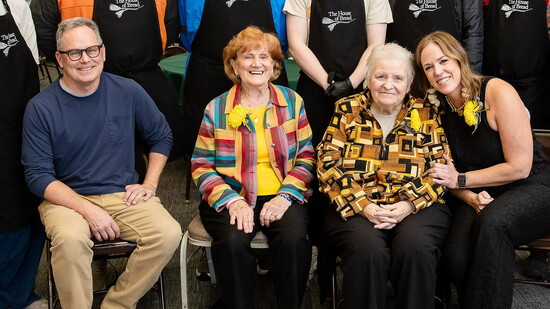
For 46 years, the House of Bread has stood as a quiet force of compassion in Hartford—feeding the hungry, educating immigrants and refugees, providing housing to the underserved, and building community where it’s needed most.
Founded in 1980 by Sister Maureen Faenza, CSJ, and Sister Theresa Fonti, CSJ, the House of Bread started by serving coffee and day-old doughnuts to homeless men in the North End of Hartford.
Today, the non-profit – a sponsored ministry of the Sisters of St. Joseph of Chambery – is led by Co-Directors Beth Boyle and Tom Porell. Together with their staff of 15 and a passionate corps of 300-plus volunteers, they oversee an organization that provides food, housing, and education to 1,000 men, women and children each day in six different buildings throughout the city.
Yet one thing is the same now as it was in the beginning: The House of Bread is a place powered by people who show up.
That tradition started with women like Kay Callahan, Patricia Dupuis Casey, Phyllis Janiszewski, Midge Redden, and Mary Sanady – friends from West Hartford who had 35 children among them but still found time to volunteer at the House of Bread when their kids were in school, in the 1980s.
“We didn’t have much back then,” recalled Casey, 98, the only surviving member of that friend group. “But we had each other, and we had the people who needed us. You just did what had to be done.”
Those early days were humble. Volunteers prepared meals in tight spaces with limited resources. Yet what they lacked in funding, they made up for in heart. Respect and kindness weren’t optional—they were the standard.
“You never felt like you were helping ‘someone else,’” Casey said. “You felt like you were part of something bigger.”
That’s what kept these five “original volunteers” coming back year after year. It also inspired the next generation to follow in their footsteps.
“I grew up watching my mom and her friends give up their time, without hesitation, to help others,” said Carol Dupuis, Pat Casey’s daughter. “They all had big families and busy lives — and still, they made room for others. That stayed with me.”
Last fall, the House of Bread opened a new Education Center on Maple Avenue in Hartford, a bright and cheerful building where volunteers help hundreds of immigrants learn English, take GED classes and prepare for the U.S. citizenship exam.
In recognition of those “original volunteers,” Dupuis organized a group sponsorship of one of the new classrooms. The children of the five women chipped in to underwrite the dedication.
“To see their names there (on the room plaque) —it means everything,” Dupuis said. “It tells future generations where this all started.”
“Legacy isn’t about being remembered,” Casey reflected. “It’s about making sure the work continues.”
In a world that often feels divided and distracted, the tradition of volunteerism at the House of Bread reminds us that real change still begins the same way it always has: with someone deciding to help … and then showing up again tomorrow.
“The strongest thing about House of Bread isn’t the building,” Dupuis concluded. “It’s the people. Always has been.”
Visit @houseofbread on socials.
“I grew up watching my mom and her friends give up their time, without hesitation, to help others. They all had big families and busy lives — and still, they made room for others. That stayed with me.”