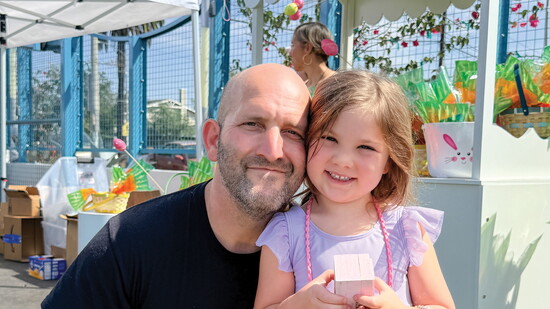
Some evenings, Jeff Levine sits in the den of the home his family purchased in 2021 and looks out the sliding glass window at the palm trees in his backyard. His wife, Lauren, and their daughters, Scarlet and Goldie, are nearby.
"I'm so richly blessed," he said of those moments.
The view means more to him than most. Jeff grew up in a slum, in a home infested with cockroaches and fleas. When it rained, water came through the roof and soaked the carpets, forcing the family to wear shoes indoors.
By the time he was a young man, he was battling addiction. It lasted 12 years, but he doesn't dwell on the details. He is candid about the pattern: a cycle of promises and relapse, and the painful truth that he treated the people who loved him most the worst.
The turning point came quietly. Desperate, he walked into a Christian bookstore, prayed for direction and found a book that changed his thinking. That night he prayed and went to bed. The next morning, he began reading scripture — something he said he has done almost every day for 23 years.
"I'm not perfect, but I'm not who I used to be," he said.
Jeff is now president and CEO of the Long Beach Rescue Mission. Ask him today, and he'll say it's what he was made to do. But the path there wasn't always clear.
How the Mission became his life’s mission
In 2006, with no formal training, a story of recovery and a love for people, Jeff joined the Mission part time as a chaplain. Over the next 12 years, he helped build the Mission's case management and discipleship programs and, from 2013 to 2018, directed all of its men's and women's programs.
In 2018, Jeff was called to become lead pastor of Bethany Church, where he served until 2022. During that time, he stayed connected to the Mission as a board member.
When the top job opened, he hesitated. Leaving the church felt like a betrayal; even praying about it was uncomfortable. Then Jeff had a dream in which someone asked him about the Mission, and he answered:
"When I'm at the Mission, it's like breathing."
He woke up with a clarity of purpose: This is what God created him to do.
He returned to lead the Mission in June 2022, with the same hope that drew him in as a chaplain: that no one who walks through its doors is beyond reach.
Building with dignity
Jeff inherited buildings weighed down by decades of deferred maintenance, including leaking roofs, water damage and termites. In four years, every building has been renovated from the roof down. He half-jokingly calls the Mission "the Ritz-Carlton of shelters," but the point is serious. The Mission's founders, Wayne and Janet Teuerle, who opened its doors in 1972, wanted "only top shelf" for the people they served, and Jeff takes the command to love your neighbor as yourself literally.
"Why wouldn't I want nice things for these families and individuals who've experienced so much trauma?" he said.
The Mission now operates four facilities: Samaritan House for men, Lydia House for women and children, the John and Helen Apostle House for men with disabilities and Timothy House for young men ages 18 to 24.
Lydia House currently has 50 beds. When the Mission broke ground on an expansion in October 2024, Jeff said about a dozen families were being turned away every day because there was no room.
The new building, a three-story center on the lot next door, will add a dining hall, chapel, rooftop deck and gym, along with 60 new beds. Many women and children are already on a waitlist.
After several delays — including time and resources being diverted from the project to restore the first floor of the original building after a fire — Jeff hopes the facility will be open in time for Christmas.
"God sees you"
Jeff crossed the campus one afternoon to give a tour when a woman stopped him at the corner. She wanted to know why he hadn't said hello. He had walked right past her car without noticing.
He knew her. Sharon had stayed at the Mission about seven years ago, and now she was sleeping in her car with her adult son, who has autism. She had just received a lead on an apartment and asked if he had a business card to use as a reference. He didn't. But he remembered the ARCO gas cards sitting on his desk, so he walked her to the office and handed her two.
"You could tell how much it meant to her," Jeff said.
As they walked back, he told her he wanted her to know that God sees her. He began recounting the story of Hagar, the servant in the Book of Genesis who is cast out into the wilderness with no food or water and nowhere to turn. In her lowest moment, God appears to her and promises to provide for her and her son — and she responds by calling him "the God who sees.”
Just as he reached that part, they passed a staff member, a graduate of the Mission's program, whose T-shirt read "The God Who Sees."
"It's almost like he peels the curtain back a little bit," Jeff said. "You're at work. You're making yourself known to this woman who's in great need."
Beyond the numbers
Like most nonprofits, the Mission tracks its impact in numbers. According to its website, it serves about 250,000 meals and provides over 60,000 nights of shelter each year. On average, 65 men and women are enrolled in its one-year New Life Program at any time, with 86% of graduates moving into independent living and employment.
Jeff values those figures, but he said they miss something.
"There are things that you can quantify," he said. "But then there are things that you can just tell the story of."
He pointed to stories like Sharon's, or the man sleeping on a bench outside Lydia House who gets a shower, fresh clothes and a meal, then is never seen again.
These stories don’t show up in an impact report, but they speak to the individual lives that are touched through the Mission.
"They are intrinsically and eternally valuable," Jeff said of the people the organization serves.
He compared people to the Mona Lisa. Things are valuable when they're rare, he said, and the painting is priceless because there's only one.
"How valuable does that make us, that in all of time, space and history, there will only ever be one of us?" he said.
Jeff believes that changes how people treat each other, including in a brief encounter with someone they may never see again.
"It might look different if we all did that," he said.
How to help
The Mission's most pressing need this season is protein. Jeff said it takes about 30 pounds of ground beef to feed everyone for one day.
"If you go to the grocery store, think of us," he said. "Grab an extra pound of meat, throw it in the freezer, drop it by when you can."
His other request is simpler.
"Come and see what God is doing there," he said. "Let God capture your heart."
Gratitude
The Mission receives no government funding, Jeff said, and depends entirely on the generosity of others. He said that generosity has shaped him, too.
"I wouldn't be who I am apart from the Mission," he said. "It's only been possible because there are people I'll never meet who believe in us. They believe in me."
That generosity reaches people like Joe, whose story appeared in the fall edition of the Mission's newsletter, Rescue Review.
Joe spent decades caught in a cycle of addiction and homelessness. After he hit bottom, his brother, a graduate of the Mission's program, brought him in.
"The love here is genuine," Joe said. "The people show sacrificial love."
Through daily prayer, reading scripture and a full commitment to the program, he began to change. This Thanksgiving, he has a renewed perspective on life and is filled with gratitude.
"Now I have joy and peace," Joe said.
It's the kind of change Jeff says he wants to thank Long Beach for making possible. Asked what he'd say to the city this November, his answer came easily.
"Thank you," he said. "Thank you for helping us do what we do."
To donate, volunteer or schedule a tour at Long Beach Rescue Mission, visit lbrm.org.
"I wouldn't be who I am apart from the Mission. It's only been possible because there are people I'll never meet who believe in us. They believe in me.”