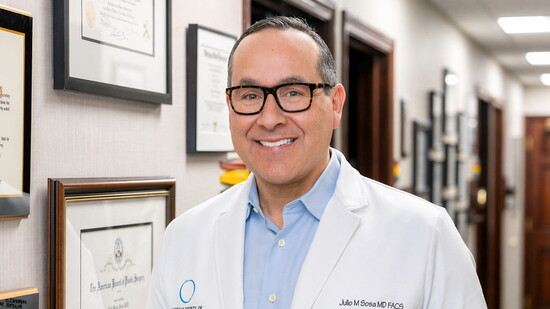
The plastic surgeon’s waiting room looks a little different than it used to. More men are seeking cosmetic procedures than ever before — and the reasons why might surprise you. We sat down with board-certified plastic surgeon Dr. Julio Sosa, owner of Bloomfield Plastic Surgery, who specializes in aesthetic and reconstructive procedures for the face, breast and body. He filled us in on what’s changed, what men are actually asking for and what everyone should know before scheduling an appointment.
BIRMINGHAM CITY LIFESTYLE Your patient mix has shifted. How much of your practice is men today?
DR. JULIO SOSA Right around 20 percent. That number has grown steadily, and I expect it to keep climbing.
BCL What's driving that?
DJS Largely the workplace. Men are staying in their careers longer and want to remain competitive alongside younger colleagues. Looking vital and rested isn’t vanity — for a lot of men, it feels like a professional necessity.
BCL Is there still a stigma around men getting cosmetic work done?
DJS There’s less than there used to be. Men are talking about it more openly, which normalizes it. I think that conversation is only going to continue.
BCL What age range are you seeing?
DJS Anywhere from 18 to 65. It’s a wide range, and the motivations shift across those decades — younger men tend to be focused on specific concerns, while men in their 40s and 50s are often thinking more broadly about looking refreshed.
BCL What are the most common procedures men are coming in for?
DJS The top three right now are liposuction for gynecomastia — excess male breast tissue, which is far more common than most people realize — eyelid surgery and facelifts. Each of those addresses something men notice in the mirror and find genuinely bothersome.
BCL Any lesser-known procedures worth mentioning?
DJS There are quite a few options men don’t always know to ask about — non-surgical skin rejuvenation, neck contouring and ear reshaping among them. A good consultation opens up that conversation.
BCL What’s the fastest growing procedure you’re seeing among men?
DJS Eyelid surgery, without question. The eyes are often the first place fatigue and age show up, and the results can be remarkably transformative with very little visible sign that anything was done. That appeals enormously to men. Men tend to want a very subtle look and do not want extreme change.
BCL Do men approach this differently than women?
DJS Very much so. Men tend to want subtle. They are not coming in looking for dramatic transformation. They want to look like themselves, just more rested or more defined. The goal is almost always that no one can quite put their finger on what changed.
BCL What’s the most exciting innovation in the field right now for male patients?
DJS The refinement of minimally invasive techniques has been significant. We can achieve results today with far less downtime than even five years ago, which matters a great deal to men who aren’t eager to take time away from work or explain a recovery to anyone.
BCL Is there a procedure men ask for that you think is often unnecessary?
DJS There are situations where men come in focused on something quite minor that I don’t think warrants surgery. Part of my job is having that honest conversation — sometimes the right answer is a non-surgical option, or simply reassurance.
BCL How do you assess whether a patient has realistic expectations?
DJS I always ask about prior procedures. One of the clearest red flags I encounter is a patient who has had multiple procedures and multiple revisions. That pattern often signals that the issue isn’t surgical — and no procedure is going to resolve it.
BCL What do men most commonly misunderstand about what surgery can do?
DJS That it’s a finish line. Surgery can refine and restore, but it works best as part of how you take care of yourself overall. It’s a tool, not a solution.
BCL What should men ask when they’re looking for a surgeon?
DJS Three things matter most. First, how many times has this surgeon performed the specific procedure you’re considering — volume and experience are everything. Second, are they board certified? And third — which often surprises people — does the surgeon have hospital privileges for this procedure? Hospital credentialing is a rigorous process. It weeds out a lot of practitioners who call themselves ‘cosmetic’ surgeons but are operating exclusively in office settings without that oversight. It’s one of the most important questions you can ask and one of the least asked.
BCL Last question: Have you personally had any work done?
DJS No, I haven’t. But I wouldn’t rule it out down the road. I’d like to think I’d be a good patient.