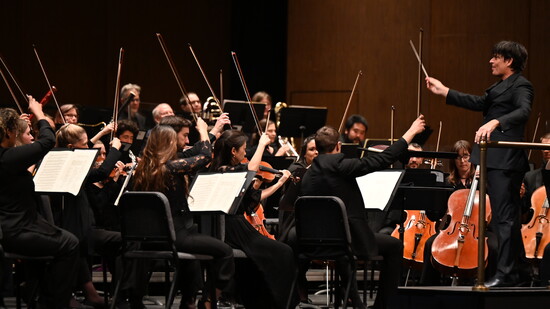
There’s no real “off-season” when it comes to planning for the Tucson Symphony Orchestra. By the time one season is underway, the next is already taking shape, with guest artists, repertoire, venues and collaborations being pieced together months—even years—in advance. Ben Nisbet, who helps shape the TSO’s programming, describes the process as a uniquely creative puzzle: complicated, constantly moving and, ultimately, a lot of fun.
The result for 2026–27 is a season designed to move comfortably between the traditional and the unexpected. The TSO’s lineup spans beloved symphonic repertoire, chamber music, Latin American traditions, film music and the LIVE@TheRonstadt Pops series, all while maintaining a strong connection to the community it calls home.
A Classic Opening
The season begins with one of the great showpieces of the violin repertoire: Tchaikovsky’s Violin Concerto, performed by 18-year-old Amaryn Olmeda, the TSO’s 2026–27 Artist-in-Residence. Nisbet calls the concerto an ideal season opener—romantic, virtuosic, exciting and familiar enough to draw in both longtime classical music lovers and newcomers. He is equally enthusiastic about Olmeda, whose youthful energy is matched, in his view, by an unusually mature musicality. The opening concerts also feature Richard Strauss’ Ein Heldenleben, creating the kind of quintessential symphony experience Nisbet believes can be an ideal introduction for someone new to the orchestra.
From there, the fall takes a distinctly Tucson turn.
A Tucson Sound
October launches the TSO’s ¡Fiesta Latina! programming, a curated series spanning multiple concert offerings and exploring music from Spanish-speaking and Latin American cultures. The series begins at Catalina Foothills High School with Joaquín Rodrigo’s Concierto de Aranjuez, performed by acclaimed Spanish guitarist Rafael Aguirre. For the TSO, bringing Aguirre to Tucson is particularly exciting: Music Director José Luis Gómez has wanted to work with the guitarist for some time, and his appearance gives audiences the chance to hear one of the most famous works for classical guitar and orchestra performed by a leading artist.
The following programs broaden the Latin American focus even further. Fandangos and Malambos explores music from Uruguay and Argentina, while Latin Sizzle brings Venezuelan musicians Alexis Cárdenas, Jorge Glem and Elvis Martínez together with the orchestra. Glem’s cuatro—a small, distinctive Venezuelan stringed instrument—along with Cárdenas’ violin and Martínez’s bass creates a program that Nisbet says may challenge expectations about what a symphony concert can be.
“It’s musically wonderful, but it’s also very entertaining and very exciting to watch,” Nisbet says. “You feel like you might have just been transported out of the concert hall and into a completely different place.”
That sense of discovery is intentional. Nisbet says the goal isn’t necessarily to offer “something for everybody,” but to create as broad a spectrum of artistic experiences as possible while remaining true to what it means to be a symphony orchestra.
Music That Reflects Its Home
That philosophy is especially evident in the TSO’s relationship with Tucson itself. The city’s Spanish and Mexican heritage, its proximity to the border and its broader Southwestern identity all inform the organization’s programming. This fall, that connection takes center stage with a Día de los Muertos concert on Nov. 1, featuring Tucson’s Mariachi Aztlán and singer-guitarist Edna Vázquez, a Mexican-born artist who has previously performed in Tucson with Pink Martini.
For Nisbet, these programs aren’t simply opportunities to play great music. They’re a way of reflecting the place where the orchestra lives and performs.
“We want to play this great music, but because it also is representative of the part of the world in which we live,” he says.
Western Roots, New Directions
November brings yet another shift in tone. The orchestra presents Beethoven’s rarely performed Triple Concerto, featuring a piano trio in a collaboration with the Arizona Friends of Chamber Music. Then the LIVE@TheRonstadt Pops series kicks into gear with Howdy Tucson! Music of the American West, the debut concert for new Principal Pops Conductor Evan Roider.
The Western-themed program offers another chance to celebrate the region’s identity while embracing the more playful side of the orchestra. Nisbet says Roider has already brought an interesting new imprint to the pops programming, and he is eager to see where that vision leads in the years ahead.
That spirit of experimentation extends throughout the season. Even the TSO’s Music of Hans Zimmer program, while rooted in familiar film scores, finds a uniquely Tucson connection through harmonica player Tom Walbank, a former Tucson musician and local legend. It’s exactly the kind of unexpected collaboration that Nisbet believes makes live performance special.
More Than the Music
Because that, ultimately, is what he hopes audiences experience this season: not simply music, but connection.
Connection between the orchestra and the community. Between musicians and conductors. Between performers and audience members. And, perhaps most importantly, between an audience member and themselves.
In an era when so much entertainment is consumed through a screen, Nisbet sees value in sitting in a concert hall for two hours and simply being present.
“You're watching and hearing that music being made live,” he says. “It’s one of the best ways to get away from your phone for two hours.”
For someone who has never attended a symphony concert, Nisbet points to opening night as a classic introduction—or the Venezuelan-infused Latin Sizzle as an opportunity to experience something entirely unexpected.
And for longtime audiences, the season offers plenty of reasons to return. From Tchaikovsky and Brahms to Gershwin, Hans Zimmer and the orchestra’s many cultural collaborations, the 2026–27 season is built around a simple idea: There is more than one way to experience a symphony orchestra.
For Nisbet, the hope is that audiences leave with more than a favorite piece or memorable performance. He wants them to feel that they were part of something shared—a moment of music, community and connection that could only happen because everyone was in the room together.
“You feel like you might have just been transported out of the concert hall and into a completely different place.”
“You’re watching and hearing that music being made live. It’s one of the best ways to get away from your phone for two hours.”