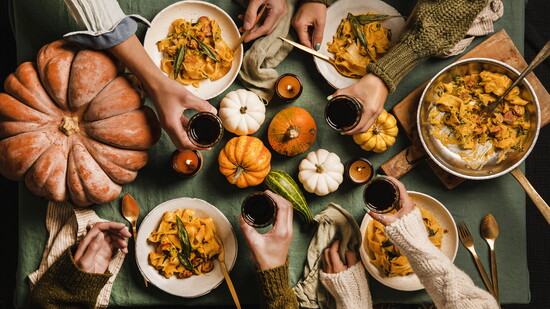
Thanksgiving brings America home. Around tables large and small, we settle into familiar company, pass dishes that carry somebody’s history and make room for whoever has arrived. As the United States marks 250 years of independence, there is something especially moving about this annual gathering. The Founding Fathers understood the importance of pausing to give thanks while a country, and all its possibilities, was still taking shape.
In 1789, George Washington proclaimed a day of public thanksgiving and prayer. He called attention to civil and religious liberty, the establishment of constitutional government and the opportunity to acquire and share knowledge. He asked Americans to acknowledge their blessings with “grateful hearts.” This year, Thanksgiving falls on November 26, the very date he designated. Across 237 years, the invitation retains its warmth.
John Adams offered a related thought in 1798. His proclamation for a May day of fasting and prayer also called for thanksgiving, and expressed the hope that Americans would be united in “amity and mutual confidence.” Friendship and trust. Those are remarkably human foundations for something as ambitious as a republic. They remain good foundations for a neighborhood, too.
I find reassurance in that connection. A country’s promise becomes tangible in the places where people spend their days. We experience opportunity through a school door, belonging through a neighbor’s welcome, freedom in the ordinary business of choosing how to live. Here in The Woodlands, we have ample reason to consider how much that promise has made possible.
Our community began in 1974, when George Mitchell’s vision brought a new town into being among the trees. Its planning drew on the principles of designing with nature. More than half a century later, that decision still shapes the experience of coming home. The trees soften the drive. Paths invite us outside. Water and woodland make room in the day for a different pace.
There is foresight in that, and generosity toward people the planners would never meet. A child riding beneath the canopy today benefits from decisions made before that child’s parents chose a home here. We inherit the shade. In time, we become responsible for what grows beneath it.
National recognition gives us another way to appreciate what has been built. In Niche’s rankings, The Woodlands has placed No. 2 among America’s best cities to raise a family, No. 3 among the best cities to live in and to retire in, and No. 4 among cities with the best public schools. Those distinctions deserve a moment of pride. Their meaning becomes clearer when we imagine the lives behind them.
A school’s reputation rests on teachers preparing lessons and noticing when a child needs encouragement. A community that welcomes families depends on parents coaching teams, neighbors exchanging numbers and people making the effort to know one another. The rankings give public recognition to qualities that require attention, year after year. We are fortunate to live among people willing to give it.
Taken together, the family and retirement honors suggest the pleasure of having several generations nearby. A grandparent can be part of an ordinary week. Children can grow up knowing the stories behind the faces in old photographs, and older residents can keep making plans of their own.
The pleasures are close at hand. A walk beside the Waterway can loosen a conversation that feels crowded at home. At Northshore Park, there is room to let an afternoon unfold. The George Mitchell Nature Preserve offers trails through the landscape that gives this community its name. November lends these outings a particular appeal, with the possibility of cooler air and a little less urgency.
We can gather for dinner at Hughes Landing, linger around Market Street or share an evening of music at the Cynthia Woods Mitchell Pavilion. Each offers a setting for the company we keep. Years later, the memory may belong to the friend across the table, or the song someone beside us knew by heart. A place earns our affection through what happens there.
That is why I think gratitude asks something quite practical of us: to be available for the life we are fortunate enough to have. Put the dinner on the calendar. Take the walk while there is still light. When an old friend calls, allow the conversation to run a little longer than planned. Friendship grows through these modest permissions we give one another.
Author Roy T. Bennett put it well: “Be grateful for what you already have while you pursue your goals.” There is sound advice here for a community accustomed to achievement. We can be pleased with where we stand and remain interested in what
comes next. Appreciation gives ambition a sense of proportion. It reminds us why we wanted a good life in the first place.
Sometimes that life is easiest to recognize after the guests have settled in. Someone tells a story the family has heard for years, and somehow it is funny again. A friend knows where the glasses are kept. The conversation wanders well beyond dessert. Such ease takes time to acquire. It grows out of shared history and the welcome extended often enough to become understood.
Thanksgiving can also bring an empty chair into sharper focus. Some of us will be missing someone. Others will be spending a first holiday here, still learning names and finding their way into the community. There is kindness in remembering that a beautiful place can feel unfamiliar until somebody invites you in. An extra setting at the table can change the meaning of an entire day.
Our thanks should reach the people whose work makes these days possible. The nurse finishing a shift, the firefighter on duty, the person tending a public space all contribute to the life around us. So do volunteers who help a neighbor through difficulty. Interfaith of The Woodlands’ food pantry, including its grocery deliveries to homebound seniors, gives that generosity a practical local expression. We can acknowledge that care by name, support it with our time and teach our children to recognize it.
This is where my optimism for the future takes hold. The Woodlands already gives us places to meet and reasons to gather. What we bring to those encounters remains wonderfully open. Today’s newcomer may become a lifelong friend. A child encouraged by a teacher may return with something valuable to offer. That gives me confidence in the young people growing up here, and in the welcome awaiting those who have yet to arrive.
“Start each day with a positive thought and a grateful heart,” Bennett advised. Imagine carrying a little of Thanksgiving’s attentiveness into an ordinary Tuesday. A word of appreciation before everyone leaves the house. A message sent when someone comes to mind. Over time, such habits make affection visible.
As America enters its next quarter millennium, our own contribution is close enough to touch. We can care for the place we call home and make it easier for others to feel at home here. We can give our families the gift of our attention, and our friendships the time they deserve.
This Thanksgiving, before the dishes are cleared, take another look around the table. Consider the distance each life has traveled to arrive there, and everything still ahead.
Here in The Woodlands, we have much to be thankful for. The future already has a place at this table.