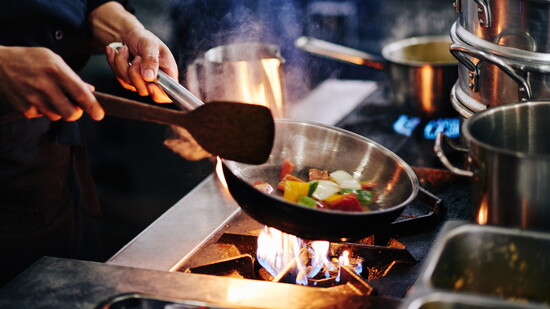
Recipes are how we learn the rules. Cooking is knowing which ones you're allowed to break. I use this reframe in session with my clients at least weekly.
A recipe will tell you exactly how much butter, how long to bake, how thin to slice. Follow it precisely and you'll get a fine, predictable result. But the cooks I admire, the ones whose kitchens I want to sit in, learned the rule well enough to know where it bends. A little more garlic than it calls for, butter instead of oil… ten minutes less because they know their oven runs hot.
I met my friend Sarah on Instagram years ago. One of those early-internet friendships that somehow became a real one. She lives here in Huntsville, and every few Fridays she'd throw open her front door for happy hour. No dinner or cooler stocked special for guests. Just an open invitation. If you needed someplace to go, this was it. Bring whatever you want to feed you and yours. There were chips in the pantry, not bought for the occasion, just available "Wine and bourbon are above the sink," she'd say, "and you know how to preheat an oven." There was always a fire going in the backyard and we played dominoes until it got too dark to see the dots.
It is, hands down, the most generous expression of hospitality I have ever witnessed and I don't think that's true despite how little she did. I think it's true because of it.
Sarah knew exactly what a "good hostess" is supposed to provide: the effort, the abundance, the visible evidence that she'd gone to trouble for you. And she skipped all of it, on purpose. What she offered instead was simpler and impossible to fake: there is room for you here, exactly as you are, and you don't have to earn it by watching me perform.
There's a word for what was actually happening in her home. Commensality comes from the Latin com, "together," and mensa, "table." Literally, to share a table. Anthropologists will tell you commensality was never really about the food. Food is just the medium; togetherness is the event. Who gets invited, who sits where, who's handed a chair without having to ask twice. A shared table has always been one of the ways humans quietly announce who belongs.
The research backs up what every person already knew around Sarah's table, long before our brains caught up. A 2026 study out of Oxford, Gallup, and Harvard, published in Scientific Reports, tracked meal-sharing across 142 countries and found something worth sitting with: people who'd shared even one meal with someone else in the past week reported meaningfully higher life satisfaction than people who'd eaten every meal alone. That gap, the researchers say, is roughly half as large as the wellbeing hit of losing a job. Evolutionary psychologist Robin Dunbar found something similar closer to home. In a UK survey, 65% of people said there was someone they knew they should be making more effort to see. Of those, three out of four said the best way to actually do it was to share a meal with them.
We didn't need a study to tell us that. But it's nice to know the fire pit and the folding chairs were doing something measurable the whole time.
What I remember most about those Fridays isn't the wine, or even the conversation. It's smaller than that. It's the specific sound of dominoes clicking against a table. Someone's laugh catching on a joke that wasn't even that funny. The fire going a little low and nobody getting up to fix it, because getting up meant missing whatever was about to be said next. Those are the details that pull you back into the life that's actually happening, instead of the one you're planning, or improving, or waiting until you deserve. The ordinary magic of rules getting broken on purpose.
I think about Sarah when I think about wanting more out of life. I'm learning to look at that desire as delightful.
You already know how to preheat an oven. The chips are already in the pantry. The rule that matters is the one that says: there's room for you here.