If you live in or visit Washington, DC and think you have seen it all or you still feel the urge to relive history without the tourists suffocating you, you are about to embark on a tour of possibly the best D.C. landmark, complete with a secret view of the capital, unparalleled history, empathy, and a military cemetery that predates Arlington.
Driving through the gate of the US Soldiers’ home into parking lot 2 (to the left) I easily found parking and entered the visitors’ center. I was greeted by Sarah Grace Grider, a Museum Program Associate at the Cottage, with a smile and radiating warm personality. She immediately answered my questions about her journey from Arkansas through Ohio and Maryland, and finally to DC where her heart was captured by the Cottage. Her love for the place is felt throughout her hour-long tour on a warm February morning.
Before entering the home built for George W. Riggs in 1842, we sat down to discuss why exactly this spot. On the 4th highest elevation in Washington, D.C the location provided cool summer breezes, a view, and the sense of distance from the blooming Capital streets of the time.
Purchased in 1851 by the Federal Government for a veteran’s home using $57,000 derived from "war booty," or tributes, set aside by General Winfield Scott during the Mexican-American War. The military began to invite presidents and important government officials to move to the bucolic campus in the summer months. In 1862, following the death of 11-year-old Willie Lincoln, the Lincolns first moved their household from the White House to the Cottage. By the time of his death, Lincoln had spent 13 months of his presidency living at the Cottage, which still offers a quiet spot for reflection.
As we walked to the Cottage, we stopped at the life size, 6-foot 4-inch, statue of Lincoln. I was reminded of what a towering man he was. After entering the steps to the Cottage and making our way to be back porch (through the jib-door, designed to maximize the breeze into the home), we stood overlooking the south lawn of the estate. If you want to imagine stepping into 1862 through the shoes of a President, this is the moment it happens. You can see into the inner city of D.C. from the left-hand side of the porch, the quarter house to the right, once used to house other presidents and cabinet members, and the other buildings used to house retired soldiers. As Sarah Grace talked, it was easy to hear children playing, soldiers banter, the Cottage cook Mary Williams offering coffee and biscuits to those visiting, and Lincoln discussing the details and drafting of the Emancipation Proclamation with his valet William Slade.
From this site, Lincoln had a 30-minute, 4.5-mile commute by horseback or carriage ride to his office at the While House.
Lincoln traveled back and forth, by military hospitals, through the DC streets, and by “contraband camps,”, sometimes taking part in gospel hymns and celebrations with the formerly enslaved people who had sought freedom in the Capitol. These daily interactions helped Lincoln remain grounded, humble, and able to build empathy for his constituents.
Sarah Grace referred to Lincoln as a “Man of his time,” which made me think of the impact these individuals, these “average people,” of the time, had on Lincoln. Is this what we are missing in the modern political divide. Or maybe just simply empathy, and this is how Lincoln sought to retain it.
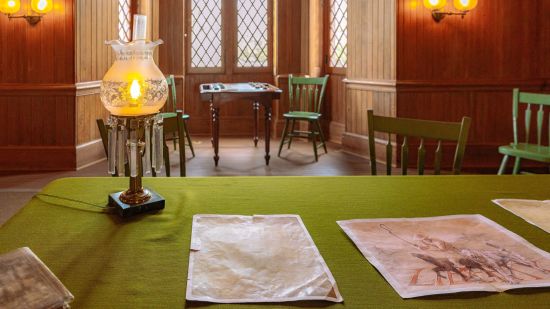
We entered a large gathering room. There were chairs, a couch, and a single book on a table with an oil lamp, where Lincoln entertained friends and dignitaries, and listened to strangers and political opponents.
Through the doorway we ventured into a wood paneled room with desk and checker table. The library is somewhat darker and full of reflection than the other rooms. It was here Lincoln likely kept his own books: literature, legal writings, historical tomes that Lincoln would pore over in his search for a legal way to end slavery.
In the hallway beyond, I saw the well-known stovepipe hat. That’s when I said to Sarah Grace, “I can see it, the people the mindset, the times of 1862 as I stand here, but what would Lincoln say to us standing here is he was with us? If he was sitting at the desk there interpreting the constitution, in the modern day? We both agreed he would be challenged, but his Empathy and desire to connect would remain.
Sarah Grace led me upstairs, holding the same banister Lincoln once held. I was still on a journey I’d never felt before. We walked through the rooms likely used by Tad Lincoln, and Robert Lincoln, when he visited from college, and ended in the bedroom used by Abraham and Mary Lincoln.
The room was well restored and adorned with one of the highlights of the tour: the “emancipation desk” overlooking the South lawn. It was here Lincoln sat up at night and pondered deep thoughts, drafted his notes for the day ahead, and reflected on what he and William Slade had discussed in the daylight. It was not just a room, not a desk, not a chair, it was our chance to reflect on the meaning of common ground, empathy, love, and moments greater than your own.
As we wrapped up and headed back to the visitor center, my deepest reflection as a human and a Veteran was yet to arrive. Sarah Grace had told me of Lincoln walking across the yard to the National Soldiers’ and Airmen’s Home National Cemetery. I knew I needed to see it for myself.
Before heading over to the cemetery though, I had a quick chat with Callie Hawkins, CEO & Executive Director at Lincoln’s Cottage. Her love for the position is rooted deep in her connection to the Lincoln’s, which was strengthened after the death of her son Coley, when she understood the Lincolns’ as bereaved parents.
Callie made clear the impacts federal cuts can have on museums and highlighted the ability for the Cottage to remain open during recent Federal shutdowns thanks to its generous donors and non-profit partners. The Cottage was able to serve as a destination for many tourists and student groups visiting DC when their plans to visit Smithsonian sites were thwarted. She was glad the Cottage had been able to stay open at a time when our need for empathy and common understanding is critical.
With her was Rebecca Kilborne, Senior Marketing and Communications Manager at the Cottage and she was a rockstar coordinating my visit. From the 2nd grade classrooms, middle school creative writing, teaching English in Prague and students in London, historical real estate, and even the ABC News family, Rebecca’s historical and social background made the decision to work at the Cottage easy. I hope to see her and Callie with their families at Bourbon and Bluegrass this year, more on that at the end.
Photo Provided, Callie Hawkins
My final stop was the National Soldiers’ and Airmen’s Home National Cemetery, created in 1861 after the battle of First Bull Run, was a designated resting place for soldiers of the Civil War, mostly Union. In 1864 the capacity was reached, leading to the establishment of Arlington National Cemetery. As I drove through the gate, I took a step back in time.
I parked and began walking through the rows of headstones, noting dates, names and services. Part of my service in the Marine Corps was making death notification during the Iraq and Afghanistan wars and performing TAPS at funerals around DC and in Arlington. Following this, the TAPS organization led me to reflect through volunteering at their summer camp with the families of the fallen. The healing began where heartache once started. The Marines of Company B 4th LAR suffered losses of Sgt. David Smith, LCPL Jeremy Kane and HM2 Qi in January 2010, they were on my mind as I walked through the rows of uniform headstones.
Sarah Grace had told me of Lincoln visiting this site a lot during his time at the Cottage, his reading of poetry in the cemetery, and his presence during burials. At a place he sought to reflect, communicate and retain empathy, it was clear why he visited this ground.
I made my way into the earliest burial ground. These were the first soldiers to perish in the war, and as I walked row by row I thought of the struggle of the times, the fear, bravery, and sacrifice they made, for a country, belief, and purpose greater than themselves. All this witnessed by a 6-foot 4-inch leader rooted in connecting to the people he encountered in life, and in their death. I was alone here, not one person around. I continued to walk, and the echo of TAPS was audible from the adjacent cemetery. The timing was remarkable and as the last note hummed, I realized I was standing at the last headstone placed in, December 1864, the last casualty of the Civil War before the opening and internments moved to Arlington.
A place surrounded by sorrow in 1864, Lincoln found it a place to heal, not only to heal personally from the recent death of his son, but a place to heal the country.
Arlington is known for the tomb of the unknown, but here you can stand among them, a lot of them in fact.
What’s fascinating is how these two places, the Cottage and the Cemetery, are intertwined. Lincoln could see the cemetery from the windows of his summer retreat. It was a daily, visual reminder of the sacrifice being made. Surely, the sight of the daily burials weighed on his conscience as he made decisions that would impact the fate of the nation. The proximity isn’t just geographic; it’s symbolic. The President’s work at the Cottage and the soldiers’ final resting place in the cemetery are part of the same story about the struggle for freedom, the burden of leadership, and the cost of war.
As I drove away, I knew it wasn’t just another history lesson here. It’s an invitation to reflect on the past in a personal way, and to consider what it means to lead, to serve, and to remember. In a city full of grand and towering monuments, these quieter places remind us that sometimes, the most powerful stories are the ones told in whispers.
Today, both sites are open to the public and are often missed by tourists rushing off to the Mall or the Capitol. But they’re well worth your time. President Lincoln’s Cottage offers programs that encourage visitors to grapple with ethical questions. There are no red barrier ropes, only the ability to immerse yourself. A few hundred feet away, the cemetery stands as a quiet testament to lives given in service.
If you are looking for a fantastic place to eat nearby, worthy of a Michelin review, check out The Hitching Post, it's right across the street at 200 Upshur St NW offering amazing chicken, fish and burgers on top of vegetarian options. If you want more culture after your trip, the Franciscan Monastery nearby offers more quiet reflection and spectacular gardens.
For more events at the Cottage visit their events page here, but make sure you plan to attend their Bourbon & Bluegrass on May 2&3 2026., headlined by Alison Brown
President Lincoln’s Cottage is also equipped to host private events and weddings, large and small.
Lincoln’s Cottage is a non-profit relying on the generosity of those who understand the importance of preserving an American Icon that was a beacon of freedom for so many. Please consider supporting them as your 2026 donor recipient. Click here to Support monthly or make a one-time gift here.
Editing support provided by Rebecca Kilborne, Senior Marketing and Communications Manager at the Cottage.
Thank you for everything you and the team do in the preservation of a truly remarkable American history story.