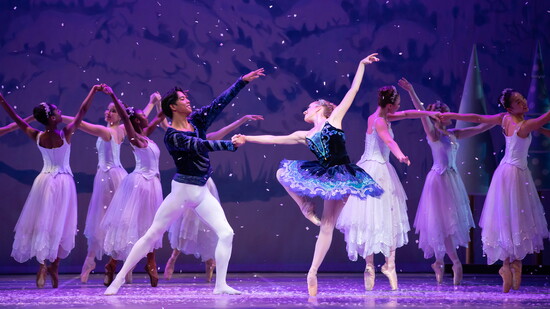
For generations of Austin families, the holidays wouldn't feel quite complete without a trip to see Ballet Austin's The Nutcracker. You get the familiar Tchaikovsky score, the anticipation as the lights dim, and, of course, that enormous Christmas tree that seems to grow right before your eyes.
This December marks the company's 64th annual production, a tradition that has become part of Austin's holiday identity. For artistic director Stephen Mills, who joined Ballet Austin as a dancer in 1987, the significance goes well beyond what happens on stage.
"We're not just a steward of the Nutcracker. We're stewards of family memories and family traditions," says Mills, who has served as artistic director for 25 years.
Mills choreographed the company's current production in 1999, and while audiences have watched it unfold hundreds of times since, he has little interest in reinventing something people love.
"The story is the story. The steps are the steps," he explains. What changes is the cast, with each dancer bringing something different to a familiar role.
This approach has served the company well. Some audience members return year after year, while others experience ballet for the first time. Mills remembers his own introduction to The Nutcracker at age 19, when he performed in a production he'd never seen.
The growing Christmas tree left him awestruck. Even today, he remembers watching the scenery transform and realizing just how extraordinary live theater could be.
He hopes every audience member, especially children, experiences that sense of wonder.
After all, as Mills points out, the story belongs to a young girl. Clara isn't simply watching the adventure unfold. She's the one who helps defeat the Rat King and sets the story in motion.
Mills sees something powerful in that.
Rather than treating Clara as a passive character swept along by events, he wants her to be the driving force behind the adventure. It's a small distinction that says quite a bit about his approach to storytelling.
And there's plenty of room for fun.
Ballet Austin's production includes playful details that returning audiences might overlook on a first viewing. The Rat King carries a butter knife and wears a platter as a chest plate. Decorations from the opening party scene grow larger as Clara's dream takes shape.
Then there's Mother Ginger, whose enormous skirt conceals a troupe of young dancers known as bonbons. Over the years, notable Austinites, including Michael Dell and former Gov. Ann Richards, have stepped into the towering costume.
The role requires far more courage than dancing.
For principal dancer Dianetzy Rojas, the magic comes from a different perspective. This season marks her third year performing the Sugar Plum Fairy, one of ballet's most recognizable roles.
Originally from Puerto Rico, Rojas began dancing at age three before earning a scholarship to the School of American Ballet in New York. She later joined Ballet Austin, where her repertoire includes the Snow Queen, Lead Flower, and the Sugar Plum Fairy.
Each role has deepened her appreciation for the people who make the production possible, from fellow dancers to the backstage crews moving scenery and preparing the stage.
She explains that the Sugar Plum Fairy requires extraordinary physical control, endurance, and precision. Much of the choreography depends on balancing and turning on one leg, all while making the movement appear effortless.
But technical skill is only part of the equation.
Rojas imagines her character as warm, confident, and elegant. With each passing season, she's become less concerned with getting through the difficult choreography and more focused on finding moments to express that personality.
Her partnership with fellow dancer Leighton Taylor has helped make that possible.
Taylor, now in his sixth season with Ballet Austin, has performed the Cavalier for five years. This will be his third year partnering with Rojas, and they've developed a familiarity neither takes for granted.
"I always say that I'm a cheerleader," Taylor says. "I adore watching [Dianetzy] dance."
Their partnership is built on trust, knowing when to support each other physically and when to let the other dancer shine.
Taylor describes the Cavalier as a more modest role than he understood it to be as a teenager. Back then, he was eager to demonstrate everything he could do. Now, he sees his job as helping the Sugar Plum Fairy command the stage.
That perspective comes with experience, and perhaps a little maturity.
For both dancers, the Austin Symphony Orchestra's live accompaniment adds another dimension. Rojas describes the difference between rehearsing with recorded music and hearing individual instruments come alive beneath the stage.
She says the music gives her goosebumps.
And while the professional dancers command much of the spotlight, the young Ballet Austin Academy students bring their own excitement to the production.
Taylor remembers being a child in Charlotte Ballet's The Nutcracker, looking up to the professional dancers sharing the stage. Rojas, too, remembers her earliest performances and the teachers in Puerto Rico who encouraged her to believe in herself.
One mentor's voice still echoes in her mind when she dances, reminding her to push herself a little further.
For Mills, those experiences are among the production's greatest rewards. Not every child on stage will become a professional dancer, but each will carry the memory of being part of something extraordinary.
After more than three decades of watching his choreography come to life, Mills still pays close attention to every performance. He watches the dancers, offers feedback, and looks for ways to help them grow.
He figures the magic isn't really meant for him anymore. It's for the people sitting in the audience, especially those seeing it for the first time.
Perhaps that's why Austin families keep returning to this iconic, timeless production.
Ballet Austin's The Nutcracker runs Dec. 4-23 at the Long Center. For tickets and performance information, visit balletaustin.org.
"We're not just a steward of the Nutcracker. We're stewards of family memories and family traditions." – Stephen Mills
"There are so many fun little things to notice that I think keep the audience engaged, and it feels like it gives it more personality." – Leighton Taylor