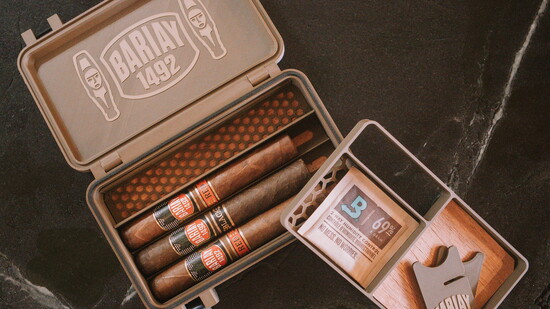
There's a ritual that happens on Friday afternoons in Fredericksburg. It doesn't have a formal name on a sign anywhere. Someone texts the group, people show up, and for a couple of hours the week exhales. Phones are set aside. Conversations take their place.
Alan Kirchoff started it alone. Just a man and a cigar on a Friday, making space to think. Then a friend joined. Then another. Now there are dozens: industry transplants and longtime locals, people whose stories would stop you mid-sentence if you heard them. They call it Fredman Friday, after a Navy SEAL frogman tradition of ending the week with a cigar and something worth raising a glass to. Kirchoff's version skips the physical challenge and goes straight to the part that matters.
“It’s not about business,” Kirchoff says. “It’s just people having a place to come unwind and get to know each other. Fredericksburg draws such interesting people, you hear their stories and you think, you did what?”
This is, it turns out, also the story of Bariay 1492.
Kirchoff is a founder and entrepreneur by background, startups, funding, operations, but the cigar brand he is building with his partner Cesar Ramirez is something harder to categorize. It is, at its core, a project about returning to origins. The name Bariay references the bay in Cuba where Columbus first encountered the Taíno people burning tobacco, not recreationally, but ceremonially. Communally. As an act of connection between people and something larger than themselves. That is the root Bariay is growing from.
The cigar itself is the result of thirty years of obsession. Cesar Ramirez, master blender and Cuban exile, developed a third fermentation process the modern industry largely avoids. What it produces is something rare, tobacco in what he calls its original state - clean, balanced and without the harshness most smokers have come to expect.
“The whole world just accepts that a cigar is going to have a bitterness,” Kirchoff says. “They know no different.”
At well under twenty dollars, it was priced that way on purpose. Cesar insisted. A premium experience, he believed, should not require a premium barrier to entry. This is tobacco for everyone, the smoke democratized, the ceremony made accessible.
But to understand why Bariay feels different from other boutique cigar brands, you must understand how Kirchoff and Cesar found each other, and what it meant when they did.
The short version involves a canceled booking, a last-minute Vegas convention and a shared smoke in a hotel lounge. The version that stays with you goes like this. Cesar was in Cuba for the first time in 30 years, 30 years since the day he left on a raft, when Kirchoff called him. He had spent decades building something the industry said could not be done and was close to walking away from it.
That night in Vegas, Kirchoff smoked Cesar's cigar and set down his own. “What are you doing differently?” He asked. Cesar smiled. A mutual friend who had been quietly observing said simply, Cesar represents ancient roots. Neither man needed to say much more.
What followed was a partnership built on alignment of values. Kirchoff brought the business architecture, funding, operations, sales and the infrastructure to make a dream a reality. Cesar brought the craft, the recipe, the process and the decades of refinement. Together with master tobacco farmer Wilfredo Ponce in Nicaragua, they are producing something genuinely rare, a boutique cigar made with full vertical integration, without mass production or compromise.
The commitment remains simple - authenticity, humility, family and staying true to the root as the business grows.
That last part, family, is where the personal and the professional become inseparable. Kirchoff's daughters, Bella and Olivia, are involved not as figureheads but as participants, learning what he calls the heart behind the work.
“I want them to know the heart,” he says. “So, when a decision comes, they can ask, does this align? If not, walk away, even if it means more money.”
The legacy play is deliberate. There are 24- to 34-year-olds discovering cigars now. They seek craft, story and a clean experience as they move away from alcohol. Kirchoff wants them to smoke Bariay for the next forty years. He wants what Padrón has, a product so consistent, so rooted in principle, that picking it up feels like a handshake across time.
There's a word that keeps surfacing, ceremonial. The Taíno used tobacco to slow down, come together and make meaning. What Kirchoff has built, through Bariay and through Fredman Friday, lives in that same spirit.
People show up on Fridays now. No agenda. Just time made on purpose, for connection and ceremony.
That's not nothing. That's the whole thing.
Bariay 1492 cigars are available locally and online at bariay1492cigar.com .