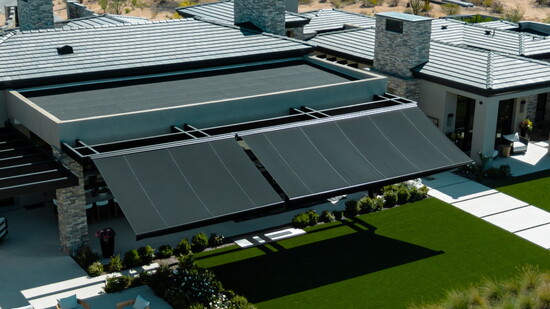
All Pro Shade Concepts has been serving Arizona homeowners for over 21 years. Founded by Arizona native Robert Mulvin in 2005, the company has grown alongside the state’s luxury real estate evolution. What drew Robert into the shade industry was simple but strategic.
“Shade isn’t just an accessory here. It’s transformational,” he says. “In Arizona, outdoor space is everything. When I saw how the right shading system could add usable square footage, protect an investment, and completely elevate the aesthetic of a home, I knew this wasn’t just another home services category. It’s lifestyle engineering.”
That mindset has kept him engaged for more than two decades. Luxury homeowners continue to push architectural boundaries. Expansive glass walls. Outdoor entertaining spaces. Motor courts. Custom steel and stone. Every estate is different. Every view matters. Every line must remain clean.
“I’m passionate about solving a complex comfort problem without disrupting the integrity of the design,” Robert explains. “When you can reduce heat by 20 degrees, preserve sightlines, and maintain a seamless aesthetic, that’s incredibly rewarding.”
When Robert steps onto a luxury property, he immediately studies what most homeowners never notice. Sun direction and seasonal shifts. Summer solstice versus winter angles. Reflection off pool water. Heat load from western-facing glass walls. He evaluates how UV exposure is quietly fading finishes and how afternoon glare is undercutting comfort.
Most affluent homeowners underestimate reflected heat. In Paradise Valley, expansive travertine, stone, water features, and large glass spans amplify ambient heat. Even when seated in shade, reflected UV can make a space unusable.
“Proper shade design controls direct sun, reflected glare, and heat load. Not just overhead sunlight,” Robert says.
At the highest end of the market, sophistication has moved beyond simple retractable solutions. The most advanced homes are investing in fully integrated, motorized shading systems that disappear architecturally. Recessed pocket installations. Concealed housings. Wind sensors. Automation integrated into the home’s control system. The goal is performance without visual intrusion. The best systems feel as though they were part of the original architectural plan.
Ultra-private estates are adding even more discreet features. Hidden drop screens integrated into structural beams. Automated wind-responsive systems. Perimeter shading for entire motor courts and outdoor entertaining areas. Climate layering that combines shade with misting, heaters, and automated louver systems that adjust throughout the day. The estate remains open-air but functions like a private resort.
The difference between a basic installation and a fully engineered shading system comes down to precision.
“Engineering,” Robert says. “Load calculations for Arizona winds. Fabric tensioning that prevents waviness. Structural integration into steel beams. Electrical pre-wiring during construction. Sensor calibration.”
A basic installation blocks sunlight. A fully engineered system protects the structure, operates flawlessly for years, and feels permanent rather than added.
Automation has raised expectations even further. At the luxury level, manual operation is no longer acceptable. Homeowners expect one-touch or fully automated control from their phone or smart system. They expect the shades to respond before they even notice the sun shift. Shade has moved from reactive to proactive.
Material innovation has also accelerated. Advanced performance fabrics now reduce heat while maintaining transparency. Slimmer cassette housings conceal stronger internal motors. Integrated wind and sun sensors adjust in real time. Powder-coated aluminum systems are engineered specifically for Arizona’s UV intensity. Today’s systems are quieter, stronger, and more architectural than they were even five years ago.
Robert sees common mistakes in multi-million-dollar homes. West-facing exposures are often underestimated. Beautiful retractable doors and expansive glass are installed without a simultaneous shade strategy. Roof overhangs are assumed to be sufficient, when in Arizona, vertical sun control is often more important than horizontal coverage.
The financial implications are significant. UV exposure fades hardwood flooring, artwork, custom cabinetry, and designer fabrics. Proper shading reduces UV penetration, lowers cooling costs, and preserves interior finishes. Over time, that protection directly impacts maintenance costs and long-term property value, particularly in seven and eight-figure homes.
“In Paradise Valley, shade is no longer a luxury addition,” Robert says. “It’s infrastructure. If you’re investing heavily in outdoor living, pools, outdoor kitchens, custom patios, shade is what makes it usable nine to ten months out of the year. Without it, even the most beautiful design underperforms.”
For those building or renovating at a high level, the most critical advice is timing.
“Plan for it early,” he says. “Integrate the shade strategy during architectural and structural design. Pre-wire for power. Plan for recessed pockets. Coordinate with steel and stucco crews. The most elegant systems are the ones that were never treated as an afterthought.”
In a market where design continues to elevate and outdoor living remains central to property value, shade has moved from accessory to asset protection strategy.
allproshadeconcepts.com