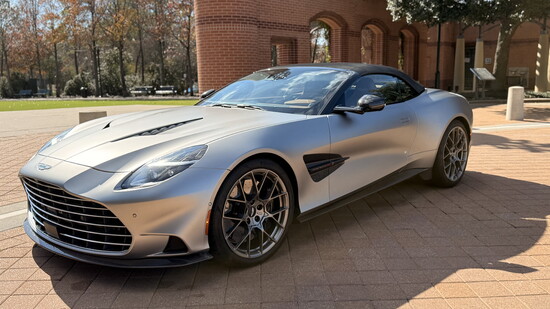
By July in Texas, the instinct to explore becomes less of a suggestion and more of a summons. The highways stretch out under hard blue skies, the evenings turn gold, and the best drives begin just as the heat loosens its grip. On the approach to America’s 250th anniversary, the 2026 Aston Martin Vanquish Volante feels unusually fitting: a British grand tourer built for the very American idea of movement, distance, independence and the open road.
That may sound lofty for a car, but Aston Martin has always traded in more than transportation. Somewhere between the DB7 Vantage of 2000 and this new Vanquish Volante, the company evolved from building beautiful performance cars into curating a broader way of living. The message is not volume—it’s taste.
The Vanquish sits at the heart of that philosophy. Not the Valkyrie, with its racing-bred extremes. Not the Valhalla, with its hybrid complexity. The Vanquish is the modern Aston Martin distilled, elegant enough for the resort entrance, powerful enough to humble nearly anything on the road, and composed enough to cross long distances without drama. Robb Report named the coupe its Car of the Year, and the logic is clear. In an era increasingly defined by electric silence and digital sameness, a front-engine, twin-turbocharged V12 still carries emotional authority.
The Volante, Aston Martin’s name for convertibles, adds open-air theatre. It arrives with 824 horsepower and 738 pound-feet of torque from a 5.2-liter twin-turbocharged V12. Aston Martin calls it the fastest and most powerful front-engine convertible in production. Numbers like that are impressive, naturally, but they are only the beginning. The appeal is how completely it understands the purpose of a grand tourer.
The Shape of Speed
You approach the Vanquish Volante from an angle. That is where the proportions announce themselves. The wheelbase has been stretched beyond the previous DBS Superleggera, the rear track is wider, and the result is muscular without becoming brutish. The hood seems impossibly long, the cabin sits far back, and the whole car carries that classic Aston posture: authority without aggression.
The front end is dramatic, anchored by a larger grille feeding air to the V12. Marek Reichman, Aston Martin’s chief creative officer, describes the shape as a shark nose, and the phrase fits. The carbon fiber hood is sculpted with purpose, the side vents pull heat from the engine bay, and the detailing has the satisfying quality of function made beautiful. Nothing feels pasted on.
The rear may be the strongest angle. The taillights create a signature unlike anything else on the road, widening the visual stance and giving the car a look you would recognize from a mile away—at night. Four substantial exhaust tips sit beneath, and the optional titanium exhaust gives the V12 a lighter, sharper note when pressed.
The convertible roof is a small piece of engineering theater. Aston’s K-fold mechanism allows the fabric top to stack neatly beneath the rear deck without spoiling the car’s lines. Raised, the eight-layer roof keeps the cabin genuinely calm, save for the low presence of the engine. Lowered, it disappears in 14 seconds. The point is not merely that it works. The point is that it vanishes from thought, which is often the mark of proper craftsmanship.
From the Driver’s Seat
Inside, the Volante is restrained rather than theatrical. The door closes with reassuring weight. The seat holds you without pinching. Materials are exactly what they should be—the leather is substantial, the carbon fiber is real, and the Alcantara-lined roof feels appropriate rather than fashionable. The steering wheel rests where it should. The pedals fall naturally beneath your feet. Before you notice the screens, you notice the driving position, and that matters.
The dashboard integrates modern technology without surrendering the cabin to it. Two 10-inch displays handle the gauges and infotainment, useful without overwhelming the architecture. Physical controls remain for climate and key driving functions, finished with the sort of knurled metal tactility that still feels superior to tapping glass. Apple CarPlay Ultra is deeply integrated, allowing core vehicle functions to sit within the familiar Apple interface. Less fiddling, more driving.
Press the starter and the V12 settles into a low rumble. The original DB7 Vantage produced 420 horsepower from a 5.9-liter V12. This new 5.2-liter engine produces nearly double that output, proof that Aston Martin’s romance has not come at the expense of engineering. The engine sits far back in the chassis, helping preserve the balance that gives the Vanquish its grand-touring composure.
In GT mode, the car behaves with impressive civility. The eight-speed ZF automatic shifts smoothly, the adaptive suspension reads the road with intelligence, and the car feels capable of devouring several states in a day. There is firmness, but not punishment. The Vanquish is always aware of its power, yet it does not make you live under constant threat from it.
The Power of Sporting
Switch to Sport mode and the tone changes. The throttle sharpens, the transmission holds gears longer, and the exhaust note opens into something more urgent. The power does not arrive as a single violent hit. It builds in a long, relentless surge, the sort of acceleration that makes speed feel less like a number and more like weather moving in.
Aston wisely limits power in the lower gears in GT mode. Sport mode removes that restraint and gives the driver more responsibility. That is part of the car’s character. It is not reckless, but neither is it sanitized. There is still a relationship to manage between your right foot, the rear tires, and common sense.
The steering is electric, and some purists will miss the texture of older hydraulic systems. What the Vanquish offers instead is accuracy. It goes where you place it, without nervousness or constant correction. Through corners, the car favors stability first, then allows the rear differential to help rotate it as power is applied. The limits are high, and the car communicates enough to remind you they still exist.
With the top down, the entire experience opens up. The V12 is no longer filtered through glass and fabric. The sky becomes part of the cabin. The road feels wider, the landscape closer, and the car more alive. The Volante gives up a little rigidity to the coupe, but what it gains in atmosphere more than justifies the trade.
A Promise Fulfilled
The Vanquish Volante is not trying to be the loudest exotic, the hardest-edged supercar, or the most technological statement. It is trying to be the definitive Aston Martin grand tourer, and in that mission it succeeds. It brings together performance, beauty, craftsmanship and distance in a way few modern cars manage.
For a July issue devoted to exploration, it is an easy car to understand. America’s roads have always carried a sense of promise, from small-town main streets to mountain passes and coastal highways. The Vanquish Volante approaches that promise with British tailoring, V12 power, and a very clear sense of occasion.
After several hundred miles with the roof up and down, in traffic and on an open highway, the Vanquish Volante occupies a rare point where luxury and performance meet without either one overwhelming the other. It is not merely fast—it is complete. And on a Texas evening, with the light glowing amber and twelve cylinders singing ahead of you, complete feels like exactly the right word.