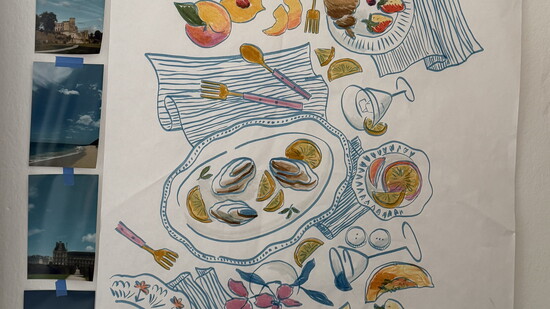
In conversations about investment, the language most often turns to growth curves, returns and expansion. Yet in creative communities, some of the most meaningful investments are quieter, measured not in acceleration, but in commitment. In Fredericksburg, artist Liza Proch represents this long view: An artist who has chosen to stay, to build and to allow her work to evolve in direct relationship with place.
Born and raised in Fredericksburg, Proch’s practice, ranging from murals and acrylic paintings to digital design and commercial collaborations, has been shaped by the textures, colors and rhythms of the Texas Hill Country. More importantly, it has been shaped by people. Her career offers a compelling case study in reciprocal investment: what happens when an artist commits to a place, and that place, in turn, commits to its artists.
For Proch, remaining rooted in her hometown has never felt like a limitation. Instead, it has functioned as a form of creative capital. “I feel like this town raised me,” she reflects. “So now all I’m doing is investing back into the community that has already given me so much.”
That investment is visible across the town - in her public mural on the exterior wall of Braveheart Boutique, in illustrations created for Enchanted Rock State Natural Area and in the way her work circulates through homes, small businesses and gathering spaces. These works operate as cultural touchpoints, reinforcing Fredericksburg’s identity not only as a destination, but as a place where creativity is lived and shared.
In a time when many artists feel pressure to leave smaller communities in order to “make it,” Proch’s experience challenges that assumption. Her choice to stay has allowed her to witness something many artists miss, the full arc of impact. “It’s not just throwing art out into the world and hoping it made a difference,” she says. “It’s the direct connection, looking someone in the eyes and knowing your work brought a little joy into their life.”
That direct connection is the return Proch values most. In a small town, the feedback loop between artist and audience is immediate and human. A collector mentions a painting at church. A neighbor recognizes a mural as they pass by. Art becomes relational rather than transactional.
From a community perspective, visibility matters. When artists are present rather than hidden or displaced, their work reinforces shared identity, inviting residents and visitors to experience Fredericksburg not just as a destination, but as a living cultural ecosystem.
In recent years, however, artists across the country have faced shrinking arts infrastructure, fewer exhibition spaces and diminished visibility. In growing towns like Fredericksburg, attention has understandably shifted toward tourism and economic development, important engines that support the local economy. Yet without balance, creative work can quietly slip to the margins.
Proch’s experience suggests the issue is not a lack of talent but a lack of pathways. “If artists don’t feel appreciated, they’ll leave,” she says plainly. Proactive support through pop-ups, shared spaces, markets and public invitations signal that creative work is not peripheral but valued.
Rather than relying solely on traditional gallery models, Proch imagines flexible and welcoming formats where pressure is low and community interaction is high. Maker markets, temporary installations and collaborations with local businesses allow artists to gather, experiment and be seen. “It’s like inviting people into your clubhouse,” she explains. “That’s where inspiration spreads.”
The Braveheart Boutique mural became a defining moment in Proch’s relationship with the town. Intended simply as a beautiful contribution to a mission-driven organization, it unexpectedly sparked a broader conversation about public art, regulation and values. The community response - diverse, vocal and deeply supportive - revealed something essential. It reminded people to say, as Proch herself put it, “Wait a second, this town is about art and supporting art. And so, while not meaning to, I feel like it brought awareness to this fact, (that) we're supposed to be standing up for art.”
Public art, by nature, carries responsibility. It speaks not only for the artist but for the place itself. Proch approaches that responsibility as stewardship, contributing to Fredericksburg’s evolving story rather than standing apart from it. “From the very beginning, people here were creating beautiful buildings and using their creativity,” she reflects. “I get to be a tiny piece of that puzzle.”
What does it look like years from now to say Fredericksburg invested wisely in its artists? According to Proch, it looks like continuity, generational creativity. A town where artists feel confident enough to take risks, knowing their community has their back. “Being grounded in a supportive place takes away some of the fear,” she explains.
Today, that grounding has given Proch the freedom to take creative risks. Her current work explores paintings on handmade paper, small-scale originals and Hill Country-inspired palettes, greens layered with yellow, moody earth tones and moments of warmth. The focus is less on expansion and more on integrity, less on volume and more on resonance.
Ultimately, her definition of success is disarmingly simple. “If one painting inspires someone else to create something beautiful, that’s everything.”
In that statement lies a powerful investment philosophy, one that recognizes art not as a luxury but as community capital. When artists like Liza Proch stay, grow and are seen, they do more than decorate a place. They help it understand itself.
Liza Proch's art can be viewed and purchased at LizaProch.com. She can be found on Instagram at @LizaProch. Her painted murals can be seen in Fredericksburg at Braveheart Unique Resale Boutique and Mesquite at the Warehouse.
“I feel like this town raised me,” Proch explains. “So now all I’m doing is investing back into the community that has already given me so much.”
“From the very beginning, people here were creating beautiful buildings and using their creativity,” Proch reflects.