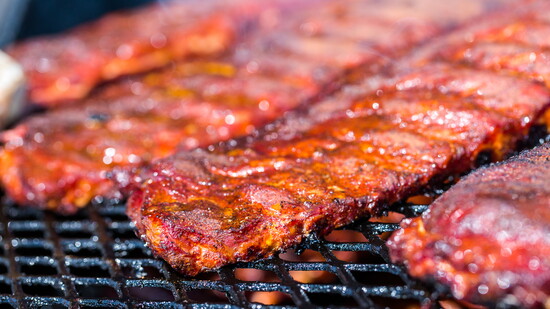
In nearly every courtroom dispute, there comes a moment when the facts are simply undeniable — when the evidence is so clear, so well-prepared, and so perfectly presented that no reasonable person could rule against you. Ladies and gentlemen of the jury, I submit to you that a properly smoked rack of baby back ribs is exactly that kind of open-and-shut case.
I’ve spent years arguing on behalf of people who couldn’t speak for themselves, and I’ve spent just as many years letting smoked pork do the talking at the table. Today, I’m here to present both arguments.
BACKGROUND
Know Your Cut: The Anatomy of the Baby Back
Before we fire up the smoker, let’s establish the record. Baby back ribs—also called loin backs—come from high along the ribcage, where the ribs meet the spine just beneath the loin. That’s the whole advantage. This is a less-worked part of the animal, which means the meat is leaner, more tender, and cleaner in flavor than the fattier spare ribs cut from the belly.
A full rack runs 11 to 13 bones and weighs around 1.5 to 2 pounds—compact, balanced, and built for low-and-slow cooking.
The “baby” refers to size, not age—the shorter, curved bones near the backbone. Don’t let the name mislead you. This is no junior varsity cut. Baby backs have anchored backyard cookouts and competition circuits for generations—approachable enough for a first attempt, but nuanced enough to spend a lifetime refining.
Historically, spare ribs were the working-class cut—richer, heavier, more forgiving. Baby backs became the premium option, eventually pushed into the spotlight by restaurant culture in the 1980s.
But real pit culture has always known: the magic isn’t in the kitchen. It’s in the smoke.
“Falling off the bone isn’t a sign of perfection — it’s a sign of overcooking. The mark of a truly great rib is meat that releases cleanly with a slight tug.”
— Counsel for the Prosecution
THEORY OF THE CASE
Why Low, Slow, and Smoke Is the Only Method Worth Arguing
There are those who oven-bake their ribs, wrap them in foil from the start, or finish them on a gas grill. I am not here to prosecute those individuals — that is between them and their conscience. What I will tell you is that if you have access to a quality ceramic kamado cooker, good hardwood, and a Sunday afternoon, there is simply no substitute for the real thing.
The science of low-and-slow smoking is well-established: cooking ribs at 225°F over several hours allows connective tissue to break down without drying the meat. The smoke isn’t just flavor — it’s chemistry. That signature pink smoke ring, just beneath the surface, is the mark of genuine pit barbecue.
The Big Green Egg — my weapon of choice — is ideally suited to the task. Its ceramic construction holds heat with remarkable consistency, and its design allows precise airflow control, meaning you can maintain 225°F for hours without constant adjustment. In the language of my trade, it is an efficient and reliable instrument.
THE METHOD
1. Remove the Membrane
Turn the rack bone-side up and remove the thin, papery membrane along the back. Left on, it becomes a chewy barrier that blocks smoke and seasoning. Slip a knife under one edge, grab it with a paper towel, and pull it off clean. It’s satisfying in a way not even a favorable verdict quite matches.
2. The Mustard Binder
Apply a thin, even coat of yellow mustard across the rack. I know what you’re thinking — mustard? Trust the process. It helps the rub adhere and tenderizes the surface. The flavor cooks off almost entirely. This is established science, and I don’t take cases I can’t win.
3. Apply the Rub
Season generously and press it in. A proper bark requires a confident hand. Use your own blend or a quality commercial rub — either way, don’t be shy.
4. Set the Heat — 225°F
Preheat your smoker or grill to 225°F with clean, steady smoke. Fruit and nut woods — apple, cherry, pecan — create a balanced, layered flavor. Once steady, place the ribs bone-side down.
5. Phase One — Leave It Alone
For the first 90 minutes, do nothing. This is where the bark sets and the smoke ring forms. Opening the lid releases heat and disrupts the process. Resist the urge.
6. Phase Two — Monitor & Spritz
After 90 minutes, begin checking every hour. Maintain 225–250°F. If the ribs look dry, lightly spritz with a mix of apple juice and water. Lightly — you’re adding moisture, not undoing your work.
7. The Finish
Around hour four or five, the ribs will tell you they’re ready. The meat pulls back from the bones, and the rack flexes when lifted. Brush with sauce, raise heat to 250–275°F, and let it set. Perform the bend test: the rack should flex and slightly crack — but not fall apart. That’s your signal. Pull them.
THE VERDICT
Let’s address a persistent myth: “falling off the bone” is not perfection — it’s overcooking.
The mark of a great rib is one clean bite, a slight tug, and meat that releases cleanly while still holding structure. Tender, but not mush. The bark intact. The smoke ring visible. The sauce lacquered, not drowning.
That’s the standard. That’s what we’re after.
I’ve presented my evidence. The record is complete.
I rest my case — and then I eat it.
ATTORNEY AT SLAW ✦ PIT & PRECEDENT
Trent Swift is a Partner at Lytal, Reiter, Smith, Ivey & Fronrath in West Palm Beach, where he focuses on personal injury and civil litigation. When he’s not in the courtroom, he can be found at the grill, making a compelling case for low-and-slow barbecue.
Next Issue: The Brisket Brief — Building a Bark That Holds Up on Appeal