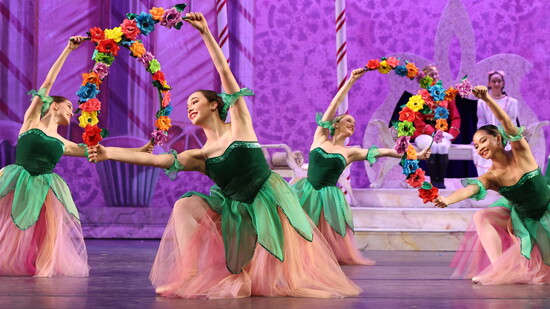
Ballet Tucson is marking its 40th anniversary season not by looking back, but by looking forward.
As Southern Arizona's only professional ballet company celebrates four decades of artistry, education and community impact, Artistic Director Margaret Mullin is treating the milestone as a launching point rather than a retrospective. The result is a 2026-27 season that honors the company's legacy while expanding its artistic horizons.
"It feels like a huge testament to how far we've come," Mullin says. "Tucson wants to maintain its vibrant arts and culture scene, and Ballet Tucson has been fortunate to have a community that continues to stand by us and help us grow."
In a post-pandemic arts landscape where many organizations struggled to survive, Ballet Tucson has continued to thrive, attracting new audiences and expanding its repertoire. Now entering her fifth season as artistic director, Mullin sees the anniversary season as a celebration of momentum.
"We're celebrating that this company is alive, thriving, and growing," she says. "The art form is alive, thriving, and growing, and the same is true for our artists."
The season opens September 11 with Steps Forward, Ballet Tucson's popular choreographers' showcase at Berger Performing Arts Center. The one-night event highlights original works by company dancers, with audiences voting for their favorite piece; the winner earns an encore later in the season.
"Steps Forward is an artistic incubator," Mullin explains. "It gives dancers opportunities to explore, create and develop their own voices as choreographers."
In October, Spirit Garden and Other Works returns to the Temple of Music and Art, featuring the revival of Chieko Imada's Día de los Muertos-inspired Spirit Garden, with artwork by Lawrence Lee and music by Calexico and guitarist Misael Barraza-Diaz.
The program also includes a world premiere celebrating Ballet Tucson's 40-year history. Titled Ovation, the work is created collaboratively by Mullin, Associate Artistic Director and Resident Choreographer Chieko Imada, and Rehearsal Director Brik Middlekauff. It brings together company members and students from Ballet Tucson's school, underscoring the organization's commitment to developing future dancers.
That link between school and company is personal for Mullin, who began her own training as a Ballet Tucson student.
"It's important to me that our students experience the same quality of training and the same environment that made me fall in love with dance," she says. "Having professional dancers in the same building is transformative. It was for me."
The holidays bring back one of Tucson's most cherished traditions: The Nutcracker, presented with the Tucson Symphony Orchestra at Linda Ronstadt Music Hall in December, combining lavish sets and costumes with Tchaikovsky's score performed live.
The anniversary season continues in February with Carmen and Other Works, showcasing three major company premieres. Among them is George Balanchine's Emeralds, which Mullin calls "opulent, lush and fantastically beautiful," and the Tucson debut of Debonair by three-time Tony winner Justin Peck, inspired by Fred Astaire and Ginger Rogers. Mullin once originated a leading role in the piece.
"The fact that Justin continues to support Ballet Tucson means so much," she says. "He believes in what we're building here."
The program closes with a world premiere of Carmen, choreographed by Imada with the Tucson Desert Song Festival, featuring new artwork by Lawrence Lee and live music led by Khris Dodge.
The season concludes in April with Appalachian Spring and Other Works, blending classical favorites with contemporary creativity: Mullin's Sobre las Olas, Imada's Don Quixote Grand Pas de Deux, and the premiere of Interim by company dancer Brooke Amundrud. The finale is Andrea Schermoly's Appalachian Spring, set to Aaron Copland's score.
For Mullin, the season reflects the company's mission to expand perceptions of ballet.
"My favorite thing is when someone leaves a performance and says, 'I didn't realize ballet could be like this,'" she says. "That's exactly what we want... the range, the versatility and the excitement of what ballet can be."
Forty years after its founding, Ballet Tucson is honoring its roots while stepping confidently into the future—one performance, one artist and one audience member at a time.