Baseball has always been America’s favorite pastime, but for a lot of dads, it’s something quieter than that. It’s time you don’t get back.
It’s the sound of a ball hitting a glove as the sun starts to set, a bucket of baseballs and a kid who wants to throw just one more, showing up again and again long after the workday ends because you know one day it won’t be there.
For Danny Openden, that’s what it became.
By day, Danny leads the Southwest Autism Research & Resource Center, an organization he’s spent nearly two decades helping build into one of the most impactful in the country. His work has helped shape Phoenix into what PBS once called “the most autism-friendly city in the world.”
But in the evenings and on weekends, he traded boardrooms for a baseball field, coaching and helping lead Arcadia Little League, pouring that same level of intention into a completely different kind of work.
“I don’t think anything is more important than giving your kids your time,” he says.
That belief is what set everything in motion.
Years ago, after watching his oldest son play under a coach who wasn’t setting the right example, Danny and his wife made a decision.
“We decided we needed to either stop complaining or do something about it,” he says. “So I started coaching.”
At the time, he had just stepped into his role as CEO. The schedule wasn’t forgiving. The timing wasn’t ideal. But a friend gave him advice that stayed with him.
You have to coach now. At some point, your kids are going to need a better coach than you. And you can’t get that time back.
What started as a way to be present for his sons became something much bigger, not just for his family, but for a group of boys growing up together on the same Arcadia fields.
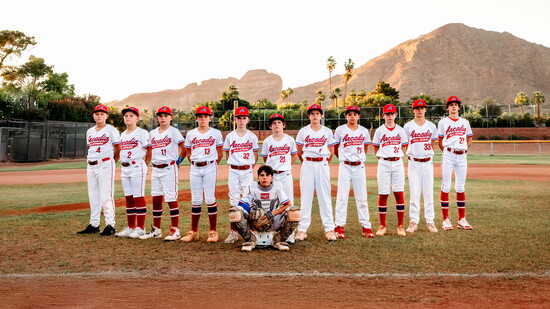
Danny's youngest son, Cody, was right there in it, catching, competing, learning alongside his teammates, not just from his dad, but with him.
The team came together in the summer of 2023, a group of ten-year-old All-Stars with talent, energy, and potential. But what stood out first wasn’t the roster.
“We had incredible parents," Danny says.
At practices, it wasn’t just twelve boys on the field. It was fathers stepping in, helping run drills, setting up stations, and making sure every kid was getting reps.
“It created structure and consistency, but more importantly, it created connection.”
It wasn’t about winning at all costs. But they won anyway.
By the time they reached their 12U season, something had shifted. They had been together long enough to trust each other and to believe they could compete with anyone.
That belief was tested against Rincon, a team they knew well and one that had beaten them before.
They built an early lead, watched it shrink, and then found themselves down 7-5 in the final inning with two outs and their season on the line.
“I remember it was an inside fastball that I turned on,” Will says. “It was cool to look over at my teammates from second base screaming 'let’s go.'”
“I remember the diving plays,” Max says. “And when Cole threw someone out at home from the outfield.”
The game tied.
And then it ended just as quickly.
“I hit a walk-off double,” Chase says. “I just remember realizing we were going to the state championship and I was so happy we beat our rivals.”
The final was 8-7, a game Danny calls the most emotionally draining he’s ever been part of, and one that defined what that team had become.
They went on to win the state championship again.
“Closing out that last game, I felt on top of the world,” Cole says.
That win sent them to San Bernardino for the West Region Tournament, one step away from the Little League World Series, and the environment changed immediately.
A real stadium. National competition. Games televised on ESPN.
Everything about it felt bigger.
“The first at-bat in that first game was intense,” Cole says. “I was leading off and I could feel it.”
“The first time we took the field was crazy,” Cody says. “None of us had ever played on a field that good.”
The pressure was real and immediate.
“It was second and third, two outs, their best hitter up,” Cody says. “It was crazy pressure but we were all locked in.”
They had a real chance.
And then the game reminded them how it works.
“When we lost, everyone was silent,” Chase says. “It humbled me. It showed me all good things must come to an end.”
That could have been the end of the story. But it wasn’t.
During that run, a man named Tony Kao kept showing up to games, first as a spectator, then as a supporter, and eventually with an idea that didn’t quite seem real.
He wanted to connect Arcadia Little League with Taiwan through baseball.
At first it sounded far-fetched. Until it wasn’t.
Families committed. Logistics came together. And before long, a group of kids from Arcadia were boarding a plane to the other side of the world.
What they walked into was something far beyond what they expected.
Opening ceremonies with music and dragon dancers. Mayors throwing ceremonial first pitches. Media coverage. Crowds.
“Insane,” Chase says. “Like nothing I had ever experienced.”
But the moments that stayed weren’t just the big ones. They were the ones in between.
Sitting at dinner across from kids who spoke a different language trying to figure out how to communicate, laughing anyway.
“When we were talking to kids in Taiwan using Google Translate, it showed me how lucky we are,” Chase says.
“We saw all this cool stuff,” Will says. “Temples, food, things we’d never seen before.”
“They would just bring out plate after plate,” he says. “Some of it was good. Some of it wasn’t.”
But they tried it anyway.
Together.
There were moments you could feel building before they happened.
“The dugout before a big game,” Liam says. “Everyone was quiet and focused. You could feel how important it was.”
And then just as quickly, it would flip... a dugout coming alive.
Even in games they didn’t win, the memories stayed.
“I jumped up and caught a line drive and doubled a guy off,” Will says.
Taiwan changed something, not just in the experience, but in perspective.
“The way we were treated was crazy,” Cody says. “We had buses, reserved tables, everything ready for us.”
Somewhere along the way, without anyone really saying it out loud, the boys learned something bigger than the game itself: that baseball is its own language.
One that doesn’t need translation. One that moves easily from a field in Arcadia to a stadium in California to a night in Taiwan, where kids who don’t share a single word still find a way to laugh, compete, and understand each other.
A language built on instinct, rhythm, and trust.
And still, just a moment in time.
“Both boys have aged out of Little League, and like every parent who has lived it, it goes fast,” Danny says.