What comes to mind when you pass the “Blue Springs” sign as you drive down I-70, or when someone asks you to tell you about the place you call home?
Maybe you think of the top-tier schools or local parks you’ve enjoyed with family and friends. Perhaps a specific event, business, or restaurant comes to mind.
For many years, Blue Springs has been described as a “bedroom community”— a place where people live and sleep, but commute elsewhere for work. But to the people that call this town home, it is much more than that. If you look beyond the neighborhoods, growing businesses, and busy roads, there is a rich history that helped shape the community we know today.
Every town has a story, and Blue Springs’ story began long before it became the city we recognize today.
This year, the Blue Springs Historical Society is celebrating its 50th Anniversary. Since 1976, the organization has been preserving the foundations of our community, proving that Blue Springs is, and always has been, much more than a place where commuters simply come home at the end of the day to sleep.
You have probably heard the saying that in order to understand the present, we have to learn from the past. Long before the Adams Dairy Landing on Coronado, the traffic along 7 Highway or the cars traveling on 40 Highway, Blue Springs looked a lot different.
Blue Springs Before the City
Long before Blue Springs existed, wagons traveling west on the Santa Fe Trail would stop here for the natural springs. Travelers would refill water barrels before continuing on their journey westward.
“We’ve found this to be a stopping point for many travelers to get fresh water before continuing their journey west,” Kay Burrus, Archivist of the Blue Springs Historical Society shared. “Many travelers stopped near Little Blue or camped near the cliffs and springs by the Blue Springs Cemetery.”
The first family to permanently settle in what is now the area across from Burrus Old Mill Park, was William and Rhoda Harris in 1832. A few years later, George and Elizabeth Burrus arrived and decided to also call this area home. Like with our city today, more families began arriving and the settlement slowly started growing.
Rhoda Harris became well-known throughout the community. “She was a midwife and herbal healer, using plants and herbs she grew to care for sick neighbors and traveling families,” Kay said.
A Name for the Town
Many years had passed, and in 1845 Franklin Smith built the first combined post office and general store. Having a post office meant there needed to be an official name. After discussion among many of the residents, the settlement became known as “Blue Springs,” named after the natural spring and waters that flowed into Little Blue River, which is the original reason many families stopped here on their journey. Over time the community started to grow, more families settled down, building farms and homes. It developed into a thriving community.
Rebuilding & Growth
Like many communities throughout Missouri, Blue Springs faced many challenges during the Civil War. Areas surrounding Little Blue were damaged or destroyed, leaving families to rebuild homes, farms and businesses in the years that followed.
Only two structures were left standing after the destruction. One of which was the Jeremiah Woods house on Walnut Street, which still stands today reminding us of our community's history.
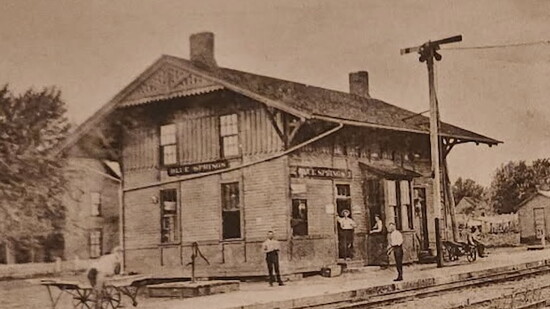
As the town began to rebuild, the Chicago and Alton Railroad arrived and began laying tracks a mile east of the original settlement in 1878.
“At the time, the heart of Blue Springs was where Burrus Old Mill Park is located,” Kay explained. “But the trains caused businesses and residents to move to ‘new town’ because the steam engines could not make it up the hill.”
As residents and businesses moved closer to the railroad, the heart of Blue Springs became what we now know as Main Street today. With all the activity that was happening in Blue Springs, on September 7, 1880, Blue Springs officially became a city.
Today, many people pass through Blue Springs without realizing how much history exists beneath the streets they travel every day. Some of the roads, neighborhoods and historic sites still remain, tying present-day Blue Springs to the people who first built the community.
In the coming issues, we will continue exploring how Blue Springs continued to grow and gradually transformed into the community residents know today.
We encourage and invite you to also take a closer look at the places you pass every day and uncover the history of how a small settlement grew and helped shape Blue Springs into the city it is today.
Photos and historical information provided by the Blue Springs Historical Society.
“The history of Blue Springs is not just found in museums or old photographs. It still exists in the roads, buildings and neighborhoods around us.”