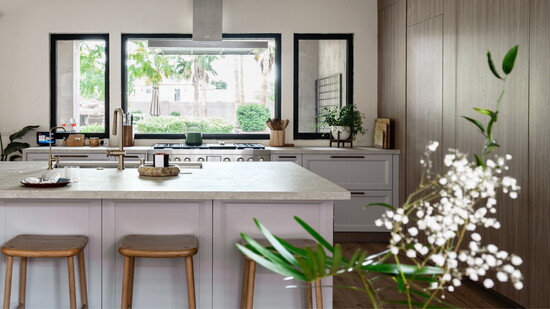
Interior designer Alex Pevtsova of Pif. Design Studio doesn’t create luxury for the sake of luxury — she believes a home must reflect the daily rhythms of those who live in it.
“Everything we do starts from function,” Pevtsova says. “Beauty is really just the byproduct.”
A first-generation American, Pevtsova arrived at preschool without speaking English. She remembers not even knowing how to ask where to find a restroom. The experience made her an observer, watching how her classmates behaved and responded to their surroundings.
Years later, she's still observing people. As an interior designer, she watches how families move through their spaces, such as kitchens and hallways, to understand where their homes are helping them and where they're not serving their lives.
But observation isn’t her only skill set. Once a competitive pole vaulter, Pevtsova says she used to train six to eight hours a day. Now she brings this same discipline to how she plans a project, including communication with contractors and tradespeople, and determining if a design aligns with how clients actually move throughout their day.
“We ask them to walk us through a typical morning,” she says.
That question reveals more than a list of preferences ever could. A spouse will point out where someone is always in the way, while children chime in about what they dislike. Pevtsova learns whether the family eats breakfast together, who drinks coffee, where routines break down, and which parts of the home add tension.
“That one conversation tells us so much,” she said. “We learn the dynamics of how they actually live, and that’s really the starting point for everything.”
Sometimes the solution is wonderfully custom. In one recent primary bathroom, a husband admitted he hated seeing the many care products his wife kept in the shower. Pevtsova designed custom angled shelves that, from the outside, concealed the products entirely. But inside? Every bottle remained easy to reach.
Pevtsova defines luxury as anticipation, comparing it to an upscale hotel where a valet is ready before you ask, and someone appears with a luggage cart because they already know where you’ll be moving next.
“We try to anticipate what it is that you’re going to need,” she said. “What is it that might cause you an issue that we can design out of the house entirely?”
That includes circadian lighting to mimic the sun’s changing color temperature throughout the day. In rooms that don’t have enough natural light, LED strips or specialized bulbs can create the effect, providing brighter light during the day and warmer light later to help the body wind down.
Some of her favorite recommendations are ones easily overlooked.
Pevtsova finds that solid brass light switches make a huge difference in a home without breaking the bank. They feel substantial and click well, and people touch them dozens of times a day.
“It doesn’t scream, ‘Hey, we spent a lot of money here,’” she says. “But it gives that body… this is permanent. This is real.”
Dimmers and solid door hardware do the same. In one project, every door had a weighty brass or bronze handle except the primary bedroom, where the owners kept an inexpensive knob. Pevtsova suspected they would notice the difference.
Her anticipation was, true to form, spot on. Within weeks, they ordered a replacement.
“When everything else feels great to hold and turn, and then you come to your primary bedroom handle, and it feels like a paperclip, you notice,” she says.
For Pevtsova, a successful home is one that supports the person living there so naturally that the design almost disappears, just as she says good lighting should.
“I want it to feel like an exhale,” she says. “Nothing pushing against you. Nothing in your way.”
Website: pifdesignstudio.com
“Everything we do starts from function,” Pevtsova says. “Beauty is really just the byproduct.”