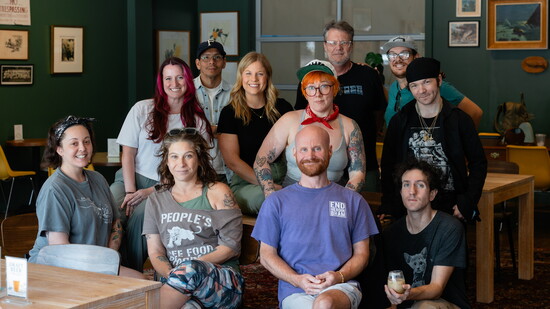
The forward-facing side of the hospitality world is enthralling: farm-to-table cuisine, aproned chefs visiting tables of effusive diners, the dance of servers and an overflow of conviviality. The “Front of the House” looks magical. Behind the scenes, there is fire, heat, emotions running at full throttle. The desire to outperform, to exceed expectations, to succeed in the fast-paced, hard-driving world of hospitality—the “Back of the House”—can be grueling. Sometimes, in the need to turn it all off, alcohol becomes the crutch that gets you through another shift. And for some, the crutch becomes the downfall. That was the case with Ben Murray, who suddenly passed away after a night of professional success.
Out of that tragedy came Ben’s Friends, a nonprofit organization founded by two of Ben’s colleagues, Mickey Bakst and Steve Palmer. They understood the unique pressures of restaurant life and developed a program intentionally geared to these professionals. With more than 20 chapters nationwide—and Zoom calls available from anywhere—Ben’s Friends offers support to hospitality professionals seeking a better way to work and live. As their mission states: “A significant number of people currently working in the food and beverage industry have self-identified as struggling with substance abuse. Ben’s Friends exists to offer hope, healing, and the tools of recovery to fight this epidemic plaguing our community. Our work is guided by six pillars: We, honesty, acceptance, gratitude, service, and hope.”
Here in Birmingham, meetings are offered each Monday at 1:00 p.m. at Bruto Restaurant. Referred to as PreShift, this is a safe place to share and receive support. Here we highlight a few of the many Birmingham hospitality workers who have embraced a sober life and found support through Ben’s Friends. For more: IG @preshiftbham and @bensfriendshope
Ramon Gonzales — Local Chef of a Michelin Bib Gourmand restaurant
Ramon’s path to sobriety didn’t begin in a bar, but in a pulpit. He came to Florence, Alabama, from Peru to study ministry and became a preacher. When his first marriage collapsed under the strain of distance, finances, and isolation from family, he left the church and found a new identity in restaurant kitchens. Starting as a line cook, he quickly rose through the ranks, discovering both his passion and a new kind of community among “the misfits” of the industry.
That same community normalized the one thing that slowly took over his life: alcohol. Ramon seemed like he was fine, but was struggling.
In 2020, during COVID-19, his wife uncovered the true extent of his drinking. Her ultimatum—get help or lose her forever—became the “gift of desperation” he needed. Ramon entered a 21-day treatment program, followed by AA and the Twelve Steps. He hasn’t had a drink since October 28, 2020.
Today, being sober in hospitality means working in an environment saturated with alcohol and temptation, yet he calls his sobriety a “superpower.” Discovering Ben’s Friends in Birmingham felt like finally finding an industry-specific extension of AA: a room where chefs, cooks, and servers speak the same language of tickets, service, and addiction. For Ramon, Ben’s Friends offers what he once searched for in a bottle—belonging, understanding, and proof that you can stay sober and still thrive in the kitchen.
Daniel Goslin — Director of Operations, Helen and Bayonet
Daniel Goslin built his career around the rituals of the table: the pop of a cork, the cadence of service, the alchemy of pairing food and wine. After cutting his teeth in restaurants during college, he found his stride at SpringHouse, where he moved from serving to managing and earned his Level One sommelier certification. Wine became not just part of the job, but a professional identity and a daily habit. By the time he joined the team at Helen in Birmingham, that habit had quietly taken over more space in his life than he was comfortable admitting.
There was no dramatic rock bottom, no single incident that forced his hand—just an unignorable awareness. The drinking had become every night, much of it alone, and when he tried to stop, he found he simply couldn’t. That realization, more than any crisis, pushed him to seek help and begin his journey of recovery in August 2021. “I am grateful to work with a team that supports my sobriety in a positive way.”
For Daniel, Ben’s Friends offered what he needed most: community and language around sobriety that made sense in the hospitality world. He didn’t go through AA; instead, Ben’s Friends gave him a room full of people who understood late nights, heavy pours, and the pressure to always say yes. It made sobriety feel not like a rejection of his career, but a way to continue it with clarity, integrity, and a renewed sense of purpose, beyond the dining table.
Katelyn Galbreath Whitmore — Manager, Bottega, Stitt Restaurant Group
Katelyn Whitmore has spent more than a decade in restaurants, now serving as front-of-house manager at Bottega, part of Stitt Restaurant Group (SRG). Long before joining SRG in 2021, she held roles in other restaurants, where drinking during and after a shift felt normal—even expected. “I was a good time,” she says now, but admits, “It was only when I went home that the good times went away.” Daily substance use stayed hidden from her family until her then-boyfriend (now husband) called her mother and laid everything bare. Given an ultimatum—get sober or be forced into it—Katelyn flushed her drugs and hasn’t used since August 2017.
The idea for PreShift percolated from a thought she shared with others, “How do you work at a restaurant if you want to live a sober life?” Together, they founded the group which later merged with Ben’s Friends, sharing a common mission. In these weekly meetings filled with industry peers, there is connection and community, support and encouragement. Together, they find a way to thrive in the beloved chaos of service, lead teams and build a life in hospitality without losing themselves in the process.
For Ramon, Ben’s Friends offers what he once searched for in a bottle—belonging, understanding, and proof that you can stay sober and still thrive in the kitchen.
I was a good time. It was only when I went home that the good times went away. - Katelyn Galbreath Whitmore