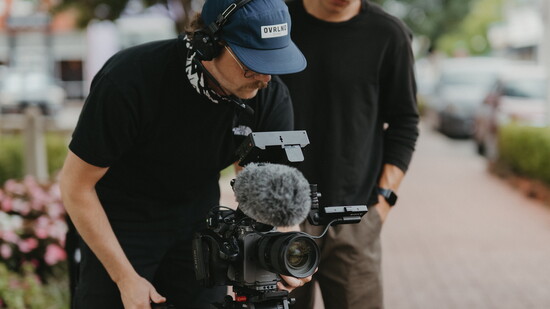
The truth about what I do is a little nuanced.
I may say I’m a documentary filmmaker, State Commissioner, or Parks and Rec Board Chair, but through it all, what I’m really doing is building relationships. I help people meet each other. I connect those with an idea to those with a resource. Sometimes I am performing. Sometimes I am observing. But mostly, I am paying attention.
When I was first asked to share my thoughts on the creative industry in Bentonville, my initial reactions were, “Why me?” and “What exactly do we mean by ‘creative’?”
That’s the thing about creativity and people whose work gets labeled as “creative”: it rarely fits into a neat definition. Creativity resists borders. It moves between disciplines and professions, appearing in places we don’t always expect. Filmmakers, entrepreneurs, chefs, architects, trail builders, musicians, scientists, mathematicians—creativity lives in all of them.
Steve Jobs once said, “Creativity is just connecting things.” And those connections rarely happen in isolation. They happen in proximity—in conversations, collaborations, shared spaces, and chance encounters between people working on entirely different problems. Over time, those connections begin to accumulate. They build.
Each person contributes something small: an idea, a project, a gathering, a space, a story. Individually, those contributions may seem modest, but together they form the structure that allows the next generation of thinkers, makers, and builders to see a little further and go a little farther.
What’s happening in Bentonville today feels familiar to something we have seen before. The early signs of a place where ideas begin to accumulate. Where conversations turn into projects. Where projects turn into movements. But movements like this are often difficult to recognize while you’re living in them.
Think about Paris in the 1880s.
Do you think Parisians of this period woke up and went about their everyday lives appreciating just how special a time and place they found themselves in? That in the coming decades, artists such as Picasso and Matisse would emerge, and that once the break from realism occurred, a flood of modern expression would follow?
Or Detroit in the early 20th century, where the creative outputs in industrial design, mass production systems, and modern manufacturing would create an automobile revolution? Cambridge in the early 20th century—no, not that Cambridge, the other one—or, for that matter, both of them—where breakthroughs in physics, mathematics, and early computing were beginning to change the scientific world.
Turn-of-the-century Vienna, where modern art, architecture, and psychoanalysis were emerging side by side; 1970s Silicon Valley, where hobbyists and engineers would spark the personal computer revolution; or 1920s Harlem, where a renaissance of music, literature, and Black cultural expression transformed American arts. And, of course, the Delta between the 1920s and 1950s, where the blues took shape and laid the foundation for much of modern music.
I firmly believe Bentonville, Arkansas, is one of those places.
And this may be one of those times.
Maybe it is just a feeling. A feeling that when enough people share it, and they start to believe, then that feeling - that belief - becomes a reality.
As I go about my days in Bentonville, I encounter transplants who chose to move here for opportunity, sitting alongside locals who chose to stay here because they appreciate the history, tradition, and beauty of the region. I see spaces being built and cultivated that give rise to intentional interaction. Some of those spaces are grand in scale—ride your bike up and down J Street if you need any example—while others are quieter, woven gently into the natural landscape.
At the Compton, sipping coffee, I hear conversations that move effortlessly from global trade and supply chains to local flora and the best trail to walk if you want to see the newest guerrilla art installation in the woods. I see families exploring wildlife in the creeks and young adults getting that first taste of freedom, riding bikes to gather on the downtown square.
I see innovation at every huddle space and along trailheads. I hear whispers of brilliance and revolutionary ideas whistle through town like the spring winds that visit us every year. Sometimes these ideas emanate from conference rooms and board meetings, and sometimes they appear unexpectedly at a splash pad or on a group ride. I smell the faint aromas coming from the kitchens of the multiple James Beard finalists scattered across the town and wonder how their expression of love and community is going to inspire the next culinary delight.
I see, hear, and smell this all as I participate in this town. I go about my daily life feeling pulled into a vortex of kinetic energy that can only occur when you combine the physical infrastructure, natural beauty, and the array of people.
Each person adds something small—a story, a gathering, a trail, a restaurant, a company, a piece of art. Individually, those contributions may seem modest. But together they create the structure that allows the next generation of creatives to see further, build further, and imagine something none of us could have built alone.
Creatives. Creators.
And who knows—maybe 75 years from now, some sixth-grader will be writing a world history essay about the cultural inflection point known as Bentonville in the 20’s.
After all, crazier things have happened–someone once decided to build a world-class art museum in Arkansas, of all places.
Allyson de la Houssaye
AWAL Productions
www.awalproductions.com
Allyson is a documentary filmmaker and founder of AWAL Productions, a Bentonville-based production company that collaborates with creatives, local organizations, and corporate partners on projects ranging from outdoor documentaries to branded storytelling.
What’s happening in Bentonville today feels familiar to something we have seen before. A place where ideas begin to accumulate. Where projects turn into movements.