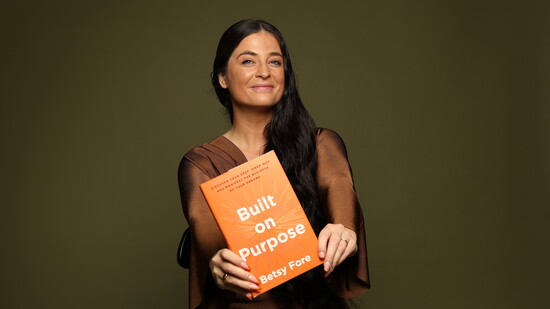
Entrepreneurship has always rewarded vision, grit and a tolerance for risk. In “Built on Purpose,” released late last year, founder and investor Betsy Fore argues that what most founders overlook is far less visible and far more consequential. The real work, she insists, begins inward.
Fore has built and exited multiple companies, including Tiny Organics, which reached more than $13 million in revenue within its first two years. The success looks conventional on paper. The method behind it is not. Her “Deep Inner Why Method” blends business fundamentals with neuroscience, meditation and values work, urging founders to align how they build with who they are.
“Founders are natural doers,” Fore said. “You build, iterate, leap before everything is ready. But the most important relationship you ever have is with yourself.” It took her years, and burnout, to learn that lesson.
In the book, Fore guides readers through identifying the values that already shape their decisions, drawing in part from the Seven Grandfather Teachings of her Anishinaabe and Turtle Mountain Chippewa heritage. Rather than aspirational slogans, values become lived experiences. She asks founders to recall moments when they embodied courage, humility or wisdom and to build from that place.
That inner alignment, she argues, is not soft thinking. It is survival. Most founders experience burnout within five years. Fore believes many companies falter not because the idea was wrong, but because the founder lost the will to stay in the arena.
One of the book’s most practical ideas is the concept of “first believers.” When launching Tiny Organics, Fore invited a small group of parents to help co-create the product before there was branding or scale. Those early believers shaped the roadmap and spread the story organically. The same approach, she argues, works in any industry, starting locally and building trust one relationship at a time.
Only later does Fore mention that she lives in Wilmette, raising three children while launching a venture capital fund alongside the book. The detail feels incidental. What matters more is her conviction that companies are canvases, not identities. “We are not the company,” she said. “We are the ones entrusted to build it.”