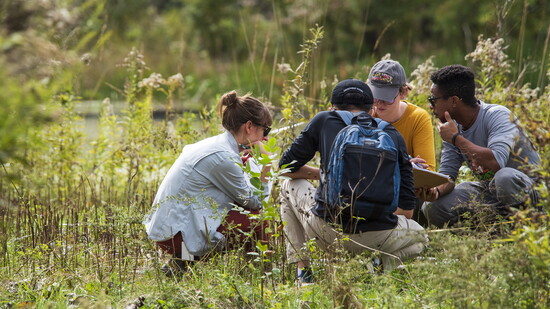
For many longtime members, the Chicago Botanic Garden lives in a familiar register. It’s where seasons announce themselves with tulips or asters, where grandchildren learn the difference between oak and maple, where a Saturday afternoon can unfold without agenda. Beauty, yes. Calm, certainly. But that picture, however cherished, is incomplete.
What most visitors don’t see from the paths in Glencoe is the scale of work unfolding well beyond the borders. Behind the displays and lagoons, the Garden has been steadily evolving into something more muscular and more urgent. It is a civic actor, a scientific institution and, increasingly, a driver of social and environmental change across Chicago and far beyond it.
Two initiatives sit at the heart of that shift: Windy City Harvest and the Negaunee Institute. One works in neighborhoods where food access and opportunity have long been uneven. The other is focused on the planet’s most elemental question: how to keep life, quite literally, from disappearing.
For members who think they already know the Garden, these programs tend to land as a surprise, which is precisely the point. One that often sparks a deeper curiosity.
A Garden That Grew Up
Since opening more than fifty years ago, the Chicago Botanic Garden has matured into a world-renowned living museum. The transformation did not happen all at once. It happened by necessity. Climate pressures intensified. Biodiversity declined. Food insecurity remained stubbornly present across Chicago’s South and West Sides. A public garden that wanted to matter in the twenty-first century could no longer limit itself to display.
Today, the Garden functions as a place of learning, yes, but also as a hub for science, education, conservation and community impact. It’s still beautiful. It’s also very busy.
“By ensuring an already engaged audience is knowledgeable about the breadth of our work, we can build capacity for our programs and continue to grow a better world for years to come,” says Gwen VanderBurg, vice president of marketing and communications, Chicago Botanic Garden.
That breadth is easiest to understand by starting not in Glencoe, but on a once-vacant lot on the West Side of Chicago.
Urban Agriculture as Civic Work
Windy City Harvest began years ago as youth-focused education. It now operates as a sophisticated urban agriculture and workforce development engine. Across a network of farms and gardens on the South and West Sides, land that once signaled abandonment has been turned into something else entirely: productive, welcoming, alive.
On any given day, participants are planting, harvesting, learning food safety protocols, earning certifications and building job skills that travel well beyond agriculture. The existence alone matters.
“The presence of program participants working on our network of urban farms is a visible signal that neighborhoods on the West and South Sides of Chicago are worth investing in,” says Britt Calendo, program director, Windy City Harvest, Chicago Botanic Garden. “What was once empty or underutilized land becomes something productive and welcoming. That shift creates a different sense of possibility.”
That possibility is not abstract. Green, well-maintained spaces reduce stress. They change how people move through their blocks. They prompt conversations. Neighbors stop to ask questions. Children watch the growing cycle. Curiosity spreads. Plants do what they have always done best. They connect people to place.
At its core, Windy City Harvest is built on the idea that agriculture is not only about food. It is about health, dignity and economic mobility.
From First Paychecks to Ownership
The program’s structure reflects that belief. Youth development introduces teens to employment and responsibility. Corps programs help participants identify strengths and build transferable workplace skills. Apprenticeships, offered in partnership with the City Colleges of Chicago, provide paid, hands-on training in sustainable urban agriculture. Farm Incubator programs support graduates as they launch and grow their own farm businesses.
For some, the trajectory is dramatic. One apprentice entered as a beginning farmer and now operates an expanding business growing culturally meaningful crops. With support from a land access partner, the farmer is working toward long-term ownership. This is not hobby farming. It is enterprise.
Participants leave with certifications in food safety, experience in production and processing and a working understanding of how produce moves from soil to market. These are skills local food systems need. They create access to steady income and, over time, generational wealth.
They also help address another stubborn challenge: food access.
Feeding Communities, Directly
Each year, Windy City Harvest grows more than 65,000 pounds of produce using organic methods. Most of it stays where it is grown. Food pantries. The VeggieRx program. Food-service partnerships. The Farm on Ogden Market in North Lawndale.
“The communities on the South and West Sides benefit most directly from our food production efforts,” says Samantha Creightney, operations director, Windy City Harvest, Chicago Botanic Garden.
VeggieRx, in particular, sits at the intersection of agriculture and health, connecting fresh produce to people managing diet-related illness or food insecurity. The program’s leaders talk openly about social determinants of health, about the reality that wellness does not begin and end in a clinic.
None of this works without partnerships. Windy City Harvest collaborates with public agencies, schools, community organizations and businesses already trusted in the neighborhoods they serve.
“Partnerships help connect the programs with organizations already embedded in and trusted by the community,” Calendo says. “They also help build capacity by training individuals who bring that knowledge back home.”
What often surprises Garden members is not just the impact, but the scale.
“Garden members may be surprised that a public garden has an urban agriculture division operating at this level,” says Sarah Leff, director of strategy and growth, Windy City Harvest, Chicago Botanic Garden. “The Windy City Harvest model is looked to by other institutions for best practices.”
While Windy City Harvest addresses immediate human needs, another arm of the Garden is focused on something more existential.
Science With a Long View
The Negaunee Institute exists to answer a difficult question: how do we prevent the quiet disappearance of the plant life that makes everything else possible.
Its work centers on four priorities: preventing extinctions, restoring damaged ecosystems, increasing access to native seed and training future conservation leaders.
“The dual threats of biodiversity loss and climate change drive our work,” says Kay Havens, chief scientist and Negaunee vice president of science, Chicago Botanic Garden. “Each time a plant species disappears, we lose the relationships it formed with pollinators, wildlife, plants and people.”
Those relationships underpin clean water, food systems, and resilient landscapes. When they erode, so does our margin for error.
Climate change has made the work more urgent. Native landscapes are struggling to perform the basic services we rely on. The Institute’s research aims to reverse that trend, locally and globally.
From Glencoe to the World
On the ground, the work is concrete. The Garden is partnering with the Forest Preserves of Cook County to grow native seed for the restoration of 30,000 acres of prairie, woodland and wetland by 2040. The Seed Amplification Program will produce thousands of pounds of seed and serve as a national model.
Closer to home, Garden ecologists manage more than 175 acres of prairie, woodland and shoreline on the Glencoe campus itself. Lessons learned there ripple outward through regional partnerships.
The Institute’s reach extends globally. Garden scientists help botanic gardens worldwide build genetic pedigrees for rare plants, guiding breeding decisions and improving the odds of successful reintroduction to the wild. Others study which plants best support pollinators in home gardens, translating science into practical guidance.
Who Carries the Work Forward
The Institute is also an educational engine. It sparks interest in middle and high school students, embeds college students in real research, and partners with Northwestern University on an innovative graduate program.
Volunteers are essential. More than 300 participate in monitoring rare plants across Illinois through the Plants of Concern program.
“The research happening at the Negaunee Institute wouldn’t be possible without students and volunteers,” Havens says.
Public education matters just as much. Many people do not realize what has been lost.
“When all you know is a world covered in pavement and turfgrass, it’s hard to imagine it was once a woodland or prairie,” Havens says.
The Institute emphasizes that contribution does not require a lab coat. A single native plant on a balcony feeds pollinators. Replacing turf with natives reduces water use and increases resilience. Small actions, multiplied, matter.
From Awareness to Participation
The Garden’s leadership is clear-eyed about what is at stake. Without this work, the planet becomes more degraded, less diverse, less able to sustain us.
Members are invited into that responsibility. They can support Windy City Harvest by visiting the Farm on Ogden, shopping the Market, sharing resources, or advocating for local food systems. They can engage with the Negaunee Institute by volunteering, visiting the Plant Conservation Science Center, or restoring habitat at home.
The goal is not admiration. It is participation.
“We hope members feel a deeper connection to the Garden,” says VanderBurg. “Seeing it not only as a beautiful place to visit, but as an organization making a meaningful impact.”
Redefining the Garden
Windy City Harvest and the Negaunee Institute together point to a larger truth. A modern botanic garden cannot afford to be ornamental alone. Beauty and impact are not opposing ideas. Plants are tools. They address food insecurity, climate resilience, public health and economic opportunity all at once.
If there is one takeaway, staff hope it is this: the Chicago Botanic Garden is doing far more than most people realize. Its influence stretches from neighborhood blocks to global conservation networks. It is shaping Chicago’s future in ways both visible and unseen.
And it is asking its members to grow along with it.