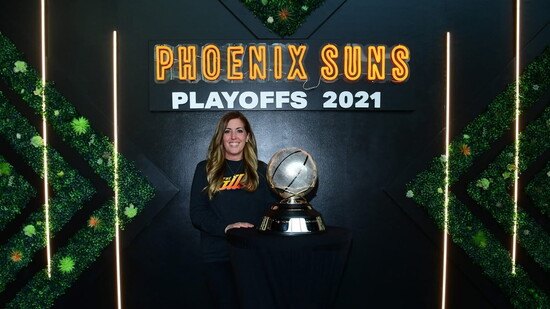
Sarah Krahenbuhl holds one of the most meaningful roles in Arizona sports, but her title tells only part of the story.
As Executive Director of the Phoenix Suns/Phoenix Mercury Foundation and Senior Vice President of Community Engagement, Sarah sits at the intersection of leadership, philanthropy, youth programming and community impact. She helps oversee millions of dollars invested throughout Arizona, thousands of volunteer hours, player and alumni programs, youth basketball initiatives and the off-court storytelling that reveals who athletes are when the lights are no longer on them.
It is a powerful position. It is also one she never set out to pursue.
Sarah did not grow up plotting a career in sports or dreaming of working in a professional front office. She wanted to become a teacher.
“I am not one of those who chased working in sports my whole life like many of my colleagues,” she says. “I was just lucky enough to have taken a chance on something I didn’t really know about, and it fit.”
An Arizona native, Sarah attended Liberty Elementary School and Chaparral High School. She began college at the University of Arizona before finishing at Arizona State University. The sports world entered her life almost by accident when she needed an internship to graduate and found one in fan development with the then-Phoenix Coyotes.
“Hockey was foreign territory for me. I had to study what hockey was,” she says.
Then came the real work. Sarah drove “a huge, oversized U-Haul truck all around the state,” hauling inflatables to parks, clinics, festivals, parades and community events. Her job was to introduce children and families to a sport many of them had never experienced.
“I fell in love with the community side of it. I fell in love with being with kids and the excitement they got when they walked up to see the mascot or got to take a slapshot by one of our inflatables.”
The internship lasted four months. A full-time role followed. Then, while Sarah was still in her twenties, one experience transformed a job into a calling.
Her first Make-A-Wish visit involved a little girl named Rachel Determan.
Rachel was in remission from leukemia, and her wish was to meet hockey star Shane Doan. Sarah helped bring Rachel and her family from Yuma for the visit. They were waiting in the locker room when Shane walked in and handed Rachel a jersey.
“Rachel just went silent,” Sarah remembers. “She was so awestruck and didn’t say a word. It was just this magical moment for the entire family.”
A few years later, Rachel’s cancer returned, and she lost her battle. Sarah attended her funeral. When she walked inside, she saw the jersey Shane had given Rachel displayed near the memorial.
“There’s a moment when you realize this is so much more powerful than wins and losses. This is a responsibility that’s indescribable.”
That moment has never left her. You can still hear it when she speaks about her work. For Sarah, the job was never simply about activating a brand or filling a calendar. It became an act of stewardship.
“Sports aren’t just a logo… they’re a community asset.”
That understanding has shaped the way she leads today.
Sarah joined the Suns in 2012 as Director of Phoenix Suns Charities. As her role expanded, so did her ability to use sports as a vehicle for meaningful change. Today, the Foundation invests more than $5 million into the community through grants and charitable giving. Her team helps generate more than 3,000 volunteer hours from team members and oversees player and alumni programs, youth camps and clinics, and Jr. Suns and Jr. Mercury programming that reaches 25,000 children.
The work extends far beyond teaching basketball. The sport becomes a pathway to STEM education, career development, mentorship, access, opportunity and joy.
“We love using our sport to change lives and investing in communities.”
One of the clearest examples of her leadership is the way she works with players. At the beginning of each season, Sarah and her team sit down with every player. They do not hand them a generic list of appearances. They begin by asking questions.
What matters to you? What shaped you? What feels real?
Most of the time, Sarah says, players initially offer the most obvious answer.
“Youth basketball, kids playing in the community, basketball, basketball, basketball,” she says. “Then I say, ‘Let’s go deeper.’”
That deeper conversation is where the real stories emerge.
One player shared that his parents kept him involved in everything as a child, including outdoor activities, church and music. Everyone in the family had to choose an instrument, and he chose the saxophone. That detail led Sarah and her team to connect him with Rosie’s House, which provides free music lessons to students from Title I schools.
“He was very excited to support their musical efforts.”
Another player spoke openly about his faith, so they created opportunities rooted in that part of his life. One player continually said yes to every request, but at the center of his generosity was a simple desire for people to treat one another with greater kindness.
That conversation became a kindness-driven initiative in partnership with The Be Kind People Project, complete with in-game seat upgrades and community touchpoints centered on that value.
Just a few weeks ago, Sarah’s own commitment to kindness and service received statewide recognition. She was named a Full Circle 2026 Awards of Excellence honoree and received the Be Kind Award of Excellence for Community Impact.
The honor reflects what Sarah has spent her career doing: turning deeply held values into visible action.
She lights up when she tells these stories because this is where her work becomes personal. The public sees the player. Sarah sees the person behind the player, then builds a bridge between that person and a community that needs what they have to give.
“There has to be an authentic connection. That’s really been our success.”
For years, Sarah frequently found herself as the only woman in the room with a senior title. She remembers entering those spaces in her late twenties and learning, in real time, how to own her place within them.
“I’ve had to do a lot of work on myself to take up space and have the confidence to speak up.”
That confidence did not arrive all at once. It developed through time, maturity, mentors and repetition. It came from being encouraged until she began to believe what others already recognized in her. Perhaps it also came with a little defiance.
Although her role is high profile, some of the most revealing moments of her story have happened outside the spotlight.
Sarah is a mother first. Throughout much of her career, Sarah watched women leave the sports industry after having children because they could not find a way to make both worlds work. She wanted to model another possibility.
Sarah remembers being six weeks postpartum when Devin Booker was preparing to surprise nonprofit organizations with grants through the Foundation.
“I wasn’t going to miss it. I was sleep deprived with a newborn in tow. I just didn’t care. I had to be there.”
Another time, her son had just received a flu shot. When he saw her at the arena, he clung to her so tightly that she could not pull him away. Sarah needed to walk onto the court for a pregame presentation, so she went out with her child still attached to her.
“I can remember being so nervous that I was going to get in trouble for that.”
Instead, women approached her afterward to tell her how much the moment meant to them.
That is often the reality for women in leadership. They are not necessarily trying to break barriers. They are showing up, solving the problem in front of them, and making it through the moment.
“I think if you show up and do the right thing, it just naturally happens,” Sarah says.
At her core, beyond the title, the teams and the demands of leadership, everything Sarah does is rooted in service.
“Giving back is the whole point of being a human.”
For someone raised in Arizona, there is something especially meaningful about where that belief has led her.
“I don’t feel like I work for the Phoenix Suns, Phoenix Mercury or Valley Suns. I feel like I work for Arizona. I just have the ultimate privilege of using the teams to make my great state better.”
nba.com/suns/foundation