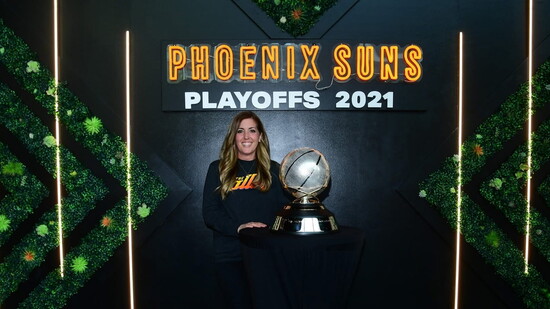
Sarah Krahenbuhl holds one of the most meaningful roles in Arizona sports, but the title alone does not tell the story.
As Executive Director of the Phoenix Suns/Phoenix Mercury Foundation and Senior Vice President of Community Engagement, Sarah sits at the intersection of leadership, philanthropy, player relations, youth programming, and community impact. She helps oversee millions of dollars invested back into Arizona, thousands of volunteer hours, player and alumni programs, youth basketball initiatives, and the kind of off-court storytelling that reveals who athletes really are when the lights are not on them. It is a powerful position. It is also one she did not necessarily chase.
“I am not one of those that have chased working in sports my whole life like many of my colleagues,” she says. “I wanted to be a teacher. However, I was just lucky to have taken a chance on something I didn’t really know about and it fit.”
An Arizona native, Sarah went to Liberty Elementary, Chaparral High School, started at the University of Arizona, then finished at ASU. The sports world entered the picture almost by accident. She needed an internship to graduate and found one with the then Phoenix Coyotes in fan development.
“Hockey was foreign territory for me. I had to study what hockey was,” she laughs.
Sarah drove “a huge oversized U-Haul truck all around the state,” hauling inflatables to parks, clinics, festivals, parades, and community events, teaching kids how to play a sport most Arizona families had never touched.
“I fell in love with the community side of it. I fell in love with being with kids and the excitement that they got when they walked up to see the mascot.”
That internship lasted four months. A full-time role followed. And amidst Sarah’s rise, still in her twenties, came the moment that turned a job into a calling.
Her very first Make-A-Wish involved a little girl named Rachel Determan.
Rachel was in remission from leukemia. Her wish was to meet hockey star Shane Doan. Sarah helped coordinate the visit, bringing Rachel and her family up from Tucson. They were in the locker room when Shane walked in and handed Rachel a jersey.
“Rachel just went silent. She was awestruck. It was just a magical moment for the entire family.”
A few years later, Rachel’s cancer returned, and she lost her battle. Sarah went for the funeral. When she walked in, she saw the jersey Shane had given her displayed near the memorial.
“There’s a moment that you realize, this is so much more powerful than wins and losses on the court. This is a responsibility that’s indescribable.”
The job, for Sarah, was never just about activating a brand or filling a calendar. It became about stewardship.
“Sports aren’t just a logo. They’re a community asset.”
That understanding has shaped everything about the way she leads now.
Sarah joined the Suns in 2012 as Director of Phoenix Suns Charities. Over the years, her role expanded and evolved with the organization. Today, her scope is vast. The Foundation invests more than $5 million into the community through grants and giving. Her team helps generate more than 3,000 volunteer hours from team members. They oversee player and alumni programs, youth camps and clinics, and Jr. Suns and Jr. Mercury programming that reaches 25,000 kids. They fund basketball programs, yes, and so much more. STEM through basketball. Career development through basketball. Exposure, access, opportunity, and joy.
“We love using our sport to change lives and investing in communities,” she says.
One of the things that sets her apart is the way she works with players. At the start of each season, Sarah and her team sit down with every single one, not to hand them a generic list of appearances, but to ask better questions. What matters to them. What shaped them. What feels real.
Nine times out of ten, she says, players begin with the obvious.
“Youth basketball, kids playing in the community, basketball, basketball, basketball,” she says. Then comes her favorite part. “I say, you all say the exact same thing. Let’s go deeper.”
That deeper conversation is where the real stories come out.
One player talked about his love for the saxophone. That detail led Sarah and her team to connect him with Rosie’s House, where kids in Title I schools receive free music lessons.
Another player simply wanted people to be kinder to each other.
“That led to a partnership with Be Kind People Project, including in-game seat upgrades and community touch-points designed around that core value.”
Sarah lights up when she tells these stories, because this is where her work becomes visible in a different way. The public sees the player. She sees the person behind the player and then builds the bridge.
“Authentic connection. That’s really been our success.”
That word, authentic, comes up often with her. Mission matching. The right person with the right cause for the right reason.
That instinct has also shaped the way she moves through leadership as a woman.
For years, sports was a room where she was often the only woman with a big title. She remembers being in those rooms in her late twenties and having to learn, in real time, how to own her space.
“I’ve had to do a lot of work on myself to have the confidence to speak up.”
It did not arrive all at once. It came with time, maturity, mentors, and repetition. It came with being encouraged again and again until she finally believed what others saw in her. And perhaps a little bit of defiance too.
That edge, paired with her warmth, is part of what makes Sarah so compelling. She is deeply gracious, deeply thoughtful, and also very clear. She knows who she is now. She knows the value of her voice, although she has to remind herself everyday to use that voice.
And while her role is high profile, the most revealing parts of her story are the ones that happen outside the spotlight.
A mom first. They are part of her life, her work, her values, and sometimes literally part of the job.
For much of her career, she watched women leave the business after having children because they could not make it work. Sarah wanted to model something different.
She remembers being six weeks postpartum when Devin Booker was surprising nonprofits with grants through the Foundation.
“I wasn’t going to miss it,” she says. “I had a baby on the boob. And I just didn’t care. I had to be there.”
There is another story she tells. When her son saw her at the arena, he clung to Sarah so tightly she could not get him off. She had to go out on the court for a pregame presentation, so she went anyway, child attached.
“I can remember being so nervous that I was going to get in trouble for that."
Instead, women came up to her afterward and expressed the impact it made.
“That was so awesome that you took your kid out there, they said.”
That’s the reality of women in leadership. Often, they’re not trying to break barriers, they’re just showing up and getting through the moment.
“I think if you show up and do the right thing, it just naturally happens.”
At her core, beyond the title, beyond the teams, beyond even leadership itself, everything she does is rooted in one thing: service.
“Giving back is the whole point of being a human. It’s your obligation of being alive.”
That belief extends beyond the Suns and Mercury. It is part of why she co-founded Copper Club, a community designed for busy, philanthropic, professional women who were craving something real.
“Women specifically lose themselves and often don’t prioritize themselves.”
Copper Club was born from that truth. Not just a networking concept. A response to a real need. A place where a woman can show up not as executive director, not as mother, not as the one holding it all together…
“...I can just show up as Sarah for a moment in time,” she says.
For someone who grew up in Arizona, there is also something especially powerful about where she has landed. She is not just serving a franchise. She is serving the place that raised her.
“I say this all the time: I don’t feel like I work for the Phoenix Suns, Phoenix Mercury, Valley Suns,” she says. “I feel like I work for Arizona. I just have the ultimate privilege of using the teams to make my great state better.”
That may be the best way to understand Sarah Krahenbuhl. She is a respected executive. She is a woman in a power position. She is helping shape one of the most visible and impactful community platforms in the state.
But underneath all of that, she is still the Arizona girl who found her way into sports by chance, then spent the next two decades turning that chance into purpose.
And in a world obsessed with what happens under the lights, Sarah has built a career illuminating what matters after the buzzer.