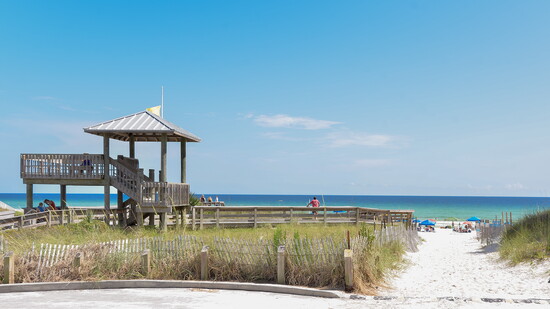
The first thing most people notice about Florida’s Emerald Coast is the water.
It’s not just blue. It’s layered with turquoise, aquamarine, and deep emerald, shifting with the light like silk in motion. For many, that first glimpse seals the deal. But for Bert Summerville and Ellen Randall of Scenic Sotheby’s Summerville-Randall Team, the water is only the beginning.
“What keeps people here,” they often say, “is something far less visible.”
Along this stretch of coastline, from Port St. Joe to Navarre, encompassing the celebrated 30A corridor, Miramar Beach, Destin, and Panama City Beach, real estate is not simply about square footage or price per foot. It’s about rhythm, nuance, and belonging. On the Emerald Coast, two homes can look nearly identical on paper and feel entirely different in person.
30A is a curated string of New Urbanist micro-towns--Seaside, Alys Beach, and Rosemary Beach, each with its own architectural DNA and carefully crafted sense of place. Here, communities are intentionally designed to be experienced at a human pace. You can walk or bike almost everywhere within your enclave. Arrival feels deliberate.
Even nature plays a role in defining boundaries. Rare coastal dune lakes, found in only a few places in the world, create natural breaks between neighborhoods, reinforcing a sense of distinct identity.
Drive a bit farther, and the atmosphere shifts. Panama City Beach carries a different energy altogether. “It’s the high-octane sibling,” they say with a smile. Between Pier Park shopping, entertainment, and vibrant vacation crowds, it feels like a city that happens to be on the beach.
In between are the hidden gems. Inlet Beach and Carillon Beach bridge the two worlds, offering proximity to 30A’s dining and design while allowing for a bit more breathing room. The coastline may be continuous. The lifestyles are not.
Bert and Ellen use a phrase clients quickly come to appreciate: lifestyle flow.
“Lifestyle flow is how naturally a community fits into someone’s daily routine.”
A home can be architecturally stunning. But if the surrounding environment doesn’t support the way someone actually lives, it will never quite feel right.
They talk clients through the details that don’t show up in listing photos: walkability, bike paths, parking realities, seasonal traffic patterns, noise levels in peak months.
Some buyers want to park the car and never use it again. Others welcome a scenic drive to dinner and prioritize privacy over proximity. “Our goal is to help clients picture their real, everyday life here, not just their vacation life.”
That distinction often determines long-term happiness.
Belonging doesn’t arrive with the closing documents. It happens in the rituals. “A house becomes a home when you stop feeling like a visitor and start recognizing the unwritten schedule of the neighborhood.” On 30A, sunset is not simply a time of day. It is a shared ceremony. Neighbors drift toward balconies and beach walkovers, glasses of wine in hand, pausing collectively as the sky performs its nightly show. There is an unspoken agreement: everything slows.
Farmers markets become social anchors. It’s not just about produce. It’s knowing which vendor makes the best sourdough, which neighbor you’ll run into, and how long you’ll linger in conversation. These rhythms mark the shift from visitor to local.
Even the humble golf cart carries social significance. In master-planned communities, it isn’t just transportation... it’s connection. The slower pace invites porch talk, quick check-ins, spontaneous conversation. Belonging is built at five miles per hour.
For many of their clients, especially those relocating from close-knit communities like Franklin, Tennessee, ownership alone isn’t enough. “They don’t just want to own here. They want to belong.” That transition from tourist to local is intentional.
Integration often begins with the practical. Bert and Ellen provide a curated inner circle of trusted service providers including boat mechanics, private chefs, and artisans. They introduce new residents to conservation groups protecting the coastal dune lakes and to neighborhood charity events. They encourage engagement during shoulder seasons, when crowds thin and authentic relationships deepen. “When a resident understands the story of their community, they become its most natural steward and advocate.”
Community also reveals itself in shared experiences: attending the 30A Songwriters Festival, snorkeling along offshore artificial reefs, or witnessing a rare dune lake outfall event when fresh water breaches the sand and flows into the Gulf. These are not brochure moments. They are lived ones.
The Gulf Coast continues to evolve. Infrastructure improves. Dining expands. Residential offerings diversify. Yet character remains paramount.
“The Gulf Coast is evolving quickly but in thoughtful ways,” they say. “Our role is to help clients choose not just where they’ll be happy now, but where they’ll still feel at home as their life, and the community around them, continues to grow.”
Because ultimately, the most valuable amenity along the Emerald Coast cannot be captured in a listing description. It’s discovered at sunset. At the farmers market. Or on a quiet paddle across a dune lake. It’s the moment you realize you recognize more faces than you don’t. It’s the feeling of belonging long after the closing papers are signed.
pull quote: . “Our goal is to help clients picture their real, everyday life here, not just their vacation life.”
Pull quote: “Our role is to help clients choose not just where they’ll be happy now, but where they’ll still feel at home as their life, and the community around them, continues to grow.”