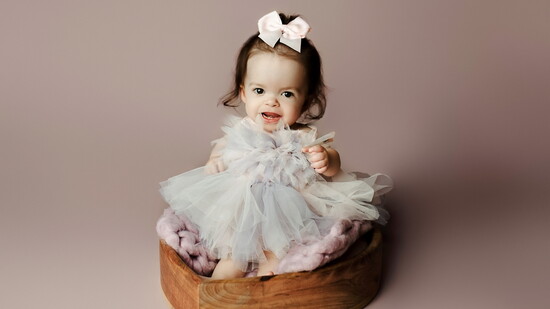
When Misty Petruzzello first reached out about sharing her daughter’s story, her goal was simple: help people see beyond a diagnosis.
Her daughter Frankie, now five, was born with achondroplasia, the most common form of dwarfism. While the condition presents unique medical challenges, Petruzzello, of Birmingham, hopes others will understand that dwarfism is only one small part of who her daughter is.
“Frankie is five years old and has a personality that lights up every room she walks into,” Petruzzello says. “She’s funny, outgoing, determined and has a way of making people smile. She loves singing, dancing, playing soccer and trying new things.”
For Petruzzello, the journey began shortly after Frankie’s birth, when she was admitted to the neonatal intensive care unit due to low blood sugar and difficulty maintaining oxygen levels.
“We were scared, nervous, but more so worried that we didn’t know exactly what achondroplasia would mean for her future,” she says.
Like many parents facing an unexpected diagnosis, the family — including husband, Frank, and daughters Leah and Arianna — immersed themselves in research, connected with specialists and sought guidance from other families who had walked a similar path. Over time, fear gave way to confidence.
“The more we learned, the more confident we became in advocating for Frankie and making informed decisions about her care,” Petruzzello says.
Frankie has undergone spinal decompression surgery, sleep studies, annual MRIs and regular visits to specialists. Yet her mother says one of the biggest misconceptions is that people assume dwarfism affects only height.
“There can be many other health concerns that require ongoing monitoring and specialized care,” she explains.
Still, Petruzzello is quick to focus on what her daughter can do rather than what she cannot.
“We always encourage her to be independent, try new things and believe in herself,” she says. “We want Frankie to grow up knowing that she is capable, loved and worthy of every opportunity.”
The experience has also shaped Frankie’s sisters, teaching them empathy, compassion and how to advocate for others.
“As they’ve grown, they’ve learned the importance of standing up for others,” Petruzzello says. “They have been some of Frankie’s biggest supporters and cheerleaders.”
For Kristy Korth of Birmingham, the path to parenthood with husband, Hunter, looked very different but carried many of the same lessons.
Her son, Chase was born at just 23½ weeks of gestation, weighing less than one pound. The family also endured the heartbreaking loss of his twin brother, Luke.
“Chase was in the neonatal unit for seven of the longest months of our lives,” Korth says. “There were many times we thought he wasn’t going to make it. He really is our miracle.”
Now nearly 20 years old, Chase lives with cognitive delays and autism and is nonverbal. Yet his mother describes him first and foremost as a joyful young man who teaches those around him what truly matters.
“He’s super happy,” Korth says. “He teaches us every day what it’s like to live in the present moment.”
Chase attends Wing Lake Developmental Center, participates in Special Olympics and enjoys spending time with family, his iPad and his beloved Sesame Street videos.
Korth says the journey has not always been easy. After bringing Chase home on oxygen and feeding tubes, she left her career to care for him full-time. Navigating services, therapies and support systems often required persistence and determination.
“You really have to be dedicated,” she says. “Ask questions and network because there are a lot of things out there that you might not know about.”
One of the greatest gifts, she says, has been watching Chase’s impact on his siblings, Sydney and Finn.
“They have a level of empathy that I think is rare,” Korth says. “They stand up for him if people give him weird looks or say weird things. My daughter even wrote her college essay about what she’s learned from him.”
Both families emphasize that inclusion is about far more than access. It is about belonging.
For Korth, that can mean adaptive playground equipment and community spaces where children of all abilities can participate together.
“I like when they expand playgrounds to accommodate children with different abilities,” she says. “So they can be part of what’s considered normal.”
For Petruzzello, representation matters just as much.
“When children with dwarfism see people who look like them represented in books, movies, television, schools and their communities, it helps them realize they are not alone,” she says.
Both mothers also stress the importance of language, education and understanding. Petruzzello notes that outdated terms can be hurtful and that respectful language helps foster acceptance. More importantly, she hopes people will focus on the individual rather than the diagnosis.
“At the end of the day, children with dwarfism are children first,” she says. “They have the same hopes, dreams, talents and abilities as anyone else.”
Korth agrees. Over nearly two decades of raising Chase, she has learned that every person has value and something to teach others.
“Chase is just unconditional, pure love,” she says. “He’s going to love you. He’s not going to judge you or hold grudges. He’s just pure.”
As communities continue working toward greater inclusion, both families believe awareness begins with conversation and understanding. Whether through adaptive playgrounds, supportive schools, representation in media or simple acts of kindness, every effort helps create a world where children of all abilities feel welcomed and valued.
Ultimately, that is the message both mothers hope readers remember.
“I wish people understood that children with dwarfism are just like any other child,” Petruzzello says. “Dwarfism does not define who they are or what they are capable of achieving.”
Korth offers a similar perspective.
“Love fully without judgment,” she says. “You never really know what someone else is going through.”
Their journeys may be different, but together they share a common truth: every child deserves kindness, respect, inclusion, and the opportunity to thrive.
“We want Frankie to grow up knowing that she is capable, loved and worthy of every opportunity.”
— Misty Petruzzello
“Chase is super happy. He teaches us every day what it’s like to live in the present moment.”
— Kristy Korth