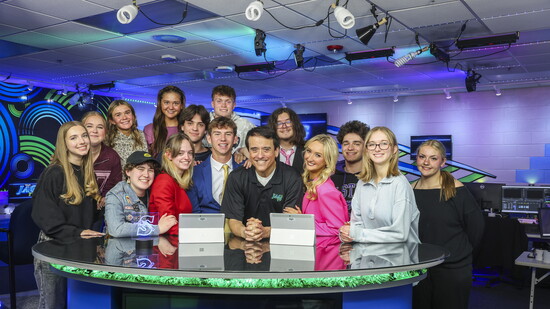
For many years, he has been a voice of calm during a thunderstorm, guiding us through the unpredictable Midwest skies. But instead of seeing Pete Grigsby on air during a weekday morning broadcast, you’ll find him at Blue Springs South High School, working with students on the fundamentals of storytelling, production, and communication.
At school, he’s not “Pete” or the meteorologist on TV. To his students, he’s “Grigsby.” Here, students learn how to report the news, take something complex and make it clear to others, and connect with an audience.
These are skills that Pete has spent decades refining on air, and now he is sharing them with students in a classroom.
Pete has been a familiar face in Kansas City since 1999, serving as a meteorologist at KMBC 9 News. But long before the cameras, green screens, and the forecast, there were two things that always captured his interest: science and radio.
Science and math came naturally to Pete, and by high school, he was fascinated by live broadcasting. “Growing up in Eastern Kentucky, we didn’t have the best radio stations,” he recalled. “When we took trips to Lexington, I couldn’t wait to get in range and flip through the different stations. I was amazed at how they could talk and make it sound so effortless.”
Eventually, he found a way to bring those interests together, turning a passion for science and storytelling into a career in meteorology.
His journey into broadcasting began at Brigham Young University, where he gained early on-air experience at a PBS station. After graduating, he returned to Kentucky where he pursued meteorology at Western Kentucky University, while continuing to do the weeknight weather reports.
Over time, he gained experience at stations in Indiana and Virginia, building both skill and confidence. By the time he arrived in Kansas City, he had already learned how to handle pressure, think on his feet, and communicate clearly.
For Pete, the most rewarding part of the job isn’t just being on camera. It’s what happens before the broadcast ever begins.
“Hours before going live, I study weather charts and analyze data,” Pete said. “I come up with and write my own forecasts for more than 40 counties across the region. I love that challenge of predicting the future.”
In 2008, after years in broadcasting, Pete made a decision he never expected and stepped into a classroom. Today, his passion of broadcasting and the lessons he learned on-air now shape how he teaches.
“Teaching wasn’t part of the original plan,” Pete shared. “My dad was in education for over 54 years and I knew that I did not want to be a teacher. But as my kids got older, I was still working weekends and late nights, and wasn’t seeing my kids, so I started considering a career change.”
At Blue Springs South, Pete now teaches broadcasting and science courses, including work with BSSD Radio, a student-run radio station, and JagTV, where students gain hands-on experiences in reporting, editing, and production.
Over the years, he has had a front row seat as he’s watched hundreds of students gain confidence, find direction, and even pursue careers in broadcasting themselves. Under his guidance, students have produced award-winning work, including a 2025 Mid-America Emmy-winning broadcast, an accomplishment that highlights student talent and Pete’s mentorship.
When talking with Pete and watching him interact with students, it’s clear his pride in their work. “If you’ve never seen an episode of JagTV, you should see all the incredible things current and past students have reported on. The kids do the work, I just give them the tools,” he shared.
For Pete, the forecast is about much more than what is to come. It’s about the impact he leaves, whether in the studio, the classroom, or in the lives of those who watch and learn from him.
Youtube: SouthJagTV