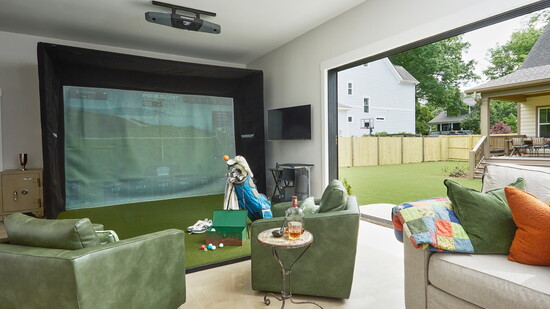
Kyle Seymour is the son of a golf pro. He had a club in his hand by the time he could walk. Growing up in cold Ohio winters, practicing in an indoor golf simulator made sense. So as a husband, father and six-handicapper living in Charlotte, he jumped at the chance to install a golf simulator in the ADU, or Accessory Dwelling Unit, he and his wife Abby added behind their home.
Just please don’t call it a man cave.
“It drives me crazy when people call it a man cave,” Kyle Seymour says. “It seems so selfish. I didn't just do it because I want to hit golf shots and be away from my family. My son and daughter will be able to learn golf in it. We'll be able to bring friends in. It's a family space.”
And it’s a way to make their existing home more livable for everyone.
The Seymours bought their 1,900-square-foot three-bedroom house in Villa Heights, a neighborhood between NoDa and Plaza Midwood that they “love and adore,” Kyle says. But with a growing family of four, they needed more space.
They quickly discovered buying a bigger house in a similar neighborhood would be pricey. But during one of their searches, they saw a house with a separate backyard building that had a garage, workshop and bonus space upstairs.
“It immediately inspired us,” Kyle says.
They enlisted Paul Kowalski Builders to construct a two-story, 1,600-square-foot ADU. Upstairs is an in-law suite that doubles as office space. The downstairs flex space has the golf simulator, a sectional couch, a kitchenette and a half bath. On one wall are sliding glass doors that open to a backyard turf play area for their 2 and 5-year-olds. On the adjacent wall is an automatic garage door that opens onto a newly laid second driveway, both good for the home’s future resale value.
PKB project manager Siwatu Spikes says the greatest challenges of the six-month project were backyard grading and installing heated floors beneath the main floor. Ductwork of HVAC units is prohibited in garages, so PKB custom-installed a water-heating system under the concrete.
Spikes said he coordinated with the manufacturer of the golf simulator to install a projection screen, mount a launch monitor on the 11-foot ceiling and hardwire internet through the walls, so the simulator wouldn’t be dependent on inconsistent wireless.
“It was an awesome project,” Spikes says. “It was definitely nice to do something like this. It was fun. They were great clients.”
The system allows a golfer to take full swings with a driver and hit standard golf balls into an impact-resistant screen.
“It's the full technology,” Kyle says. “It takes thousands of pictures per second and instantaneously turns it into data to show an image on the screen of the flight of your golf ball. It does that with just incredible accuracy.”
With the simulator’s subscription, he can “practice” on some of golf’s most storied courses. His 5-year-old son likes to line up on an image of Pebble Beach’s No. 7 to “hit balls in the ocean,” as he says.
Think of all the money they’ll save on Topgolf birthday parties.
“Exactly,” Kyle says, laughing. “That’s how I pitched this to Abby.”
Abby is not a golfer but comes from a “golf-crazed” family, too, she says. Her grandparents lived on Muirfield, the prestigious Jack Nicklaus course in Dublin, Ohio. With a golf simulator, her husband is home more, and her kids can learn the game.
“Then you’ll come through on the golf scholarship,” she responds.
Meanwhile, she has a family-friendly space for movie nights, an upstairs room for Mahjong parties, and easy access to bicycles.
“It's been really fun to bike to all the coffee shops, breweries, our son’s soccer games and all that we live right by,” Abby says. “It’s one of the reasons we love our neighborhood.”