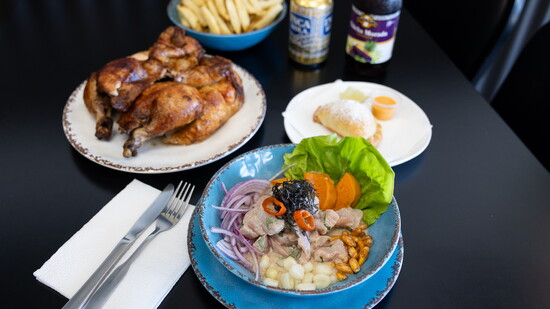
One weekend, chef Dante Balarezo decided to grill a whole chicken, seasoning it with a combination of spices and chiles inspired by his homeland of Peru, using his trusty Weber grill and rotisserie system.
It was a hit with Balarezo’s wife, who thought others would think so, too. She took a photo and suggested they sell them. Balarezo had his doubts but gave it a whirl.
“If we don’t sell them, I guess we can eat them,” Balarezo said to his wife, Miryan.
Miryan posted the photo of a perfectly golden brown chicken flaunting patches of succulence and a hint of char in all the right places to Facebook. That weekend, they sold 62 chickens to friends, family, and strangers who saw the post.
Balarezo added two more grills to accommodate orders. He was manning the grills from 2 a.m. to 7 p.m. and selling his signature birds from their Chandler home.
Demand skyrocketed. Cars lined up down the street for Balarezo’s chickens that defied all the usual pitfalls with juicy breast meat, crispy non-greasy skin, and just the right amount of savory warmth.
Months later, the restaurant industry veteran’s side gig became a full-time one in the form of Mi Corralito, the cozy Peruvian eatery he and Miryan opened in 2025.
The Balarezos’ four rescue dogs inspired the name of the restaurant. When Balarezo cooked in his backyard, he wanted to keep them safe from the hot grills. He set up a large collapsible fence around him and his grills, creating a cage—corralito—for himself so his fur kids could run free, rather than be restricted to crates.
Balarezo heads to California every few months to procure unique Peruvian spices and chiles. He still cooks over charcoal and marinates the chicken for at least 24 hours.
“We try to be as original and authentic as possible. We take our time and do it the right way,” Balarezo says. “The response has been really, really good and everyone is so happy with what we are doing.”
The plan was to sell only chickens to go. But customers craved more Peruvian dishes. They also wished for tables so they could enjoy their meal hot as soon as possible.
Balarezo listened. Today, there’s seating to accommodate about a dozen dine-in patrons, and in addition to chicken, there are 15 dishes on the menu. This includes fried yucca, ceviche with mahi-mahi, Peruvian chiles, corn and corn nuts, and Lomo Saltado—a classic Peruvian dish made with tender strips of beef sauteed in a wok with red onions and tomatoes. It’s served with rice and fresh-cut fries that are handcrafted and double-fried, yielding a crispy exterior and fluffy interior.
Balarezo acknowledges the extra effort is a labor of love.
“I’m trying to distinguish myself from other chicken restaurants,” Balarezo says. “It’s not right or wrong, just different.”
Born in Lima, Balarezo’s grandfather was a Chinese immigrant who arrived in Peru to work in the fields. He later opened a restaurant in the 1980s. At the time, cultural norms dictated that the kitchen was for women only. So while his grandfather ran his restaurant, Balarezo remained home and curious about what his aunts were doing in the room from where all the tantalizing aromas emerged.
When he immigrated to the U.S. in 1990, Balarezo was exposed to different flavors and dishes and yearned for his homeland’s cuisine. He asked his mother how to cook those dishes and wrote down recipes he found in cookbooks. This gave Balarezo the opportunity to finally experience what his aunts did in the part of the house he was kept out of.
“I tried recipes, messed them up, and I would eat and learn from my mistakes,” Balarezo recalls.
He began working in restaurants in California and opened his first Peruvian restaurant in 2000. Although he was a chef, he wanted to continue his education and enrolled in the former Le Cordon Bleu College of Culinary Arts in Hollywood.
Balarezo has now spent 35 years working in and running restaurants, helming kitchens, and even working as a private chef. When he and Miryan moved to Arizona in 2021, Balarezo was working as a chef in California, splitting his time between the states. Eventually, they decided to make Chandler their full-time home.
Balarezo believes that people eat with their eyes before they eat with their mouths. This is why how his creations look is just as important as how they taste. If a guest debates whether to take a photo first or a bite first, the mood is set.
“Cooking is a form of art. Unfortunately, our art lasts seconds,” Balarezo says. “If I can get a smile from you or you say, ‘Oh my god, this moves me to my childhood,’ or ‘I didn’t know this existed' ... that, to me, is the payoff.”
Mi Corralito Peruvian Ceviche
Serves 2–4
Ingredients
- 1 lb. fresh mahi mahi or other firm white fish, cut into bite-sized cubes
- Juice of 8-10 fresh limes
- 1 small red onion, thinly sliced
- 1–2 ají limo peppers, thinly sliced
(or substitute serrano or habanero peppers) - Kosher salt, to taste
- Fresh cracked black pepper, to taste
For Serving
- Butter lettuce leaves
- Boiled sweet potato, sliced
- Peruvian choclo or large-kernel corn
- Cancha (toasted Peruvian corn nuts)
Directions
- Place fish in a chilled mixing bowl and season with salt and black pepper.
- Add sliced ají limo and half of the red onion.
- Pour fresh lime juice over the fish until lightly submerged.
- Toss gently and allow to marinate for 3 to 5 minutes, just until the fish begins to turn opaque.
- Adjust seasoning to taste.
- Plate immediately, topping with remaining red onion.
- Serve alongside lettuce, sweet potato, choclo, and cancha.
Chef Dante’s Tip
“The secret to great ceviche is balance—fresh fish, enough lime to brighten but not overpower, and serving it immediately while the texture is still perfect.”
“We try to be as original and authentic as possible. We take our time and do it the right way,” Balarezo says.
When he immigrated to the U.S. in 1990, Balarezo was exposed to different flavors and dishes and yearned for his homeland’s cuisine.