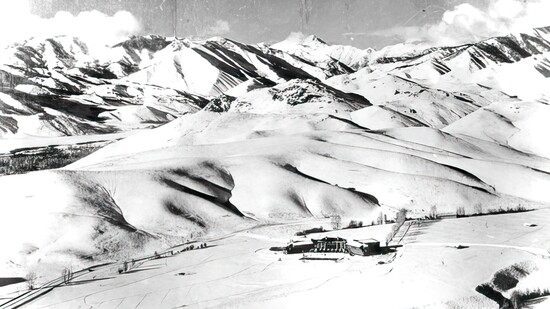
In May of 1936, during the economic hardship of the depression era, Averell Harriman, son of Union Pacific tycoon, Edward Henry Harriman, enlisted the help of Austrian adventurist, Count Felix Schaffgotsch, Los Angeles based architect Gilbert Stanley Underwood and Company, and eager workers from near and far to begin construction on the Sun Valley Lodge. By June, construction was moving swiftly. The buzz around the new ski town taking shape was making the Sun Valley Lodge a popular destination even before its completion. The last major task at hand before opening was to find a way to get skiers up and down the slopes. Union Pacific engineers looked at several “mechanical devices” like the J-Bar and an up-ski toboggan, which was already being used in Yosemite, California, but both were limited by the amount of people that could be taken up at once. It took an adaptive idea from Jim Curran to spark the perfect lift for the new mountain resort. Curran invented the chairlift by creating a variation of a conveyor system he had envisioned to streamline the process of loading bananas onto fruit boats in South America. With the help of pioneer skier, Charley Proctor, Curran’s innovation began to take shape.
At the time, the concept of a purpose-built ski resort was nearly unheard of in the United States. Most Americans who skied did so on local hills or improvised slopes, and the sport was still considered largely a European pastime. Harriman’s vision was to combine the luxury and convenience of a grand hotel with the excitement of alpine recreation. Through a bold experiment in bringing modern leisure and tourism to the rugged landscapes of the American West, Sun Valley would become the first destination ski resort in the U.S.
Three hills within walking distance of the lodge were first to be commissioned for skiing in Sun Valley: Ruud, Proctor, and Dollar mountains. “Monocable” lifts were built on the sides of each mountain and thus began another subsequent influx in interest, the likes of which had not been seen in the area since the mining boom in the early days of Ketchum. On December 21, 1936, Sun Valley opened. Four years later, the ambition of Felix Schaffgotsch would transform nearby Bald Mountain into a skier’s paradise with a three-tiered lift system, making Sun Valley home to the finest lifts anywhere in the country at the time.
Almost overnight, Sun Valley became a magnet for Hollywood celebrities, professional athletes, and international travelers. Figures like Clark Gable, Ernest Hemingway, and Ingrid Bergman flocked to the resort, helping to cement its reputation as “America’s St. Moritz.” The Union Pacific Railroad promoted Sun Valley heavily, using glamorous posters and travel packages to lure visitors westward. High profile endorsements established Idaho as a winter destination and helped usher in the modern era of American ski culture.
Averell Harriman noted, “Sun Valley achieved its objective of encouraging the development of ski resorts in many parts of the west, and Idaho has the pioneer resort it is justly proud of. My hopes have come true.”
For readers interested in diving deeper into the stories, archives, and photographs that shaped Idaho’s past, the Idaho State Historical Society offers extensive resources at history.idaho.gov
Sun Valley marks its 90th season with 90 new acres of gladed terrain, expanding advanced skiing while continuing its long tradition of innovation.