What happens when a doctor with a passion for healing also carries a passport stamped with a love for global impact?
In the case of Dr. Hayes Gladstone, that blend sparked a movement—one that now provides life-saving skin cancer surgeries to patients around the world who would otherwise go without.
Gladstone, a board-certified dermatologist and the founder of Gladstone Clinic, established Blade and Light International together with Dr. Murad Alam in 2003.
The non-profit organization is dedicated to providing Mohs surgery for skin cancer and educating medical practitioners on the procedure in underserved regions of the world.
Developed in 1936 by surgeon Frederic Mohs, it is a procedure used to treat skin cancer.
Mayo Clinic defines Mohs surgery as removing thin layers of skin. "Each thin layer is looked at closely for signs of cancer. The process keeps going until there are no signs of cancer."
Prior to medical school, Gladstone graduated with a degree in international relations and was even an award-winning photojournalist and sports editor.
“Before I went to medical school, I wanted to make sure I eventually tried to marry both medicine and some aspect of international relations,” says Gladstone.
Inspired by his medical school advisor—a plastic surgeon who frequently traveled abroad to repair cleft lips and palates—and by his early work with Operation Smile, Gladstone teamed up with Alam to launch Blade and Light.
“Blade obviously represents the scalpel. Light means a few things, but in our case, it meant lasers,” explains Gladstone.
From there, the nonprofit grew into a global effort, reaching about 16 to 18 countries. Gladstone usually brings a team consisting of around six to eight Mohs surgeons, a nurse or two, and some technicians.
The surgeons from the team teach dermatologists and plastic surgeons in these countries the ins and outs of performing Mohs surgery.
“Usually, on the first day, we will give all these lectures on Mohs surgery and reconstruction. And then the next several days after that, we'll do the surgeries,” says Gladstone.
Partnership with the hosts in countries they visit is essential, he says.
“I mean, we obviously are doing the surgery and teaching them (the hosts) and collaborating with them, but a lot of it depends on them,” he says, “You really find out in other countries how amazingly gracious and hospitable they are and that they want to learn.”
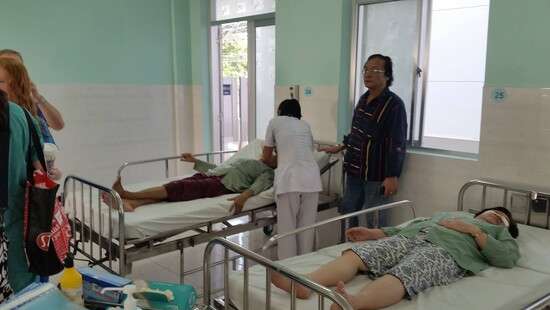
Over the years, the team from Blade and Light have gone on many volunteer missions in the Philippines, Chile, Romania, Costa Rica, Columbia, Greece, South Africa and Vietnam.
Gladstone says the team usually reviews photos of potential patients with advanced skin cancers. They then treat the patients on-site, working with the local doctors and demonstrating Mohs surgery techniques.
The surgeries are performed pro bono for patients who would otherwise be unable to get them.
“Usually we'll go to places where there isn't Mohs surgery or occasionally there’s one Mohs surgeon in the entire country, many times, none,” says Gladstone. “So we're introducing it and also teaching them so they can start their own Mohs surgery units.”
Two years ago, that mission became a reality as Gladstone and his team helped a medical center in New Delhi, India.
“They didn't have a Mohs unit. So we taught them how to do that. And they started a Mohs surgery unit and have actually been pretty successful in the last 18 months or so,” he notes.
For more information, visit Blade and Light International at Bladelight.org