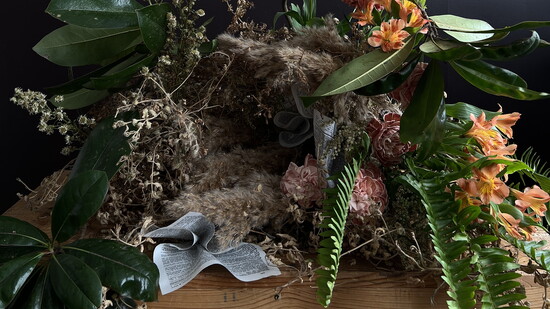
For Jessica Rauls, the florist behind Gather Flower Studio, every arrangement starts with intention. It's flower-focused, built from local, seasonal blooms and often layered with produce for texture and surprise. She doesn't simply arrange flowers; she aims to create art, thinking first about sentiment and emotion before placing a single stem. So when asked to interpret four local paintings in her own arrangements, the challenge felt like a natural extension of her work: reading each canvas as a lifetime of experience distilled into color and form, then responding in kind with something just as intentional.
ORANGE HAZE, 2023
Amir H. Fallah
Acrylic and collage on canvas, 12 in. diameter (tondo)
SOCO Gallery, from the exhibition What the Wind Carries
In Orange Haze, Amir H. Fallah brings together California poppies, Asian clematis and Mediterranean daffodils, arranging them in a single, harmonious ecosystem despite their origins on opposite sides of the globe. The painting is part of What the Wind Carries, a body of work built around Fallah's signature round tondo format, in which botanicals—rather than the human figure—carry the composition’s narrative weight.
Across this series, Fallah's flowers appear windswept, as though scattered and regathered by forces beyond their control—the fruits of a migration. This visual language is consistent with the rest of his practice, drawing on ancient and modern ornate patterns from West Asia, Persian miniatures and folklore imagery, set against American and European visual traditions. Through this layering, Fallah explores questions of identity, migration and community, treating each flower as a carrier of its own history and meaning.
In Orange Haze, that migration becomes visible in a single frame: three flowers from three continents coexisting in bloom together, each retaining its own identity while contributing to a shared, thriving whole. The piece asks viewers to consider how displacement and difference can resolve not into conflict but unexpected harmony.
—Hilary Burt, Director of SOCO Gallery
This piece was the most challenging for me because I wanted to honor the story without simply replicating the flowers. I chose blooms associated with different parts of the world in a similar palette, color-blocked to create visual significance the way the painting does. Each flower was chosen for petals that are thin and soft—holding their own space through color while gently weaving through the haze of the orange cosmos. Nothing competes or forces its way in, yet each is noticeable and present. All soft, all bold, all woven together in a bit of a dance. —Florist Jessica Rauls
SHE'S GOT PIZAZZ
Mixed media on canvas, 36 x 24 in.
Shain Gallery
My work is deeply rooted in my identity as an Appalachian artist and informed by the lands and waters I love. I often find myself drawn to vignettes from mountain trails—pillows of moss under tangles of vines, speckles of wildflowers, leaves animated by a breeze, light dappling the path. It's a wild, untamed landscape that follows no order and is all the more breathtaking for it. This piece was made in spring, when Appalachia is at her most colorful.
I'd point a florist first to the little "wild lines" that run throughout the piece—my favorite part of any painting, always making me think of tangles of vines. Here, I especially love the reds, pinks and yellows, and the movement they create together. They remind me of my own garden on a breezy spring day, busy with pollinators.
She's Got Pizazz is part of my "Girl's Girl" collection for Shain Gallery. I consider my work bold and feminine in its expression, made for strong, courageous women—women with pizazz.
Made with acrylic and charcoal, this piece took a lifetime to create, in the sense that a lifetime of experience has shaped my perspective, gestures and taste. I couldn't paint it the same way twice. But I also want my work to feel spontaneous and of the moment, so when the inspiration is right, I can finish a painting in a single day.
I hope anyone who engages with this piece walks away embracing their own sense of wildness—and the freedom and playfulness that come with it.
—Artist Marcy Parks
This piece features spring blooms—hellebore, tulips and anemones—with vines running throughout and golden fall leaves at the base. What I love about the painting is that natural wildness. It’s like an overrun garden, or a young girl growing up, emotions inconsistent, navigating the world with new eyes: curious, excited, fumbling through it all. That's why the flowers are so crowded, with tulips growing up between clumps of hellebore. The colors are faint, to replicate the softness and innocence I felt in the painting. —Florist Jessica Rauls
JACK IN THE PULPIT, 1930
Georgia O’Keefe
Oil on canvas
National Gallery of Art, Alfred Stieglitz Collection, Bequest of Georgia O’Keefe, 1987.58.1 Currently on display at The Mint Museum
Jack in the Pulpit is a vibrant abstraction of nature, celebrating the delicate forms of flowers and the American landscape.
As part of the “Across the Nation” initiative, works by Georgia O’Keeffe and other artists such as Edgar Degas and Alma Thomas will be on display at The Mint Museum through March 22, offering a unique lens into the American experience. These iconic pieces explore themes of beauty, movement and abstraction, providing a compelling dialogue on the nation’s cultural legacy.
—Courtesy of the Mint Museum
This piece hit differently. What's often overlooked in O'Keeffe's work is her appreciation for the divinely feminine energy in all of us—that when we soften and surrender, we gain a new sense of personal power. The dark purple calla lily stems have been peeled, so they can't stand upright; they must surrender into themselves. The red and ombréd green anthuriums represent the root and heart chakras. Ultimately, when we trust that life is working in our favor, we breathe easier, and our hearts open to what arrives. To me, that's the embodiment of the feminine. The surrender. —Florist Jessica Rauls
THE SCHOLAR & THE SPARK
40 x 20 in. Oil on canvas (framed 43 x 23 in.)
Anne Neilson Fine Art
A handsome fox, surrounded by the great literature of another time, appears to have abandoned his studies. Great Expectations, The Canterbury Tales, and The Divine Comedy lie beneath him, but his attention has been claimed by something considerably smaller—and perhaps more intriguing. A hummingbird hovers just beyond his reach, while a blue jay quietly observes from the table, looking back at us as though he knows precisely what is about to happen.
This is what I call "Wildlife with a Twist." I work primarily in realism oil painting, but I love placing my animal and bird characters in unexpected settings—on an old box, among vintage books or alongside objects with a history of their own. I bring together realism, literary references, whimsy, a touch of humor and just enough mystery to make the viewer wonder: “What is about to happen?”
Perhaps these paintings are little modern-day fables. The characters simply happen to be animals, but their expressions, relationships and curious surroundings invite us to imagine the rest of the story.
My love of painting birds has a particularly personal beginning. My late father carved wooden birds as a hobby and often encouraged me to try painting them. I didn't take his suggestion until late in his life, but eventually birds found their way into my work—and they've remained some of my most enduring characters ever since.
I hope my paintings make you pause, look a little closer and definitely smile. In The Scholar & The Spark, I suspect the fox has just discovered something far more interesting than the book he was reading.
The question is … what happens next?
—Artist Barbara Rudolph
The artist poses a question: what comes next for these creatures? Her work also carries literary references, which led me to imagine the fox—notoriously cunning in children's literature—as a bit misunderstood. Entranced by the hummingbird, he tries to build her a home the only way he knows: by burrowing, lining it with fur and flowers, taking everything literally—so the dictionary pages feature words like pollen and self-realization. Yet, the home suits only himself; the flowers are orange, like his fur. A single blue feather hints that the hummingbird once visited and found no place for her there. —Florist Jessica Rauls