As America celebrates its 250th anniversary, Pascack Valley offers a tangible connection to the nation's earliest days.
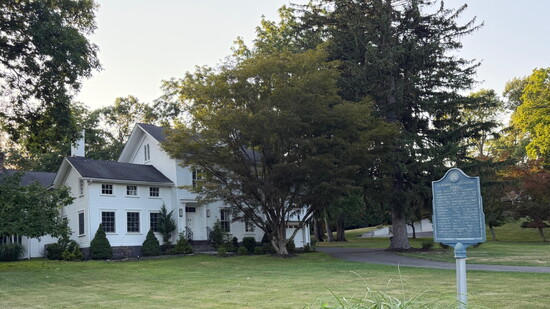
Since 1960, the Bergen County Historical Society has installed and maintained more than 160 historic blue markers identifying landmarks throughout the county. Cast by Sewah Studios in Marietta, Ohio, the original signs feature a distinctive Delft blue color, a nod to Bergen County's Dutch colonial heritage.
Westwood, often considered the hub of Pascack Valley, is home to several of these markers. While many visitors recognize the historic Westwood Train Station, built in 1932, another notable marker sits near Bogert's Pond. The site marks Bogert's Mill, one of the area's earliest grist mills. Originally built in the 1730s, the mill was purchased by Isaac Bogert in 1765. Bogert later acquired more than 500 acres, becoming one of the area's earliest settlers. During the Revolutionary War, Gen. George Washington and his troops stopped at Bogert's Mill in 1780. The Bogert family owned the mill until it was destroyed by fire in 1910.
Near Westwood High School stands another important landmark, the oldest surviving home in Washington Township. Built by Nicholas Zabriskie in the 1740s, Seven Chimneys reflects traditional Dutch colonial architecture and, as its name suggests, features seven chimneys. Local legend holds that Washington stayed there during the Revolutionary War. The Zabriskie family owned the home for 158 years, during which time it reportedly served as a stop on the Underground Railroad. Publisher William Howland, a friend of President Theodore Roosevelt, later purchased the property, and Roosevelt was among its notable visitors. Following Howland's death, the surrounding Chimney Ridge Court neighborhood was developed around the historic home.
In Old Tappan, two blue markers face one another along Westwood Avenue at Stone Point Park and the Claudius Collignon House. Together, they tell the story of a property that evolved from a colonial grist mill into an industrial center. Stone Point was home to a grist mill beginning in the 1720s before passing to Loyalist John P. Durie during the Revolutionary War. Durie forfeited the property in 1779, giving rise to local folklore that his wife placed a curse on the land, ensuring no future owner would prosper. In 1857, Claudius and Nicholas Collignon established a chair factory there and are credited with patenting one of the nation's first folding rocking chairs. Their Greek Revival and Italianate-style home, completed in 1864, survived a devastating fire that destroyed the factory and surrounding buildings in 1904. Stone Point Park was established on the site in 1962.
Hillsdale also preserves significant Revolutionary-era history. Along Pascack Road, the Capt. John H. Banta Homestead stands as an enduring example of colonial stone architecture. Banta, a veteran of the French and Indian War, purchased 395 acres in 1755 and built the existing home in 1796. Although the interior has been renovated over the years, the exterior remains largely intact. Nearby on Ell Road, the Garret Durie House was built in 1767 on land inherited by patriot, blacksmith and farmer Garret Durie. Durie later served Bergen County as a freeholder, justice and judge. The property remained in his family for generations, including ownership by his grandson, Judge Albert J. Terhune.
Montvale's Octagon House stands out for its uncommon eight-sided design. Built in 1855 for John Blauvelt Jr. on Grand Avenue, the home follows the octagonal architectural style popular during the mid-19th century. Over the years, it served as the home of three Montvale mayors: Garret Hering, Jules Schwenker and George Huff, whose family also operated a restaurant there. The borough acquired the property in 2021. Near the New York state line, another blue marker identifies the Eckerson House, built in the 1790s by Jacob Eckerson on his 119-acre farm.
Park Ridge is perhaps best known for the Wortendyke Barn, but directly across the road stands the even older Wortendyke Homestead. Built in the 1750s by Frederick Wortendyke Jr., it is the oldest surviving building in Park Ridge. Later generations of the Wortendyke family relocated to nearby Woodcliff Lake, and the property eventually became associated with Judge Terhune's family. Just down the road, the Ackerson Homestead, built around 1800, offers another glimpse into the area's early history.
Throughout Pascack Valley, these blue markers preserve the stories of the people, places and events that helped shape both Bergen County and the nation. Together, they commemorate more than 250 years of perseverance, sacrifice and community. As the United States marks its semiquincentennial, these historic sites offer residents and visitors alike an opportunity to discover the remarkable history waiting just beyond the roadside.