Born and raised in Osceola, Arkansas, artist Brantley Ellzey has built a distinctive career by finding beauty and possibility in unexpected places. Best known for his intricate mixed-media works, Brantley transforms magazine pages into sculptural compositions by rolling, layering and assembling them into richly textured pieces that blend collage and sculpture.
Raised by parents who encouraged hands-on projects and imaginative thinking, Brantley learned to see potential where others might not. He also credits his piano teacher with encouraging him to perform in community theater, an experience that taught him to approach creativity with intention and purpose. “Those experiences felt like a window beyond my small town and showed me there was a much larger world out there,” he says.
We sat down with Brantley to discuss his artistic journey, creative process and the influences that continue to shape his work today.
How did your studies and early creative experiences shape your artistic approach?
I entered Tulane University as an undeclared freshman. After taking a set design class, the professor encouraged me to pursue architecture, and I eventually double majored in architecture and theater. That combination shaped my approach to my work. I’ve always been interested in the overlap between structure, narrative and performance.
In school, my work expanded beyond architecture into installation, performance, fashion and sculpture. I was less interested in staying within a single discipline than in experimenting with materials, form and visual language. My thesis project reflected that approach. It was a truck stop design presented as a series of mixed-media constructions rather than traditional drawings and models.
How did your background in architecture and set design lead you to the sculptural, layered work you create today?
After graduation, I lived briefly in New York before moving to Memphis to work in architecture. I eventually specialized in church design, which often included custom lighting and furnishings. Around that time, I started developing my own furniture concepts and remembered a craftsperson from my hometown who worked with rolled paper objects. I began thinking about rolled paper as a kind of decorative marquetry.
I returned to that idea later when I was invited to participate in an exhibition focused on shelter. I realized the rolled pages weren’t just creating texture and form. They were also preserving imagery, text and information, making the source material part of the meaning of the work. For that piece, I used Martha Stewart Living, which felt directly connected to ideas of domestic space and shelter.
Over time, my work evolved from flat, graphic compositions into more dimensional sculptural forms, drawing in part from my background in architectural model-making. I think of each piece as both object and archive, as a record of a subject, a moment and a way of seeing.
What does your creative process look like on a day-to-day basis?
My practice isn’t defined by sudden breakthroughs so much as a steady progression of thought and making. I grew up in a household where staying busy and productive was simply part of daily life, and I think that sense of discipline still shapes the way I work across different projects and mediums.
How do you source and select the materials you use in your work?
The rolled paper pieces involve a very structured process. They usually begin with research, sketches and drawings, followed by selecting printed material that best expresses the idea visually and conceptually. I often work with multiple copies of the same publication, carefully considering color, imagery, text and how each page will function once it’s rolled.
There’s a strong sense of order that runs throughout the process. I determine the size of each roll, arrange them as a working palette and build the piece incrementally, one roll at a time. The process is repetitive and precise, but also meditative, and it allows the work to gradually reveal itself.
Even though the work requires a lot of discipline and concentration, I never want it to feel rigid. There’s always room for surprise, humor and unexpected relationships to emerge.
Your recent show, Reflection + Ritual + Refuge, brought together a range of mediums and ideas. What inspired the exhibition, and how did you approach its creation?
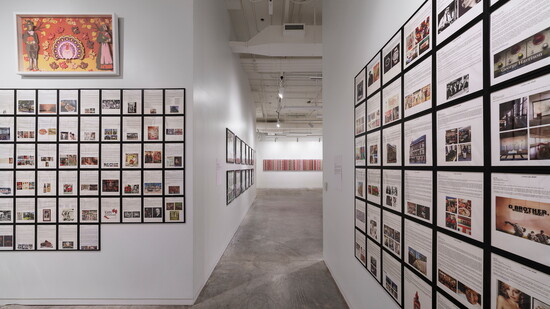
Reflection + Ritual + Refuge developed over the course of about a year, which gave me time to really respond to the spaces at Crosstown Arts and shape the work in relation to them. I was also thinking a lot about wanting to work at a larger scale and across multiple mediums in a more integrated way than I had before.
A lot of the emotional tone of the work came from that period: the intensity of the news cycle, the presidential election and the experience of constantly consuming information online. I found myself thinking about looking back as a kind of coping mechanism, and about how making work can function as a form of refuge within that.
Ritual is something that runs through everything I do, not just in the studio process, but in how I organize time, attention and materials. This exhibition became an extension of that, but also an opportunity to expand into different forms. Alongside my rolled paper pieces, I worked with installation, photography, documentation, sculpture, film and graphic design.
In that sense, the show became a way of building a certain environment, one that could hold different kinds of making, different tempos and different ways of seeing. It allowed me to move between mediums while still staying connected to a single throughline of repetition, attention and return.
Tell us about your Things I Find at My Studio series. How did it begin, and what has kept you engaged with the project over time?
The series began as a daily ritual of picking up trash around my studio on Summer Avenue in Memphis. I moved into this space about five years ago after spending a decade in the Crosstown neighborhood, and over time, I started noticing small, discarded objects like packaging, receipts, broken items, little fragments of everyday life. I began photographing them and posting them with a date and hashtag.
The project connects to a lot of the same ideas that interest me in the studio: order, process, collecting and paying attention to things that are usually overlooked.
Over time, the images have become an accidental archive of the neighborhood, traces of behavior, economics and change. I’m interested in what these objects can reveal about a place and how those stories shift as neighborhoods evolve.
Looking ahead, are there new materials, mediums or creative directions you are eager to explore?
I’m always interested in working with new materials and techniques. For Reflection + Ritual + Refuge, I directed my first experimental film. I designed a piece of jewelry for the opening, based on my rolled paper works, which I wore as a kind of translation of the work into another scale. I have a hyperactive mind, and I'm always interested in experiencing new things. Dorothy Parker once said, "Curiosity is the cure for boredom. There is no cure for curiosity." This is pretty much my motto.
Throughout his career, Brantley Ellzey has remained guided by curiosity and discipline. Whether working with rolled magazine pages, found objects, photography or film, he approaches each project with detailed attention to his process. Today, he maintains an inventory of available work at his Summer Avenue studio in Memphis and welcomes visitors to experience the work in person. He also enjoys collaborating with collectors through commissions. Collaboration, he says, is at the heart of what inspires him. “Collaboration is something I value deeply, and I’m always interested in what emerges from working with others.”
As he continues to experiment with new materials and ideas, Brantley receives his inspiration from the city he calls home. “I feel fortunate to be part of the Memphis art community right now. There’s a lot of energy coming from new voices, new spaces and new conversations, and it feels exciting to be part of that moment.”