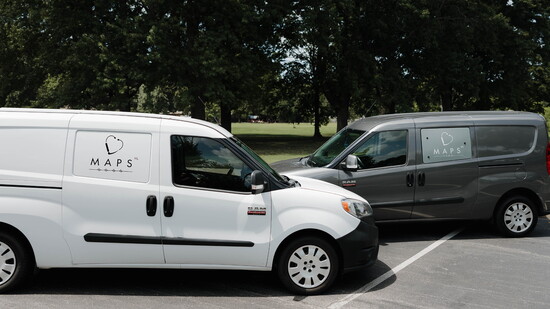
For many people, the most stressful part of a medical or dental procedure isn't the treatment itself. It's everything surrounding it. The unfamiliar hospital, the long wait for an operating room, or the anxiety of walking into a place that feels anything but comfortable. MAPS Healthcare Logistics is working to change that by bringing hospital-level anesthesia services directly into dental and medical offices throughout the Kansas City area.
Rather than simply providing an anesthesia professional for a procedure, MAPS manages the entire anesthesia process. Their team completes pre-anesthesia evaluations, coordinates medical clearances, brings hospital-grade equipment and medications, stays with patients through recovery, and follows up the next day. "We're not sending a provider," says co-founder Daniel Roberson. "We're deploying a department."
That difference is what inspired Roberson to build the company. Throughout his career in anesthesia, he watched practices refer patients to hospitals or surgery centers simply because anesthesia wasn't available in the office. The result was often unexpected facility fees, weeks or months of waiting, and in some cases, patients who never returned for the treatment they needed.
"We saw the need for a mobile service that would widen access for patients while letting practices offer anesthesia to their own patients without building a surgery center," Roberson says. "Patients deserve more than having an anesthesia provider in the room. They deserve a team built around preparation, communication, and emergency readiness."
Unlike many mobile anesthesia services, MAPS handles virtually every aspect of anesthesia care. Before procedure day, the company's nurse practitioner team performs a comprehensive history and physical, reviews medications, orders testing when needed, and coordinates any additional medical optimization. MAPS also carries its own DEA license and controlled medications, eliminating extra work for the practice.
For physicians and dentists, that means one trusted partner overseeing the entire anesthesia process instead of piecing together multiple services. For patients, it means familiarity which is equally valuable.
"A great deal of what people call fear of anesthesia is really fear of the hospital," Roberson says. "Walking into a building you've been to before, greeted by staff you recognize, in a chair you've sat in, eases the whole day in a way an unfamiliar facility never can."
As more procedures safely move into outpatient settings, office-based anesthesia continues to grow. Advances in monitoring technology, medications, and patient screening now make it possible for many healthy patients to receive the same level of anesthesia care they would expect in a hospital while avoiding lengthy scheduling delays and unnecessary facility costs.
"The standard doesn't move when the setting does," Roberson says. "Anesthesia in your dentist's office should mean the same monitoring, the same preparation, and the same care you'd receive in a hospital."
That standard is something Director or Operations and partner David Tafreshi has helped build from the ground up. Drawing from years in anesthesia and leadership, Tafreshi believes preparation begins long before a patient enters the procedure room. "You don't build systems around average days," he says. "You build them around the unexpected." Every operational decision, he explains, starts with a simple question. "Does this make the patient's experience safer? If the answer is no, we don't do it."
That philosophy influences everything from comprehensive pre-anesthesia evaluations completed days before surgery to standardized equipment layouts that remain identical from one office to the next. "The point of all that preparation is to be able to say yes," Tafreshi says. "A well-screened patient is a patient we can safely care for in an office. Occasionally someone truly belongs in a hospital, and knowing the difference is part of doing this properly."
One of the company's most unique influences comes from outside of healthcare altogether. Roberson, an avid pilot, credits aviation with shaping many of MAPS' safety systems. "Aviation doesn't rely on perfect pilots," he says. "It relies on systems that anticipate human error." He often repeats one lesson he learned during flight training. "Hope is not a plan." Just as pilots never rely solely on memory before takeoff, every MAPS procedure follows standardized checklists, equipment inspections, medication verification, and team briefings before anesthesia begins. "The checklist exists precisely because experience makes people confident," Roberson says. "Confidence is where steps get skipped."
That commitment to preparation becomes even more important when caring for children. Unlike many mobile anesthesia providers, MAPS staffs every pediatric case with two Certified Registered Nurse Anesthetists. "Children deserve every advantage we can reasonably provide," Tafreshi says. "Emergency readiness means a second set of trained hands is already there, not on the way."
The company also eases the workload for the practices it serves. Office teams no longer have to chase medical clearances, manage controlled medications, or coordinate complicated anesthesia logistics. "We take care of all of it," Tafreshi says. "The patient arrives prepared, we arrive having already met them, and the day runs on time."
For many patients, the greatest benefit is finally receiving care they may have postponed for years. "Dental anxiety and procedural fear are incredibly common," Tafreshi says. "Safe anesthesia allows patients who may have delayed treatment for years to finally receive the care they need comfortably."
Many leave with a different perspective than they expected. "What we hear afterward is usually, 'That wasn't nearly as scary as I expected.'"
As MAPS continues to grow, Roberson says the company remains intentionally focused on relationships rather than rapid expansion. "This work runs on trust that's built one case at a time," he says. "Being local means our partners see the same faces, know the same people, and have someone who's personally invested in their success."
That commitment extends beyond the operating room. Recently, MAPS partnered with one of its local dental practices to donate anesthesia services for a patient receiving life-changing dental implants, something Roberson says reflects the kind of community partnerships the company hopes to continue building throughout Kansas City.
The company is equally intentional about the people it hires. "Clinical excellence is expected," Roberson says. "That's the entry requirement, not the decision." Instead, MAPS looks for clinicians who demonstrate humility, integrity, teamwork, and the confidence to speak up if something doesn't seem right. For Roberson, one of the most rewarding moments since launching MAPS has been watching experienced anesthesia professionals choose to join the company because they believe in its mission.
If there's one message both Roberson and Tafreshi hope patients remember, it's to be informed and ask questions. "Ask who is delivering your anesthesia," Roberson says. "Ask how current and proficient that person is. Those two questions tell you almost everything." Because at the end of the day, Tafreshi says, every patient deserves the same level of preparation, expertise, and attention, regardless of where they're receiving care.
"Every family who trusts us with their care deserves our very best," he says. "That's the standard we hold ourselves to every single day."
Credits: Photoshoot Location Stone Manor on 79th
Instagram: @mapshealthkc
Website: mapshealthkc.com