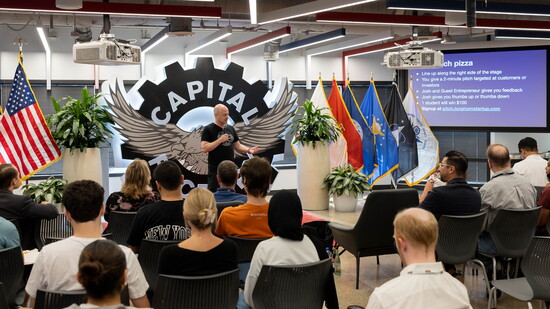
When Joshua Baer launched his first company from his Carnegie Mellon dorm room, it was an early email hosting service — years before “software as a service” became a common phrase.
“I started my first company in college, and I had no idea what I was doing,” Baer said during a recent interview at Capital Factory’s downtown headquarters. “I didn’t raise any money, because I didn’t know there was any such thing as raising money.”
Initially, consulting for businesses struggling to manage their email servers, Baer shifted to a subscription model after one client proposed paying him $50 a month rather than per emergency repair.
“That sounded like a good idea,” he recalled. Within months, the business was generating recurring revenue while he was still in school.
That accidental start shaped his long-term philosophy. In 2009, he founded Capital Factory, which has since become one of the most active early-stage investors in Texas.
“For me, the why … it’s really kind of a way of life and a set of values,” Baer said. “Helping somebody become an entrepreneur is an incredible gift.”
From Teaching to Talent Pipeline
Baer has also taught entrepreneurship at the University of Texas since 2011. He views that connection to students as both personally grounding and strategically important.
“Every week, I’m hanging out and talking with college kids and listening to what they’re talking about,” he said.
He believes innovation thrives at the intersection of deep expertise and fresh perspective. Students, unburdened by industry assumptions, often see opportunities others miss. One former student, Pamela Valdez, enrolled in UT Austin as an exchange student, slipped into a Capital Factory session, and later founded Beek, a Spanish-language audiobook and podcast platform that Amazon acquired.
What began as mentorship has become a pipeline. Many former students now work within Austin’s startup ecosystem — some even at Capital Factory itself.
Redefining the “Accelerator”
Capital Factory has evolved beyond the traditional accelerator model.
“We don’t call ourselves an accelerator,” Baer said. “We’re not that.”
Instead, it operates as a connector at scale, working with more than 100 new companies each year. Central to that model is “First Look,” a monthly private event where founders present to investors, mentors, and ecosystem leaders.
“First Look is named because it’s actually my first look at what is being offered,” Baer said.
Unlike demo days that cap a program, First Look happens at the beginning. Founders pitch immediately and are paired with someone in the room who can help them advance.
“The goal is to get people help right away,” he said.
Baer advises founders to tell a story, simplify their language, and practice relentlessly. “You want to use fourth-grade language,” he said. “And always leave the room with a memorable final line.”
Why Austin Wins
Baer believes Austin’s advantage is cultural and structural.
“Austin is this aspirational city,” he noted. “It’s a place people come to build something, to join something, to be part of something.”
The numbers support the narrative. The Austin metro area has ranked among the fastest-growing large metros in the U.S. for much of the past decade. Texas consistently leads the nation in business formations, according to U.S. Census Bureau data. In 2024, Texas entrepreneurs filed nearly 500,000 new business applications, while the state continues to attract corporate relocations and expansions.
But Baer argues the biggest shift is not population growth — it’s what is being built here.
“There’s been a massive change over the past five years in the importance of hardware and physical things versus software,” he said. “Come to Texas to build things.”
Advanced robotics companies such as Apptronik, energy startups such as Base Power, and aerospace firms such as Firefly Aerospace are part of that transformation.
“Firefly landed on the moon last year,” Baer said. “That’s a Texas company, an Austin company.”
He also points to the presence of the U.S. Army Transformation and Training Command, formerly known as Futures Command, in Austin as a catalyst for advanced technology and dual-use innovation. Federal investment has fueled growth in sectors ranging from defense tech to energy infrastructure.
“Geography, regulatory, tax — all of it is super attractive and makes it one of the best places to go build stuff,” Baer said.
Unlike cities known for a single dominant industry, Austin’s diversity stands out.
“Austin has everything,” he said. “If it’s interesting, it’s happening in Austin.”
Investing in the AI Era
Artificial intelligence is reshaping both startups and investing. Baer sees AI as an equalizer rather than a threat.
“AI is giving the best of everything to everyone,” he said. “Everybody has an expert in their pocket.”
He believes AI will reduce barriers to entry, enabling founders to move faster and operate leaner. At the same time, he expects Austin’s current wave of advanced hardware, robotics, and energy companies to create a new generation of entrepreneurs and reinvested capital over the next decade, further strengthening the city’s global standing.
For Baer, investing in Austin is no longer a regional bet. It is participation in a globally relevant innovation cycle rooted in Texas.
Editor's Note: The cover image for this feature showcases the painting "My Robot World" by Liza Fishbone (www.lizafishbone.com | @lizafishbone)
“Austin is no longer just a software town. It’s becoming the place to build hard, physical things that shape the future.”