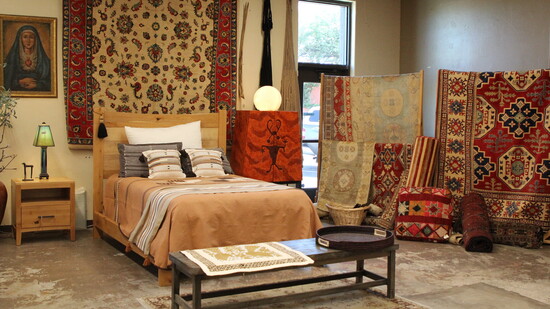
For Ana Leyva, home has never been just a place. It’s a feeling — one rooted in refuge, tranquility, and love, surrounded by objects that carry meaning.
“I like to think of a home as a place of peace,” Leyva says. “A place of love. And being surrounded by beautiful things that have meaning to you.”
That philosophy is at the heart of Felix Copper & Wood, the Tucson-based custom furniture and cabinetry studio where Leyva serves as furniture and kitchen designer. Every piece that leaves the workshop is designed not only to function within a space, but to tell a story — one meant to be lived with, passed down, and remembered.
Designing With Stories In Mind
Unlike mass-produced furniture, Felix specializes in fully custom, heirloom-quality pieces, crafted by hand and designed in close collaboration with each client.
“The entire premise of our business is to custom-make furniture,” Leyva explains. “We delve deep into the customer’s taste — their surroundings, their travels, their favorite places. It’s not just about function. It’s about what the piece will mean to them in the future.”
Before a single tool touches wood, the process begins with conversation. Clients are invited into the showroom, where Leyva sketches alongside them, asking questions about how they live and what they need.
“We always start with function first,” she says. “If it doesn’t work for your life, then it doesn’t matter how beautiful it is.”
From there, design takes shape — literally. Leyva creates architectural drawings from her initial sketches, allowing clients to visualize scale, proportion, and detail before production begins. Each piece typically takes eight to ten weeks to complete, depending on complexity.
“It’s important for people to feel confident and secure,” she says. “We update them throughout the process so they feel part of it from beginning to end.”
Inspired by the Desert
While every Felix piece is one of a kind, many share a common visual language inspired by the Sonoran Desert and the Southwest.
Leyva, who grew up in Mexico City and has spent most of her life in southern Arizona, draws heavily from regional landscapes and cultural motifs. Petroglyphs, chevrons, stair-step patterns, and organic geometry appear throughout her work, echoing the natural and historical textures of the region.
“A lot of our pieces are inspired by petroglyphs from the Arizona–Utah border,” she says. “They tell a story. We use colors from the desert — purples, fuchsias, blues, earth tones, copper tones — all the warm colors you find here.”
One of her favorite designs was inspired by a trip to Sedona, where she sketched the trapezoidal shape of the Chapel of the Holy Cross directly into a furniture concept.
“I was sitting on a rock sketching shapes, and suddenly there it was — the shape of an armoire,” she says. “It was very literal. Just sitting in front of it and drawing.”
Materials That Live
Two materials define Felix’s aesthetic: wood and copper.
Wood, Leyva explains, is essential not just visually, but structurally. Felix uses a traditional joinery method called mortise and tenon, which relies on interlocking joints instead of screws or nails.
“It’s a male and female joint,” she says. “When the wood expands and contracts, it does so together. That’s why our furniture remains stable and true over time.”
The technique dates back thousands of years — ancient Egyptian furniture was built the same way.
“Your furniture might get scratched or dented,” Leyva says, “but the structural integrity will never be compromised.”
Copper, on the other hand, adds warmth, texture, and emotional resonance.
“We’re the Copper State,” she says. “And copper and wood just work beautifully together, especially in southern Arizona architecture.”
Together, the materials create pieces that feel alive — evolving naturally with time rather than deteriorating.
A Quiet Rebellion Against Fast Furniture
In an era dominated by flat-pack furniture and fleeting trends, Felix stands firmly in opposition to disposability.
“People are tired of being wasteful,” Leyva says. “It’s frustrating to replace furniture every three to five years because it’s not holding up. You realize you’re wasting money and harming the environment.”
Instead, she encourages clients to invest in fewer, better pieces — furniture designed to move with them through different homes and life stages.
“These are meant to be taken with you when you move,” she says. “Think about how you’ll use it when you’re older, not just right now.”
That mindset extends into design philosophy as well. Rather than chasing trends, Leyva leans into natural proportions, materials, and colors.
“Nature is wise,” she says. “If you follow nature’s suggestions, it’s very hard to fail.”
She points to pastel-painted Southwest furniture from the early 2000s as an example of how trend-driven design can quickly feel dated. Natural woods, metals, and earth tones, she believes, stand the test of time.
“You have to future-proof your pieces,” she says. “Technology changes. Trends change. But nature doesn’t.”
Craft, Culture, and Community
For Leyva, supporting local artisans isn’t just good business — it’s essential to preserving cultural identity.
“Artistry is getting lost,” she says. “Whether it’s furniture makers, tailors, seamstresses, or artists — these people are what make a community.”
Tucson, she says, thrives because of its creative culture.
“Without artists and makers, we lose what makes this place unique.”
Felix works primarily with local vendors and employs artisans who are passionate about working with their hands — even as fewer young people pursue traditional trades.
“It’s hard work,” Leyva says. “But it’s meaningful work. And it deserves to be valued.”
More Than Furniture
Ultimately, what Felix offers isn’t just custom cabinetry or handcrafted tables — it’s a different way of thinking about home.
When a piece is finally delivered and installed, Leyva hopes clients feel pride — not just in the object itself, but in the experience of creating it.
“I want them to see it and think, ‘I helped design that,’” she says. “And remember it as something special. Something they would do all over again.”
Because at Felix, furniture isn’t meant to simply fill space. It’s meant to hold stories, anchor memories, and turn houses into homes.
“A lot of our pieces are inspired by petroglyphs from the Arizona–Utah border."
“We delve deep into the customer’s taste — their surroundings, their travels, their favorite places. It’s not just about function. It’s about what the piece will mean to them in the future.”
"We use colors from the desert — purples, fuchsias, blues, earth tones, copper tones — all the warm colors you find here.”