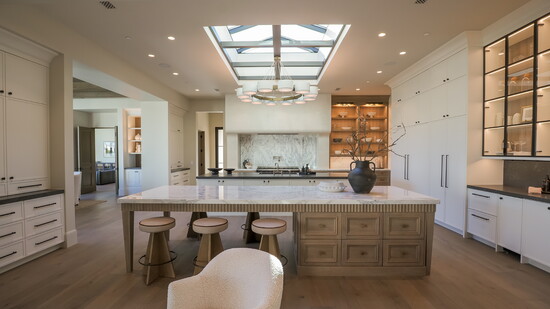
A beautiful kitchen is one thing. A kitchen that works beautifully is another.
Today’s best kitchens are expected to do both. Appliances are disappearing, pantries are working harder and storage is being designed around real families instead of generic floor plans. Interestingly, some of the most luxurious details are the ones guests will never see.
For our Food & Drink issue, we turned to Cole Derosier, owner of Integrity Custom Cabinetry, a family-owned Arizona company that designs and manufactures its cabinetry locally. Integrity’s work can be seen throughout the Valley, including the cabinetry inside Paradise Valley's Project Homestead, Tinker Development’s record-setting $16.5 million estate and largest residential build to date.
Because Cole’s team oversees everything spanning design, engineering, manufacturing, finishing and installation, he has a clear view of where luxury kitchen design is headed.
Here are Cole's five insights into what’s next in luxury kitchens and pantries.
1. The pantry is getting promoted.
The pantry is no longer just a place to store cereal, snacks and the air fryer. In many of today’s most elevated homes, it is becoming a true second kitchen.
These working pantries can include a sink, dishwasher, refrigerator, coffee station, small appliances and plenty of prep space. They take on the messier side of cooking and entertaining so the main kitchen can remain beautiful, calm and ready for guests.
But the real luxury is having two spaces designed for two different purposes. The main kitchen becomes the place where people gather, while the pantry quietly keeps everything moving behind the scenes.
2. Appliances are blending in.
For years, oversized professional appliances were meant to be noticed. Now, Cole says, many homeowners want them to practically disappear.
Refrigerators, freezers and dishwashers are increasingly hidden behind custom panels. Coffee makers, toasters and other countertop appliances can live behind retractable doors, ready when needed and concealed when they are not.
The result is a kitchen that feels calmer and more architectural. Instead of the eye jumping from one appliance to the next, the cabinetry becomes the focus.
Of course, making an appliance disappear is far more complicated than placing a panel over it. The cabinetry must account for ventilation, weight, hinge movement and exact alignment. Even the spacing between doors and panels must remain consistent.
“When you are working within architecture of that scale, cabinetry cannot be approached as a separate element. Every measurement and material decision has to support the larger vision for the room," says Cole.
3. Storage is getting personal.
True custom cabinetry should start with what the homeowner owns and how the family actually lives.
That means going beyond a standard set of drawers and shelves. Does the homeowner have oversized cookware? A serious collection of serving pieces? Children who need easy access to snacks? Multiple devices charging on the counter?
Spice organization, tray dividers, deep cookware drawers, concealed charging stations and appliance garages may not be the first things guests notice, but they can make the biggest difference in everyday life.
Cole believes some of the best features in a kitchen are the ones nobody else knows are there.
4. Cabinetry is becoming part of the architecture.
In the most thoughtfully designed homes, cabinetry no longer looks like a series of boxes placed against a wall. It feels as though it is part of the house itself.
Full-height cabinetry can emphasize soaring ceilings. Integrated doorways can lead discreetly into a pantry. Furniture-style pieces can add warmth, while a beautifully proportioned island can anchor the entire room.
Because Integrity creates truly custom cabinetry, Cole is not limited to predetermined cabinet sizes. His team can design the cabinetry around the room instead of forcing the room to work around the cabinetry.
That was especially important inside Project Homestead. Despite its impressive size, Tinker Development wanted the home to feel warm, comfortable and genuinely livable.
“Project Homestead was grand, but it was never meant to feel excessive. Our job was to create cabinetry that matched the caliber and scale of the home while still making the kitchen feel inviting," Cole says.
Cabinetry, appliances, lighting and architecture all affect one another, and the strongest kitchens are usually the result of those teams working together from the beginning.
5. Luxury is getting quieter.
Luxury used to mean more. More detail, more ornamentation and more obvious signs of expense.
Cole sees that changing.
The next generation of luxury kitchens is more restrained, with cleaner lines, thoughtful proportions and materials that bring warmth without competing for attention. Natural woods, sophisticated stains and subtle painted finishes are replacing surfaces that feel overly manufactured or tied to one particular moment.
Project Homestead reflected that. Even with its record-setting scale, Camelback Mountain views, and dramatic steel skylight, the home relied on precision, proportion and beautifully executed materials rather than decoration for decoration’s sake.
But simple does not mean easy. In fact, the quieter the design, the more precise the work must be.
When there are fewer decorative details, there is nowhere for imperfections to hide. The grain must align. The spacing must be consistent. The finish must be beautiful. Every door, panel and reveal has to sit exactly as intended.
Cole’s Two Cents
Before finalizing a kitchen, Cole suggests thinking beyond the finishes and asking a few practical questions:
How does your family use the kitchen on a normal day?
What do you want visible, and what would you rather conceal?
Which appliances and countertop items do you use most often?
What choices will still feel right ten or twenty years from now?
For Cole, keeping the process local is another important part of that equation. Integrity’s designers, draftsmen, craftsmen, finishers, project managers and installers remain connected throughout the project. That gives the company greater control over quality and allows its team to solve challenges quickly, something that becomes especially valuable on technically demanding builds like Project Homestead.
“Our name may be on the cabinetry, but our people are the reason behind its quality,” he says.
integritycustomcabinetry.com
“Cabinetry cannot be approached as a separate element. Every measurement and material decision has to support the larger vision for the room.”