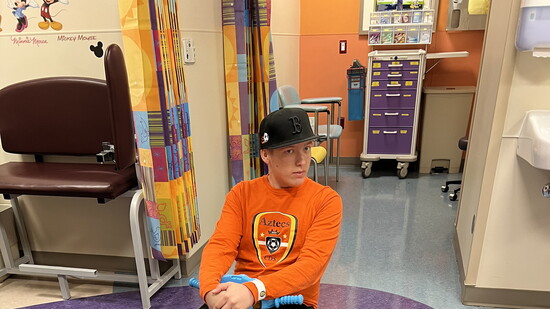
Before cancer, Jackson Bickler was the kid knocking on doors, gathering neighborhood children for soccer, Nerf battles and whatever adventure came next. Even during COVID, he found ways to keep everyone connected.
When his mother, Abby, talks about him, she begins there, not with a diagnosis or hospital room.
“He was just such a kind kid, and that has proven to be his legacy,” she says.
Jackson had played soccer since he was two and dreamed of joining the team at Grand Canyon University. He loved dinosaurs, imagined becoming a paleontologist and hoped to open a restaurant someday.
Then, at 15, a fall during a soccer game led to persistent pain in his back and groin. He rested for two weeks, but the discomfort remained. His pediatrician offered an appointment the following week.
“I just had a feeling.”
Abby took Jackson to the emergency room at Phoenix Children’s. Bloodwork revealed elevated calcium and low platelets, and he was immediately admitted. After days of scans, tests and a biopsy, Abby and her husband, Brandon, were called into the hallway.
“A nurse looked at us and said, ‘We believe your son has leukemia or lymphoma.’ I heard leukemia, and I physically fell to the ground.”
On June 12, 2023, Jackson was diagnosed with metastatic alveolar rhabdomyosarcoma, an aggressive soft tissue cancer that had spread to his bones.
“I still look back at pictures from that April and May and think, how?” Abby says. “He was big and strong, going to the gym, and comparing muscles with his friends. There was no way to know.”
Abby and Brandon chose to tell Jackson themselves.
“He said, ‘Just tell me what I need to do to get to the end of this. Just tell me what I need to do, and I will do it. But I just don’t want to be alone.’”
That became the family’s promise.
Though advised to attend school remotely during chemotherapy and radiation, Jackson returned whenever he felt well enough.
“He never complained. He would say, ‘Can we get this chemo over with? I need to get back to my friends.’”
For several months, scans showed no evidence of disease. Then, just before what should have been Jackson’s final treatment in April 2024, the cancer returned. During a Make-A-Wish trip to Hawaii, Abby sensed another devastating change. A scan after they returned home revealed that the cancer had spread to the tissues surrounding his brain and spinal cord.
On June 12, 2024, exactly one year after his diagnosis, the family learned Jackson’s cancer was incurable.
"Doctors believed he had weeks to months to live. He was going through literal hell, but showed a radiant positivity I have never seen.”
Jackson wanted to spend as little time as possible in the hospital. He wanted to be home with his family and friends, and he wanted to cook.
“He said, ‘Wouldn’t it be cool, Mom, to cook with Bobby Flay?’ As a mother, I thought, if this is what you want to do, I am going to do whatever I can.”
Abby began reaching out. Chef Jeff Kraus opened Crepe Bar exclusively for Jackson and his family. Beau MacMillan called him in the hospital. Local restaurants invited him into their kitchens and created dishes in his honor. Gordon Ramsay, David Chang and Scott Conant sent messages. The Arizona Diamondbacks welcomed him to a game, and GCU made him an honorary captain.
Then Bobby Flay sent Jackson a cast iron skillet from his own kitchen and joined him over Zoom to make cornbread.
“They talked for almost two hours. Bobby was in his kitchen, and Jackson was in ours. They laughed and talked about making eggs.”
Jackson died on September 11, 2024, at age 16, with Abby beside him.
“What keeps me going is Jackson’s positivity, his love for his family and what we are doing now to share his mission.”
One part of that mission began with a chair.
At six foot one, Jackson did not fit comfortably in many hospital beds, treatment tables, or infusion chairs when at Phoenix Children’s.
“He said, ‘Mom, we should really get some new chairs,’” Abby recalls. “I told him, ‘Let’s focus on kicking this cancer, and then we’ll work on those chairs.’”
His request returned to Abby during a pedicure, when she realized she was more comfortable than Jackson had been during eight-hour chemotherapy treatments.
“Kids lose a lot when they walk through the doors of a hospital. There should be no chair more comfortable than the one a child sits in while getting chemotherapy. They deserve comfort and dignity.”
Abby is now carrying Jackson’s vision forward by advocating for more comfortable chairs designed for teenage patients at Phoenix Children’s through The Jackson Bickler Foundation (jacksonbicklerfoundation.com). Thanks to The Gold Movement, his face and mission were featured in Times Square.
“I go on because I have three children and a husband who look to me to be Mom and to be a wife,” she says. “Am I sad? Incredibly sad.”
That tension began during Jackson’s treatment, when Abby was trying to remain fully present for all four of her children. Her daughter, Ava, was preparing to leave for college, while Chase and Cruise still needed their mother at home, at practices, and at games.
“I was a ‘momcologist’ and a mom. I would think about how my children would tell this story later. Did Mom forget about me? Did she miss a moment? Was she sad all the time?”
She allowed her children to see her emotions, but she never wanted them to feel invisible.
“Jackson got all of me, and I cannot imagine it any other way. But I had to give even more to make sure my other children felt seen, heard and not alone. Jackson didn’t want to be alone. Why would my other kids want to be alone?”
Now the Bicklers are learning how to be a family changed by loss and how to give one another space to grieve differently.
Their experience makes clear that pediatric mental health is never about one child alone. Illness, trauma and loss ripple through an entire family. Children need care that recognizes what they are carrying. Siblings need to feel seen. Parents need support as they try to hold everyone together. For families like the Bicklers, emotional care is not separate from physical care. It is part of surviving what no family ever expects to face.
That belief is at the heart of PCH Sage, a community of women using their voices, relationships, resources and connections to advance pediatric mental and behavioral health at Phoenix Children’s. Its events may be its most visible work, but they serve a larger purpose: raising awareness, creating partnerships, generating philanthropic support and uniting the community around the belief that a child’s mental health deserves the same attention and resources as physical health.
According to Phoenix Children's, many children arrive at its emergency department each day in a mental health crisis, at risk of harming themselves or others.
Phoenix Children’s is building a more complete system of care for those children and their families. Its emergency department now has 24/7 mental health coverage designed to reduce wait times and overcrowding. A suicide evaluation program uses screening questions to identify children who may be at risk. The expanding Bridge Clinic supports children during the critical transition from hospital discharge to longer-term community care, while a planned behavioral health hospital will significantly increase inpatient capacity for those requiring the highest level of intervention.
These efforts are designed to help families before, during and after a crisis through timely intervention, appropriate treatment, and greater continuity on the path toward healing.
Abby still carries profound sadness, but she also carries Jackson’s kindness into her family, her advocacy, and every child she hopes to help.
“I am different now,” she says. “But I watch the impact he had on people, and that keeps me going.”
phoenixchildrensfoundation.org/giving-groups/pch-sage
“I was a ‘momcologist’ and a mom. Jackson got all of me, and I cannot imagine it any other way. I am different now, but I see the impact he made and that keeps me going.”