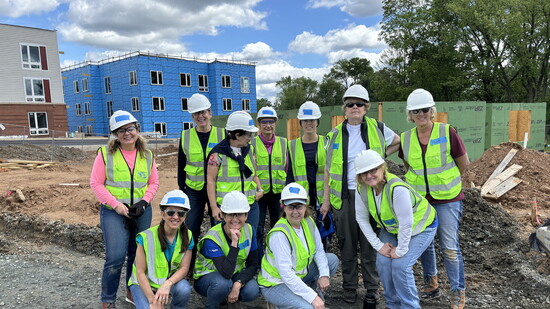
When Mimi Brodsky Kress first learned about Women Build Week through Habitat for Humanity Metro Maryland in 2016, she immediately saw its potential. After decades of working in construction, Mimi understood how rare it still was for women to gain hands-on experience on a job site. Women Build offered something different: a way to empower women through learning, labor, and shared purpose, while supporting families in need of safe, affordable housing.
That year, Mimi formed her first Women Build team, a group of ten women who volunteered for a single day on a Habitat renovation project. They installed flooring and interior trim while raising $5,000 toward Habitat’s fundraising goal. The experience proved transformative. The team, later named Hammer Chicks, returned year after year, growing steadily in size and impact. Today, roughly 35 women participate across multiple build days each season, and Hammer Chicks consistently raises more than $50,000 annually to support Habitat’s work.
The work is intentionally hands-on. Volunteers range in age from their early twenties to their seventies, many with no prior construction experience. Under the supervision of Habitat crew leaders, participants learn job site safety, power-tool use, and the fundamentals of building. Over the years, Hammer Chicks volunteers have completed demolition, exterior framing in extreme temperatures, and interior trim and door installation, contributing thousands of hours of skilled labor.
“We aren’t pretending to build—we’re out there doing the hard work,” Mimi said.
For her, the value of Hammer Chicks lies not only in the homes completed, but in the confidence women gain by stepping outside their comfort zones together.
Beyond the work of Hammer Chicks alone, Women Build has become Habitat for Humanity Metro Maryland’s largest annual fundraiser, generating hundreds of thousands of dollars and thousands of volunteer hours each year in support of affordable housing across the region. In a community where rising housing costs continue to put homeownership out of reach for many families, the combined labor and fundraising efforts of Women Build teams play a critical role in closing that gap.
Participation is equally impactful for the volunteers themselves. Many women arrive on site intimidated by tools like nail guns or skill saws. Working alongside other women creates a supportive learning environment where mistakes are part of the process, and growth is collective. By the end of the day, participants are physically exhausted, but proud.
“Everyone is sweaty and tired,” Mimi noted, “but they feel full of pride for what they’ve accomplished.”
Mimi’s commitment to Habitat aligns closely with her professional life. She is the co-owner of Sandy Spring Builders, a firm focused on high-end residential projects. While her daily work serves a different market, she remains deeply aware of the region’s affordable housing crisis and believes strongly in Habitat’s philosophy of providing a “hand-up, not a handout.”
Looking ahead, Mimi hopes to see Women Build continue to expand by encouraging more women to form their own teams. More teams mean more funds raised, more labor provided, and greater awareness of the need for affordable housing.
“Home is where the heart is,” Mimi said—and through Hammer Chicks, she is helping ensure more families have a safe place to call home.